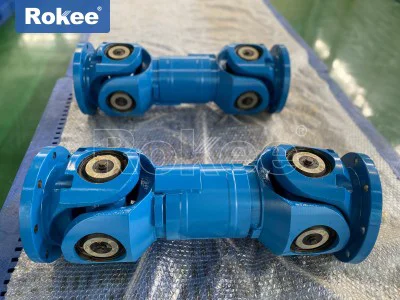
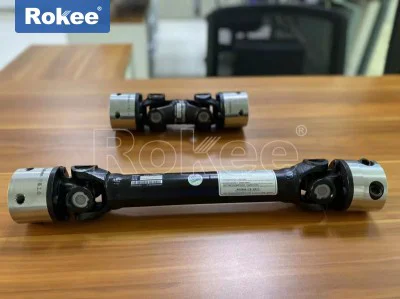
Industrial Cardan Drive Shaft
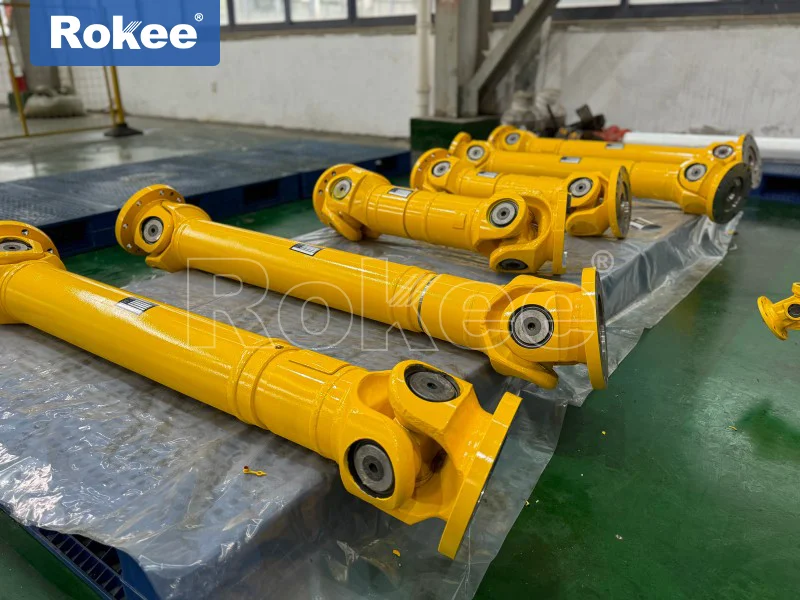
As a core flexible transmission component in modern industrial mechanical systems, the industrial cardan drive shaft occupies an irreplaceable position in mechanical power transmission scenarios that require adaptive connection and torque transfer under non-coaxial operating conditions. Unlike rigid transmission shafts that rely on precise axis alignment for stable operation, the cardan drive shaft adopts a unique universal joint hinge structure, which can effectively compensate for angular deviation, axial displacement and radial offset between the driving end and the driven end of mechanical equipment, realizing continuous, efficient and reliable transmission of rotational torque and motion. Its flexible transmission characteristics break through the limitations of traditional rigid transmission structures, enabling mechanical power to be stably output in complex and changeable working environments, and it has become a key basic component supporting the normal operation of various heavy-duty, mobile and dynamically adjusted industrial equipment.
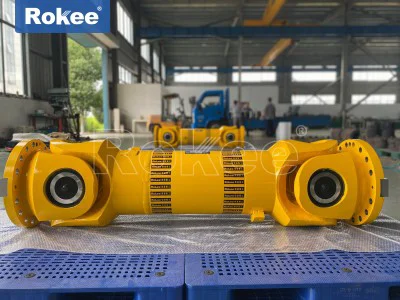
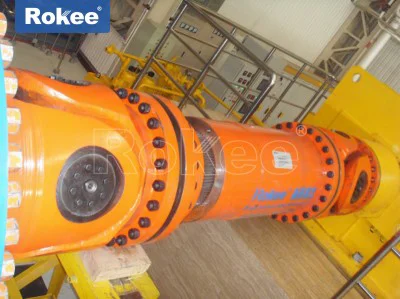
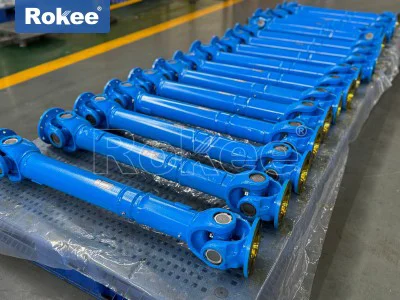
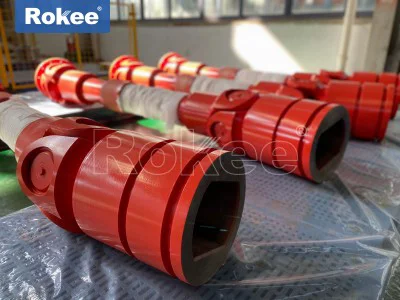
The basic structural composition of the industrial cardan drive shaft is highly sophisticated and modular, with each component cooperating closely to ensure overall transmission performance and structural stability. The core functional components include universal joints, cross shaft assemblies, bearing sets, shaft tubes, spline telescopic structures and connecting flanges. The universal joint is the core flexible unit of the entire drive shaft, and the internal cross shaft serves as the central force-bearing and motion-converting component. The cross shaft is equipped with precision bearings at each end, which can realize multi-directional flexible rotation, effectively converting the rotational motion of the driving shaft into stable rotational output of the driven shaft even when there is a certain included angle between the two shafts. The shaft tube, as the main force-bearing and connecting body, adopts high-strength alloy materials after precision processing and heat treatment, which can withstand large torque impact and mechanical tension and compression during long-term industrial operation while maintaining excellent structural rigidity and fatigue resistance. The spline telescopic structure installed on one side or both sides of the shaft tube can adapt to the axial distance change between equipment components during operation, avoiding structural jamming or transmission failure caused by thermal expansion and contraction of parts, equipment vibration or position deviation. The connecting flanges at both ends adopt high-precision matching structures, which can realize firm and concentric connection with driving and driven equipment, ensuring no torque loss and stable power input and output during high-speed rotation.
The working principle of the industrial cardan drive shaft is derived from the spatial linkage mechanism theory and mechanical kinematics laws, realizing flexible and continuous power transmission through the coordinated movement of multiple structural units. When the power source drives the driving end flange to rotate at a constant speed, the torque is first transmitted to the joint yoke of the universal joint, and then transferred to the cross shaft through the bearing assembly. Relying on the multi-dimensional rotational freedom of the cross shaft, the universal joint can adapt to the angular deflection between the driving and driven shafts, and transmit rotational torque to the driven joint yoke and the rear shaft tube. In practical industrial applications, most cardan drive shafts adopt a double universal joint structure design. This structural design can effectively compensate for the periodic angular velocity fluctuation defect of a single universal joint during deflection operation. When the two universal joints are installed with a reasonable phase matching angle, the speed unevenness generated by the front universal joint can be completely offset by the rear one, ensuring that the driven shaft maintains a constant rotational speed and stable torque output, avoiding vibration, impact and power loss caused by speed fluctuation. This unique motion compensation mechanism enables the cardan drive shaft to maintain excellent transmission accuracy and stability under dynamic working conditions where axis offset and angle change frequently occur.
Compared with traditional rigid transmission shafts and other flexible coupling components, industrial cardan drive shafts have prominent comprehensive performance advantages, which make them widely applicable in complex industrial scenarios. First of all, it has excellent multi-dimensional compensation capability, which can simultaneously adapt to angular deviation, axial displacement and radial misalignment between connected shafts, with a large allowable deflection angle and strong environmental adaptability, far exceeding the compensation range of ordinary elastic couplings and rigid couplings. Secondly, it has high transmission efficiency and strong torque bearing capacity. The precision matching structure of bearings and cross shafts reduces friction resistance during operation, ensuring low-loss transmission of mechanical power, and the high-strength structural design can withstand heavy-load torque impact and frequent start-stop working cycles, suitable for heavy-duty industrial production conditions. In addition, the overall structure of the cardan drive shaft is compact and reasonable, with flexible installation forms and no strict requirements on equipment installation space and axis layout, which can meet the transmission needs of various complex mechanical layouts. Meanwhile, it has good dynamic balance performance and low operating noise. After precision dynamic balance calibration, the drive shaft can maintain stable operation at high rotational speeds, without obvious vibration and abnormal noise, improving the overall operating stability of mechanical equipment. Finally, the structural design is highly versatile and replaceable, with standardized modular components, convenient maintenance and replacement, and low later operation and maintenance costs.
The application scenarios of industrial cardan drive shafts cover almost all industrial fields that require flexible power transmission, showing strong industrial adaptability and practical value. In the field of engineering machinery and construction equipment, it is widely used in the power transmission systems of large mechanical equipment that frequently changes operating postures and working angles, adapting to the dynamic position offset and angle adjustment of equipment during walking, lifting and rotating operations, and ensuring continuous power output of the equipment under complex working conditions. In the field of metallurgy and mining industrial equipment, heavy-duty cardan drive shafts undertake the torque transmission work of large-scale rolling mills, mining conveyors and crushing equipment. These equipment often operate under heavy-load, high-impact and dusty harsh environments, and the excellent structural strength and environmental adaptability of cardan drive shafts can effectively resist mechanical impact and environmental erosion, maintaining long-term stable operation of the transmission system. In the field of agricultural machinery and industrial transportation equipment, cardan drive shafts adapt to the uneven ground and frequent posture changes of mobile equipment, solving the power transmission problem of mobile mechanical equipment in variable working environments.
In addition, in the fields of industrial automation production lines, packaging machinery, chemical equipment and textile machinery, precision cardan drive shafts are used in small and medium-load power transmission links. These scenarios require high transmission stability and low vibration noise, and the precise motion compensation performance of cardan drive shafts can ensure the accurate operation of automated production equipment and improve production precision and efficiency. In the field of ship and port machinery equipment, cardan drive shafts adapt to the position deviation and vibration displacement of equipment caused by hull shaking and load changes, providing reliable power transmission guarantee for port handling equipment and ship auxiliary mechanical systems. It can be said that in all mechanical transmission scenarios where coaxial precision cannot be permanently maintained and dynamic adjustment of transmission angles and distances is required, industrial cardan drive shafts are the optimal transmission component choice.
Although the industrial cardan drive shaft has excellent structural performance and stable operating capacity, its long-term service life and operating stability are closely related to daily maintenance, operating specifications and working environment. In actual industrial operation, abnormal working conditions such as long-term overload operation, excessive deflection angle beyond the allowable range, and frequent violent start-stop impact will cause accelerated wear of internal bearings and cross shafts, and even lead to structural deformation and fatigue damage of the shaft tube. Therefore, standardized daily maintenance is essential to maintain the performance of the drive shaft. Daily maintenance work mainly includes regular cleaning of the outer surface to avoid dust, impurities and corrosive substances from adhering to the components and causing wear and corrosion; regular inspection of the connection tightness of flanges and fasteners to prevent equipment failure caused by loose connection and torque loss; regular supplementation and replacement of lubricating grease for universal joint bearings and spline structures to reduce internal friction and wear, and ensure flexible rotation and telescopic performance of components. In addition, regular dynamic balance detection and structural deformation inspection should be carried out for drive shafts that have been operated for a long time. Once slight deformation, abnormal wear or unbalanced vibration is found, targeted maintenance and component replacement should be carried out in a timely manner to avoid small faults evolving into large-scale equipment failures and affecting the overall production efficiency.
With the continuous upgrading of modern industrial manufacturing technology and the continuous improvement of industrial equipment's requirements for transmission precision, stability and service life, the manufacturing and design technology of industrial cardan drive shafts is also constantly innovating and optimizing. In terms of material application, new high-strength, wear-resistant and corrosion-resistant alloy materials are gradually replacing traditional materials, which further improves the structural strength, fatigue resistance and environmental adaptability of the drive shaft, and extends the service life under harsh working conditions. In terms of processing technology, the application of precision CNC machining, integral forging and heat treatment processes makes the dimensional accuracy and structural uniformity of each component higher, effectively reducing assembly errors and operating friction, and improving transmission efficiency and stability. In terms of structural optimization, the lightweight and integrated structural design has become the mainstream development trend. On the premise of ensuring torque bearing capacity, the overall weight of the drive shaft is reduced, the operating inertia is lowered, and the dynamic response speed of the transmission system is improved. At the same time, the optimized universal joint structure further reduces the operating friction coefficient and speed fluctuation, realizing higher-precision and smoother power transmission.
In the future, with the deep integration of intelligent manufacturing and industrial equipment, industrial cardan drive shafts will develop towards intelligent monitoring and adaptive adjustment. By combining sensor monitoring technology, the operating state of the drive shaft, such as torque, vibration, temperature and wear degree, can be monitored in real time, realizing early warning of faults and predictive maintenance, which greatly improves the intelligent level of equipment operation and maintenance. At the same time, the adaptive adjustable cardan drive shaft structure can automatically adjust the compensation angle and telescopic stroke according to the real-time operating state of the equipment, further adapting to more complex and changeable industrial working conditions and meeting the higher precision and more stable transmission needs of modern intelligent industrial equipment.
In conclusion, the industrial cardan drive shaft, as a classic and efficient flexible transmission component, relies on its unique universal joint flexible structure, excellent multi-dimensional compensation performance, stable torque transmission capacity and wide environmental adaptability, and has become an indispensable key part of modern industrial mechanical transmission systems. From heavy-duty engineering and metallurgical equipment to precision automated production machinery, it provides reliable power transmission guarantee for various industrial scenarios. With the continuous progress of manufacturing technology and the continuous upgrading of industrial equipment performance requirements, the structural design, material performance and intelligent level of industrial cardan drive shafts will continue to be optimized and improved, constantly adapting to the development needs of modern industrialization, and providing more solid technical support for the stable and efficient operation of industrial mechanical equipment.