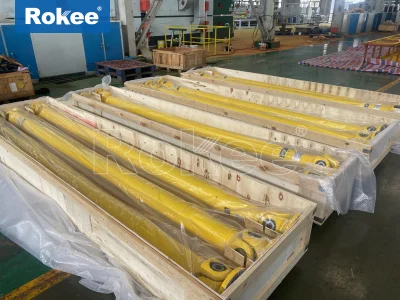
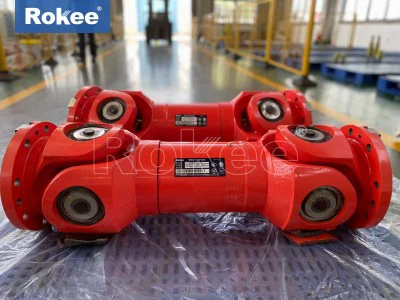
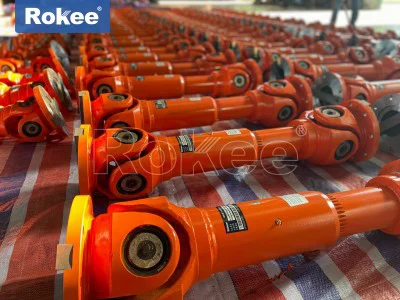
Telescopic Cardan Drive Shaft
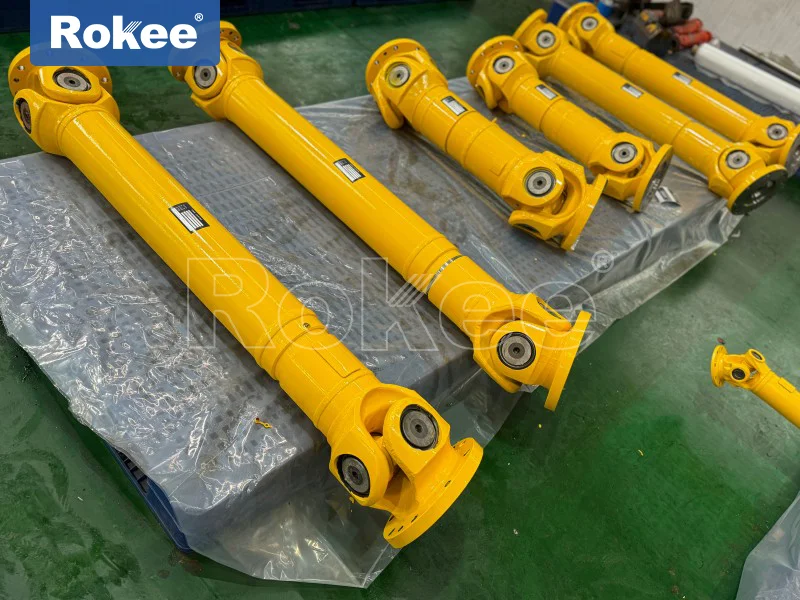
As a core power transmission component in modern mechanical systems, the telescopic cardan drive shaft integrates dual functional advantages of universal angle adaptation and axial telescopic adjustment, serving as a key connecting medium for torque and motion transmission between driving and driven equipment. Unlike conventional fixed-length transmission shafts that rely on rigid connection and precise installation alignment, this specialized mechanical part is engineered to adapt to complex and dynamic operating conditions, effectively resolving transmission failures caused by angular deviation, axial displacement, structural deformation and installation tolerance errors during equipment operation. Its unique structural design and flexible working characteristics make it widely applicable in mobile machinery, industrial transmission systems and various power equipment with variable operating postures, delivering stable and efficient power transmission support for diversified mechanical operation scenarios.
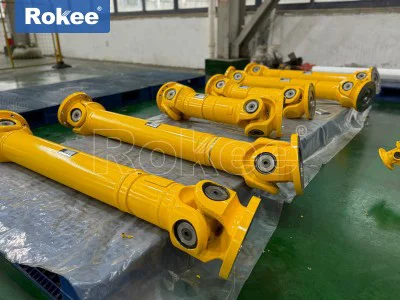
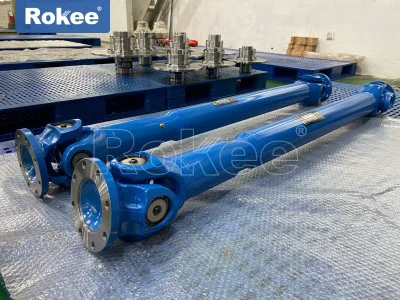
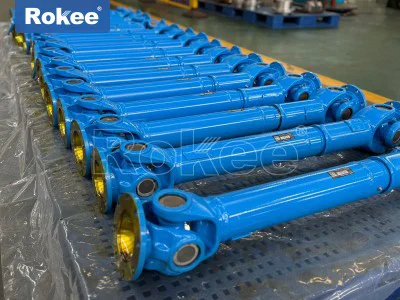
The basic structural composition of the telescopic cardan drive shaft is composed of three core functional parts that coordinate with each other: universal joint assembly, telescopic spline mechanism and end connection structures, and each part undertakes independent and collaborative transmission tasks. The universal joint assembly is the core module for angular compensation, mostly adopting a mature cross-joint structure, which consists of symmetric fork-shaped yokes and a central cross journal. The cross journal connects the two sets of yoke structures through precision bearing components, enabling free rotational deflection within a certain angle range. This structure allows the drive shaft to maintain continuous and stable torque transmission even when there is a non-coaxial angle between the input end and output end, breaking through the limitation that traditional rigid shafts can only work in a straight coaxial state. The bearing components matched with the cross journal are processed with high-precision craftsmanship, with excellent rotational flexibility and load-bearing capacity, which can reduce friction resistance during angle deflection and avoid power loss caused by rigid extrusion and mechanical jamming.
The telescopic spline mechanism is the key functional unit that distinguishes the telescopic cardan drive shaft from ordinary cardan shafts, undertaking the core task of axial length compensation. This mechanism is composed of mutually matched internal spline shaft and external spline sleeve, forming a precise sliding fit structure. The spline surfaces are finely polished and treated with wear-resistant processes to ensure that the internal shaft can slide freely along the axial direction inside the external sleeve while transmitting rotational torque. In the actual operating process, when the relative distance between the driving equipment and the driven equipment changes due to mechanical vibration, suspension movement, thermal expansion and contraction or structural deflection, the spline pair can automatically complete telescopic adjustment in real time. This dynamic length adaptation effectively eliminates axial tension and compression stress inside the transmission shaft, preventing structural deformation, component wear or transmission interruption caused by rigid force bearing. The sliding stroke of the spline mechanism is designed with reasonable redundancy according to actual application demands, ensuring that it can cope with axial displacement changes under various extreme working conditions without affecting the overall transmission performance.
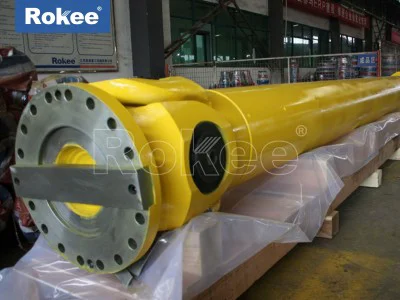
The end connection structures at both ends of the drive shaft adopt modular design, which can be matched with different connection forms according to the assembly requirements of various mechanical equipment. The connection parts are processed with high-strength integral forging technology, with compact structure and high structural rigidity, which can stably lock the transmission shaft with the power input and output ends, avoiding loosening and displacement during high-speed operation and heavy-load transmission. Meanwhile, the connection structure is equipped with integrated sealing and dust-proof accessories, which can effectively isolate external dust, moisture, debris and corrosive media. This protective design prevents the precision matching surfaces of the spline mechanism and the rotating friction pairs of the universal joint from abrasion, corrosion and dirt accumulation, greatly improving the environmental adaptability and service life of the entire component.
The working principle of the telescopic cardan drive shaft is based on the collaborative operation of angular compensation of universal joints and axial compensation of telescopic splines, realizing all-dimensional adaptive power transmission. When the power source outputs rotational torque, the torque is first transmitted to the input end of the drive shaft, driving the universal joint assembly to rotate synchronously. The cross-joint structure of the universal joint can offset the angular deviation between the two connected shafts through flexible deflection, ensuring consistent rotational speed of the input and output ends and avoiding periodic speed fluctuation and power jitter caused by angle offset. At the same time, with the operation of the equipment, the real-time changing axial distance between the connected components drives the spline telescopic structure to perform linear sliding adjustment. The dual compensation mechanism of angle and axial direction enables the drive shaft to always maintain a reasonable stress state and stable connection state in dynamic working conditions, ensuring continuous, uniform and efficient transmission of torque and motion.
Compared with traditional fixed transmission shafts and ordinary non-telescopic cardan shafts, the telescopic cardan drive shaft has outstanding comprehensive performance advantages in practical application. First of all, it has ultra-high fault tolerance for installation and operation errors. In the equipment assembly process, it does not require extremely precise coaxial alignment and distance control, which greatly reduces the difficulty of installation and debugging and improves the assembly efficiency of mechanical equipment. During long-term operation, it can automatically adapt to small structural deformations and position deviations of equipment caused by load changes and mechanical fatigue, reducing the failure rate of transmission systems. Secondly, it has excellent dynamic stability. The cooperative work of the universal joint and spline mechanism can effectively buffer and absorb the impact load generated during equipment start-up, shutdown and variable-speed operation, reduce mechanical vibration and noise, and make the power transmission process smoother and more stable.
In terms of load-bearing performance, the integral high-strength structure and optimized force-bearing design enable the telescopic cardan drive shaft to withstand large torque and heavy-load operating conditions. The spline pair with uniform force distribution can disperse the axial and torsional stress generated during transmission, avoiding local stress concentration and component damage. The high-precision bearing and cross-joint matching structure ensures low friction and high efficiency operation, with high power transmission efficiency, which can effectively reduce energy consumption in the power transmission process and improve the overall energy utilization rate of mechanical equipment. In addition, the modular structural design brings excellent maintainability. The core components are standardized and generalized, with simple disassembly and assembly processes, convenient daily inspection, lubrication maintenance and replacement of vulnerable parts, which can effectively reduce the operation and maintenance cost of the equipment life cycle.
The application scenarios of telescopic cardan drive shafts cover almost all mechanical fields involving variable-position power transmission, showing strong scene adaptability. In mobile engineering machinery, it is applied to the power transmission systems of various walking and operating equipment. Such equipment will produce continuous suspension jitter and structural displacement during walking and operation, and the telescopic cardan drive shaft can adapt to the real-time changes of working posture and position, ensuring stable power output of walking devices and operating actuators. In industrial automated production lines, many transmission mechanisms need to cooperate with the reciprocating movement and telescopic action of automated components, and the telescopic cardan drive shaft can accurately transmit power in dynamic displacement states, meeting the continuous operation requirements of automated production.
In addition, it also plays an irreplaceable role in special power transmission equipment such as heavy-duty transmission devices and mobile power units. In heavy-load working scenarios, the large-angle compensation capability and stable load-bearing performance can cope with complex torque impact and position changes; in mobile power equipment, the flexible telescopic function can adapt to the power transmission demands of different working distances and operating angles. Whether it is continuous high-speed operation or intermittent variable-load operation, the telescopic cardan drive shaft can maintain stable working performance and provide reliable guarantee for the normal operation of mechanical systems.
Daily maintenance and reasonable application management are crucial to giving full play to the performance of the telescopic cardan drive shaft and extending its service life. The core of daily maintenance lies in the lubrication protection of precision friction pairs. The universal joint bearing and spline matching surface are key friction parts, which need regular filling of high-quality lubricating grease to form a stable lubricating film. This can reduce dry friction and wear between components, avoid heating and ablation caused by long-term high-load operation, and ensure the flexibility of angle deflection and axial sliding. At the same time, it is necessary to regularly check the sealing performance of the external protective structure. Once aging, damage or failure of the sealing element is found, it should be replaced in a timely manner to prevent external impurities from entering the internal matching structure and causing abrasive wear and transmission jamming.
In the process of equipment operation, excessive overload operation and long-term extreme angle deflection should be avoided. Although the drive shaft has good adaptive capacity, long-term operation beyond the design load and angle range will cause fatigue damage of structural components, accelerate the wear of bearings and splines, and reduce transmission accuracy and service life. Regular appearance inspection and running state monitoring are also essential. It is necessary to check whether there are cracks, deformation, looseness and abnormal wear on the shaft body and connection parts, and observe whether there are abnormal vibration, noise and power attenuation during operation. Timely discovery and elimination of potential faults can effectively avoid major equipment failures and ensure the long-term stable operation of the transmission system.
With the continuous upgrading of modern mechanical equipment towards high efficiency, high stability and high intelligence, the performance requirements for supporting transmission components are also constantly improving. As a flexible and efficient power transmission core component, the telescopic cardan drive shaft is also constantly optimized and upgraded in structural design, material application and process technology. The continuous innovation of high-strength wear-resistant materials further improves the load-bearing capacity and fatigue resistance of the product; the optimized spline structure and universal joint layout design further enhance the compensation accuracy and transmission stability; the improved sealing and protective processes enable the product to adapt to more harsh working environments such as high temperature, low temperature, dust and humidity.
In the future development of mechanical transmission technology, the telescopic cardan drive shaft will continue to rely on its unique dual compensation advantages and wide scene adaptability, and become an indispensable basic component in the field of mechanical power transmission. Its flexible adaptive performance can perfectly match the development trend of modern mechanical equipment towards dynamic operation and multi-working condition adaptation, providing more reliable, efficient and durable power transmission solutions for various mechanical systems. With the continuous progress of manufacturing technology and structural optimization design, the comprehensive performance of telescopic cardan drive shafts will be further improved, and its application scope will be more extensive, injecting continuous power for the iterative upgrading and performance improvement of modern mechanical equipment.