Cross Cardan Shaft Improves The Transmission Reliability And Accuracy Of PU Sandwich Panel Line

The continuous production of PU sandwich panels relies heavily on the coordinated operation of multi-stage mechanical transmission systems, where the stability and precision of power transmission directly determine the forming quality, dimensional consistency and operational continuity of finished panels. In the traditional PU sandwich panel production line, ordinary transmission connecting parts often fail to adapt to the complex operating conditions of long-distance power transmission, multi-angle shaft connection and dynamic mechanical vibration, resulting in unstable speed transmission, cumulative transmission errors and frequent mechanical operation deviations during long-term continuous production. These transmission defects will further induce a series of production problems, including uneven foaming density of PU materials, inconsistent panel thickness, irregular edge forming and low product yield, which seriously restrict the high-efficiency and high-quality production of sandwich panels. As a core universal transmission component based on Hooke hinge principle, the cross cardan shaft has unique structural advantages and excellent kinematic performance, which can effectively solve the transmission pain points of traditional production lines, significantly improve the overall transmission reliability and operation accuracy of PU sandwich panel production equipment, and provide stable mechanical power support for standardized and high-precision panel production.
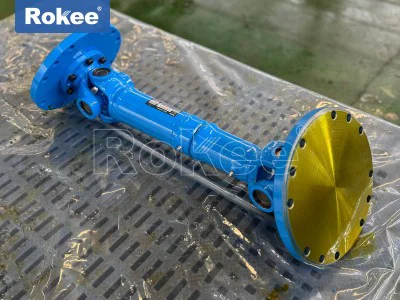
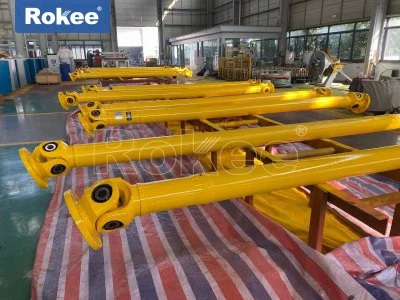
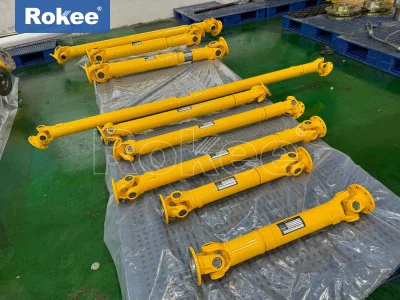
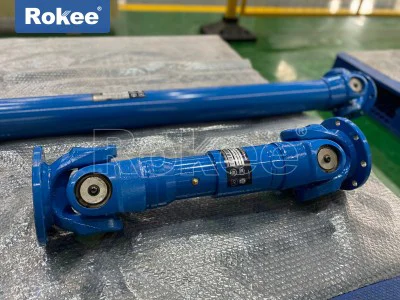
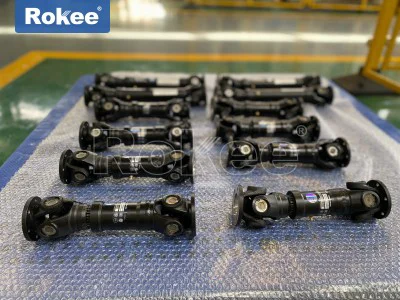
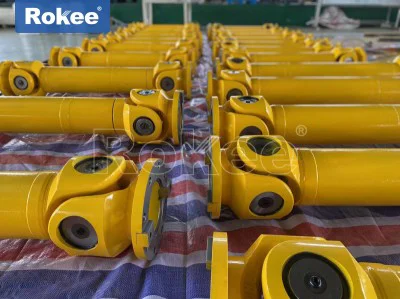
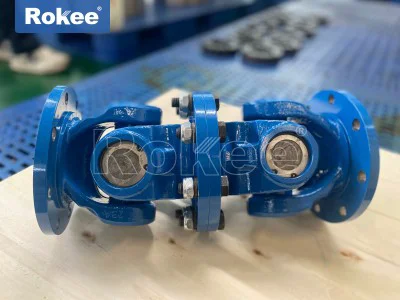
The core structural characteristics of the cross cardan shaft lay a solid foundation for its superior transmission performance in PU sandwich panel line. Different from rigid connecting shafts and ordinary coupling structures, the cross cardan shaft is mainly composed of two symmetric universal joint forks and an intermediate cross shaft, with four journals of the cross shaft flexibly connected to the bearing structures of the two universal joint forks respectively. This unique cross hinge structure enables the transmission shaft system to maintain stable power output under the conditions of axial deviation, angular deflection and parallel displacement between the driving shaft and the driven shaft. In the actual operation of PU sandwich panel production lines, most transmission mechanisms need to realize power transmission between non-coaxial shafts due to equipment layout restrictions, mechanical installation errors and structural design requirements. Traditional rigid transmission parts are extremely sensitive to shaft misalignment, and slight deviation will cause additional torsional stress and friction loss, leading to shaft body deformation, part wear and transmission jitter after long-term operation. In contrast, the cross cardan shaft can adapt to a certain range of angular changes and position deviations in the transmission process, automatically compensate for the installation errors and dynamic displacement of the transmission shaft system, and ensure continuous and stable power transmission without generating additional mechanical stress. This adaptive structural feature fundamentally avoids the transmission interruption and operation fluctuation caused by shaft misalignment, greatly improving the overall operational reliability of the production line transmission system.
In the full-process production of PU sandwich panels, each link from raw material feeding, roller pressing, foaming curing to fixed-length cutting and finishing molding puts forward high-precision requirements for transmission synchronization and speed stability, and the excellent constant-speed transmission performance of cross cardan shafts effectively guarantees the production accuracy of each process link. The production of PU sandwich panels is a continuous integrated process, where the operating speed of feeding rollers, pressing rollers and traction devices must maintain strict synchronization. Once the transmission speed of any link fluctuates or deviates, it will lead to inconsistent feeding volume of PU raw materials, uneven pressing force of the roller group and asynchronous traction speed, ultimately affecting the internal structure uniformity and external dimensional accuracy of the sandwich panel. The optimized kinematic design of the cross cardan shaft realizes equal-angle and constant-speed transmission under standard assembly conditions. When the two-end universal joint forks are kept in the same plane and the deflection angles of the two-stage universal joints are consistent, the shaft system can completely eliminate periodic speed fluctuation and maintain a constant angular velocity in the whole transmission process. This stable constant-speed transmission characteristic ensures that the operating speed of each functional module of the PU sandwich panel production line is always synchronized, avoiding the quality defects caused by speed difference.
In the raw material feeding stage of PU sandwich panel production, the precise transmission of the cross cardan shaft ensures the uniform and stable conveying of polyurethane raw materials and base materials. The accurate proportioning and uniform feeding of PU combined materials are the key prerequisites for the uniform foaming and stable density of sandwich panels. The feeding transmission system needs to operate at a constant low speed with high stability to prevent material accumulation or insufficient feeding. Traditional transmission structures are prone to intermittent jitter and speed fluctuation during low-speed operation, resulting in uneven material output and local material accumulation on the production line. The cross cardan shaft has low transmission resistance and high motion stability, which can realize ultra-smooth low-speed power transmission, effectively eliminate low-speed crawling and jitter phenomena, ensure that the feeding mechanism conveys raw materials at a uniform and fixed rate, and make the PU composite materials evenly spread on the base material surface. This stable feeding transmission effect makes the foaming reaction of polyurethane materials more sufficient and uniform, avoids the problems of local hollowing, uneven density and inconsistent hardness of the sandwich panel, and greatly improves the internal quality consistency of finished products.
In the roller pressing and forming stage of PU sandwich panels, the high rigidity and low deformation characteristics of the cross cardan shaft transmission system effectively improve the dimensional accuracy of panel forming. The pressing process determines the thickness flatness and surface smoothness of the sandwich panel, requiring the upper and lower pressing roller groups to maintain consistent operating speed and stable pressing gap. The transmission error and mechanical deformation of the traditional pressing transmission system will lead to inconsistent roller speed and offset pressing gap, resulting in uneven panel thickness and warped surface. The cross cardan shaft adopts an integrated high-strength structural design, with strong torsional resistance and structural stability. It will not produce obvious torsional deformation and elastic displacement under long-term high-load pressing transmission conditions, effectively controlling the transmission error within an extremely small range. The accurate power transmission ensures that each pressing roller can operate in strict accordance with the set speed and displacement parameters, maintaining a uniform and stable pressing gap throughout the forming process. Therefore, the produced PU sandwich panels have uniform thickness, flat surface and consistent overall dimensions, which greatly reduces the rate of defective products caused by forming errors.
The long-term operational reliability of the cross cardan shaft effectively reduces the failure rate and maintenance cost of the PU sandwich panel line, and ensures the continuity of industrial production. PU sandwich panel production lines mostly work in long-term continuous industrial operation mode, and the transmission system needs to bear repeated torsional load, mechanical vibration and alternating stress for a long time. Ordinary transmission parts are prone to wear, fatigue deformation and loose connection after long-term operation, leading to increased transmission errors, frequent equipment failures and forced shutdown maintenance, which seriously affects production efficiency. The cross cardan shaft has a compact and reasonable structural layout, with moving parts adopting flexible friction matching design, which can effectively disperse torsional stress and reduce mechanical wear during operation. Its excellent fatigue resistance and load-bearing capacity enable it to maintain stable transmission performance under long-term high-intensity operation, without obvious performance attenuation and structural failure. In actual production applications, the cross cardan shaft can effectively resist the mechanical vibration generated by the operation of rolling, cutting and other equipment, avoid transmission parameter changes caused by vibration displacement, and maintain long-term operational stability of the transmission system. This long-life and high-reliability transmission performance greatly reduces the frequency of equipment shutdown maintenance, improves the continuous operation cycle of the production line, and creates higher production benefits for industrial production.
The adaptive displacement compensation function of the cross cardan shaft solves the transmission instability problem caused by equipment thermal deformation and installation deviation in PU sandwich panel production lines. In the continuous production process, the long-term operation of mechanical equipment will generate a certain amount of heat, causing thermal expansion and slight deformation of the frame and transmission shaft components, resulting in tiny changes in the relative position and angle of the transmission shaft system. In addition, long-term mechanical vibration and equipment load changes will also cause subtle displacement deviation of the transmission structure. Traditional rigid transmission systems cannot adapt to these dynamic deviations, and small position changes will produce large transmission resistance and operation errors, affecting production accuracy. The cross cardan shaft has flexible angle adjustment and displacement compensation capabilities, which can automatically adapt to the tiny position and angle changes of the shaft system caused by thermal deformation and mechanical vibration. It can always maintain efficient and stable power transmission in the dynamically changing operating environment, avoid transmission jitter and accuracy attenuation caused by structural deviation, and ensure that the production line can maintain high-precision operation for a long time under continuous working conditions.
The improvement of transmission accuracy and reliability brought by the cross cardan shaft also optimizes the overall production efficiency and product qualification rate of the PU sandwich panel line. In traditional production modes, due to insufficient transmission accuracy, enterprises often need to spend a lot of time on equipment debugging, parameter correction and defective product rework, which not only reduces production efficiency but also increases production cost investment. After adopting the cross cardan shaft transmission structure, the production line realizes stable and high-precision operation in the whole process of feeding, pressing, foaming, traction and cutting. The dimensional error, surface defect and internal structural inconsistency of finished panels are greatly reduced, and the product qualification rate is significantly improved. At the same time, the stable transmission performance reduces equipment failure downtime and frequent parameter debugging operations, improves the effective operation time of the production line, and realizes the dual improvement of production quality and production efficiency. In addition, the efficient and low-loss transmission characteristics of the cross cardan shaft reduce mechanical friction loss and power waste in the transmission process, making the operation of the production line more energy-saving and efficient, which conforms to the development requirements of modern industrial high-efficiency and low-consumption production.
With the continuous upgrading of the PU sandwich panel industry towards high precision, high efficiency and intelligent production, the requirements for the operational stability and transmission accuracy of production line equipment are becoming increasingly stringent. The traditional transmission mode can no longer meet the standardized and refined production needs of high-end sandwich panels. As an efficient and reliable universal transmission component, the cross cardan shaft makes up for many defects of traditional transmission structures with its unique structural design, excellent kinematic performance and strong environmental adaptability. It not only realizes accurate and stable power transmission of each functional link of the PU sandwich panel production line, but also improves the overall operational reliability and service life of the equipment, providing strong technical support for optimizing product quality and improving industrial production efficiency. In the future, with the continuous optimization and innovation of mechanical transmission technology, cross cardan shafts will be more widely used in high-precision continuous production lines, and play a more important role in promoting the high-quality development of the PU sandwich panel manufacturing industry.