Universal Shafts
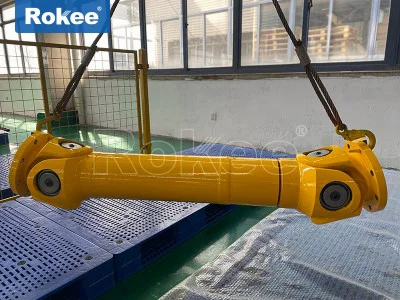
As a key component in mechanical transmission systems, universal shafts play an irreplaceable role in modern industrial equipment. It can achieve efficient transmission of torque and motion when the two axis lines do not coincide and there is an angle, solving the problem of angle deviation that traditional rigid couplings cannot cope with.
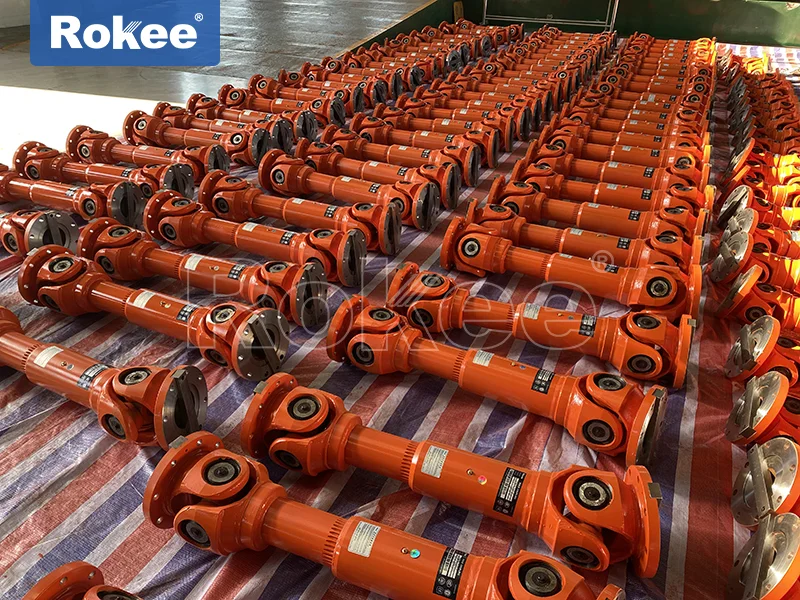
Universal shaft is a special type of flexible joint, whose core function is to connect two shafts (active shaft and passive shaft) on different axes, enabling them to achieve continuous rotation and reliably transmit torque and rotational motion in the presence of axis angles. This type of coupling overcomes the limitations of traditional couplings that require high accuracy in shaft alignment through its unique mechanism design, providing greater layout flexibility for mechanical transmission systems.
From the perspective of mechanical principles, the core feature of universal couplings is their ability to provide significant angular compensation. The allowable angle range between the two axes of universal couplings with different structural forms is usually between 5 ° and 45 °, depending on the type and design of the coupling. For example, the cross axis universal shaft generally allows an axis angle of 15 ° -45 °, while the ball cage universal shaft can achieve greater angle compensation capability. This angle compensation capability enables universal couplings to adapt to various complex installation conditions and operating conditions, including axis deviations caused by installation errors, foundation settlement, shaft deformation, and other factors.
In addition to angle compensation capability, universal couplings also have two major advantages: compact structure and high transmission efficiency. The compact structural design enables efficient power transmission within a limited space, while a transmission efficiency of up to 98% -99% ensures minimal energy loss during transmission. These characteristics collectively make universal couplings an indispensable transmission component in many industrial applications, especially in situations where high torque transmission is required and there is axis deviation.
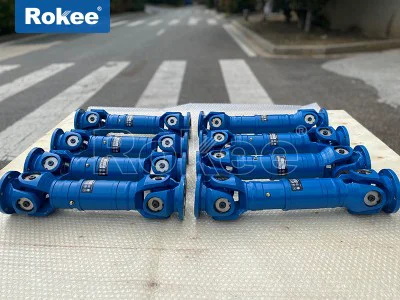
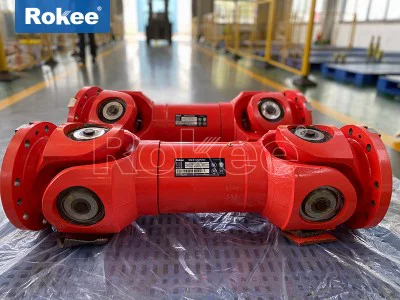
The cross axis universal shaft is the most common and widely used type, with its core components including two fork joints and a cross axis assembly. The cross axis is connected to the fork head through needle roller bearings, allowing for angular deflection in two planes. This structure is simple and reliable, with relatively low manufacturing costs and the ability to transmit large torque, making it particularly suitable for heavy industrial equipment such as metallurgy, mining, and lifting and transportation. Cross axis universal couplings can be divided into various forms such as SWC type (integral fork head), SWP type (partial bearing seat), and SWZ type (integral bearing seat), produced according to JB/T series industry standards to meet different load and working condition requirements. In practical applications, in order to eliminate speed fluctuations in single cross shaft coupling transmission, a double coupling form is usually adopted. Two single cross shaft couplings are connected in series through an intermediate shaft, and the principles of "the fork heads at both ends of the intermediate shaft are in the same plane" and "the angle between the input and output shafts and the intermediate shaft is equal" are followed to achieve constant speed transmission.
The ball cage universal shaft represents a more advanced technology, which adopts a precision structure composed of a spherical shell, star shaped sleeve, and steel ball. The steel ball is fixed between the inner and outer raceways by a cage, and constant speed transmission is achieved through precise geometric design. The biggest advantage of ball cage couplings is their constant speed and greater angle compensation capability (up to 40 °), as well as smooth operation and low noise, making them particularly suitable for high-speed precision transmission applications. The front wheel drive system of automobiles commonly uses ball cage universal shafts, effectively solving the complex angle changes caused by steering and suspension movements. In the industrial field, ball cage couplings are gradually replacing traditional cross axis products and are applied to equipment such as machine tools and robots that require high transmission accuracy.
The ball fork cardan shaft is another common type, with a structure similar to the cage type but typically using four or six steel balls to transmit torque instead of a cage structure. Ball fork couplings are relatively simple to manufacture and have lower costs, but their load-bearing capacity and angle compensation performance are slightly inferior to cage couplings. This type of coupling is commonly used in low to medium precision transmission systems such as agricultural machinery and engineering vehicles. It is worth noting that the ball fork coupling has slight speed fluctuations during transmission and is not suitable for situations that require strict constant speed transmission.
Other special types of universal couplings include:
Ball joint universal shaft: adopting a spherical joint structure, the overall strength is increased by 37%, and the radial bearing capacity is increased by 52%. It is suitable for situations with large radial displacement
Steel ball universal shaft: With the characteristic of self determined rotation center, high transmission efficiency and good dynamic balance accuracy, it is specially used for precision transmission systems such as diesel engine common rail oil pump
Triple wishbone universal shaft: angle compensation is achieved through three articulated rods, suitable for situations with excessive torque transmission
Convex block universal shaft: simple structure, easy maintenance, commonly used in low-speed heavy-duty equipment
According to the magnitude of the transmitted torque, universal couplings can be divided into four levels: heavy, medium, light, and small, meeting different needs from micro instruments to large industrial equipment. In terms of material selection, 45 steel, 40Cr alloy steel, and cast iron are commonly used materials, and stainless steel or surface special treatment processes can also be used for special working conditions.
The correct selection and configuration of universal couplings are crucial for ensuring the reliable operation of the transmission system, which requires comprehensive consideration of multiple technical parameters and operating conditions. The selection of universal shaft is a systematic project that involves multiple factors such as torque calculation, speed determination, and angle compensation requirements.
Angle compensation capability is a characteristic parameter of universal couplings, and the allowable range of axis angles varies significantly among different types of couplings. When selecting, it should be ensured that the maximum allowable angle of the coupling is greater than the maximum possible angle in practical applications, and appropriate safety margins should be retained. During actual installation, the axis angle should be minimized as much as possible (ideally not exceeding 3 °), as operating at large angles can significantly reduce bearing life, increase vibration, and energy consumption. For situations that require large angle compensation, a double joint universal shaft structure can be used to achieve constant speed transmission through reasonable configuration.
In the vast landscape of mechanical power transmission systems, the universal shaft stands as an indispensable and versatile component, engineered to bridge the gap between misaligned or offset shafts while efficiently transferring torque and rotational motion across diverse industrial and mechanical setups. Unlike rigid shafts that demand perfect axial alignment for optimal operation, universal shafts are purpose-built to accommodate angular, parallel, and even axial misalignments between driving and driven shafts, a trait that has cemented their role as a cornerstone of modern mechanical engineering. Their design marries structural resilience with functional flexibility, allowing them to operate reliably in environments where conventional transmission components would fail due to misalignment, vibration, or dynamic load shifts. Every aspect of a universal shaft’s construction, from material selection to internal component configuration, is tailored to enhance its performance metrics, including load-bearing capacity, rotational speed tolerance, wear resistance, and transmission efficiency, making it adaptable to an extensive array of operational scenarios across countless sectors.
At its core, the structural integrity of a universal shaft is defined by its key internal components, each engineered to work in tandem to facilitate smooth power transfer while compensating for shaft misalignment. The fundamental structure of a standard universal shaft revolves around a central joint mechanism that enables angular flexibility, paired with a shaft body that serves as the primary conduit for torque transmission. For the most widely utilized universal shaft variants, the joint assembly consists of precision-machined yokes, a central pivoting element, and bearing components that reduce friction and enable seamless rotation. The yokes, typically forged from high-strength alloy steel, are attached to the ends of the driving and driven shafts, forming a robust connection point that withstands repeated torsional stress. The central pivoting component, often cross-shaped in conventional designs, fits snugly between the paired yokes, with its arms housed within precision bearings that minimize rotational resistance and prevent premature wear. This basic structural framework can be modified and refined to create distinct universal shaft types, each optimized for specific performance parameters such as maximum torque capacity, operating speed, allowable misalignment angle, and environmental durability.
Material selection plays a pivotal role in shaping the structural performance of universal shafts, directly impacting their strength, durability, and resistance to fatigue, corrosion, and extreme temperatures. Most industrial-grade universal shafts are fabricated from high-quality carbon steel or alloy steel, materials chosen for their exceptional tensile strength, toughness, and ability to withstand heavy torsional loads without deformation or failure. For applications involving harsh operating conditions—such as exposure to moisture, chemicals, or abrasive particles—shafts may be constructed from corrosion-resistant stainless steel or coated with protective layers to enhance longevity. Heat treatment processes, including quenching and tempering, are routinely applied to critical components like yokes and cross pivots to boost surface hardness and internal toughness, ensuring the shaft can endure cyclic loading and heavy-duty operation over extended service lives. The shaft body itself is often a hollow or solid forged rod, with hollow designs favored for their lightweight properties and improved balance at high rotational speeds, while solid shafts are preferred in heavy-load scenarios where maximum rigidity and torque transmission are non-negotiable. Bearing components, too, are crafted from hardened steel or specialized bearing alloys, paired with sealing elements to retain lubrication and block contaminants, preserving the joint’s smooth operation and extending maintenance intervals.
The performance characteristics of universal shafts are defined by a set of core metrics that dictate their suitability for specific applications, with torque capacity, rotational speed limits, misalignment compensation range, and transmission efficiency standing as the most critical. Torque capacity refers to the maximum torsional force a universal shaft can transmit without suffering structural damage, a parameter heavily influenced by shaft diameter, component material, and joint design. Heavy-duty universal shafts boast exceptional torque capacity, engineered to handle the extreme loads of industrial machinery, while lighter variants are optimized for low-to-medium torque applications in precision equipment. Rotational speed tolerance is another key performance indicator; universal shafts designed for high-speed operation feature refined balancing, compact joint designs, and low-friction bearings to minimize vibration and heat buildup, whereas those intended for low-speed, high-load use prioritize structural strength over high-speed agility. Misalignment compensation is the defining performance trait of universal shafts, with most models capable of accommodating angular misalignments ranging from a few degrees to over forty degrees, alongside limited parallel and axial misalignment. This flexibility not only simplifies installation by reducing the need for perfect shaft alignment but also compensates for misalignment caused by thermal expansion, mechanical wear, or dynamic load shifts during operation. Transmission efficiency is equally vital, with well-designed universal shafts achieving efficiency rates of over 98% in optimal conditions, minimizing energy loss and reducing operational costs by ensuring the majority of input power is transferred to the driven component.
Universal shafts are categorized into distinct types based on their structural design, joint configuration, and intended performance profile, with each variant offering unique advantages tailored to specific operational demands. The most prevalent type is the cross-shaft (Cardan) universal shaft, a classic design characterized by its cross-shaped central pivot and paired yokes. This variant is celebrated for its simple, robust construction, high load-bearing capacity, and ease of maintenance, making it the go-to choice for heavy-duty, low-to-medium speed applications. While single cross-shaft universal shafts may exhibit minor speed fluctuations due to angular misalignment, pairing two such joints with an intermediate shaft eliminates this issue, delivering consistent rotational speed and smooth power transmission. A second major category is the constant velocity (CV) universal shaft, engineered to eliminate speed variations entirely, even at significant misalignment angles. Featuring a precision ball-and-cage or ball-fork joint design, CV universal shafts ensure the input and output shafts rotate at identical speeds, making them ideal for high-speed, precision-critical applications. The ball-cage CV universal shaft, with its compact structure and large misalignment tolerance, excels in scenarios where space is limited and smooth, vibration-free operation is paramount, while ball-fork CV universal shafts offer a balance of moderate load capacity and constant velocity performance for mid-range applications.
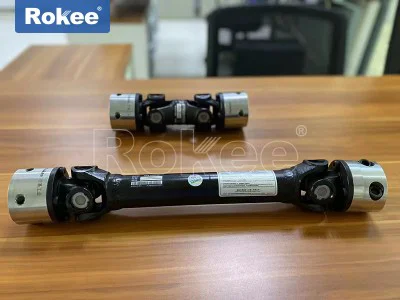
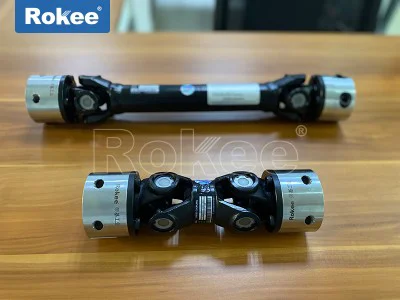
Beyond these primary classifications, universal shafts are further divided into specialized variants to address niche operational requirements, including telescopic universal shafts, triple-pin universal shafts, and block-type universal shafts. Telescopic universal shafts feature a splined shaft body that allows for axial length adjustment, making them perfect for applications where shaft distance varies during operation, such as mobile machinery or systems with thermal expansion. Triple-pin universal shafts are designed to handle larger angular misalignments and absorb impact loads, offering enhanced flexibility in heavy-duty settings with extreme operational stresses. Block-type universal shafts, with their simplified joint structure, are optimized for low-speed, high-torque use and excel at absorbing shock loads, making them suitable for rugged equipment subjected to intermittent heavy loading. Additionally, universal shafts can be classified by load capacity into heavy-duty, medium-duty, light-duty, and miniature categories, each scaled to match the torque and load requirements of specific equipment, from massive industrial processing machinery to small-scale precision instruments. This diverse range of types ensures that there is a universal shaft variant capable of meeting the unique structural and performance demands of nearly every mechanical transmission application.
The versatility of universal shafts is reflected in their widespread adoption across countless industries, where they serve as critical transmission components in an endless array of machinery and equipment. In the automotive and transportation sector, universal shafts are integral to vehicle drivetrains, connecting the transmission to the differential in rear-wheel-drive and all-wheel-drive vehicles, accommodating the vertical movement of the suspension and ensuring consistent power delivery to the wheels. They are also used in steering systems, enabling smooth steering control by compensating for misalignment between steering components, enhancing vehicle handling and safety. In heavy industrial machinery, including metallurgical equipment, mining machinery, and construction gear, heavy-duty cross-shaft universal shafts are indispensable, transmitting extreme torque between misaligned shafts in rolling mills, excavators, crushers, and conveyor systems. Their ability to withstand heavy loads, shock, and harsh industrial environments makes them vital for maintaining continuous operation in high-stress manufacturing and processing settings.
In the realm of precision manufacturing and machinery, constant velocity universal shafts take center stage, powering machine tools, textile machinery, packaging equipment, and robotic systems. The smooth, vibration-free operation and consistent speed of CV universal shafts are critical for maintaining machining accuracy, ensuring precise fabric weaving, and enabling reliable automated packaging, where even minor speed fluctuations or vibration can compromise product quality. Agricultural machinery also relies heavily on universal shafts, with these components powering tractors, harvesters, planters, and other farm equipment. They compensate for misalignment caused by uneven terrain and absorb shock loads from field operations, ensuring reliable power transmission to attachments like mowers, plows, and threshers, even in rugged outdoor conditions. In marine and aerospace applications, specialized universal shafts built from corrosion-resistant materials are used to transmit power in marine propulsion systems, aircraft control mechanisms, and auxiliary equipment, operating reliably in high-humidity, high-altitude, or corrosive environments while meeting strict performance and safety standards.
Universal shafts also play a vital role in energy production and industrial processing equipment, including wind turbines, pumps, compressors, and material handling systems. In wind turbines, they transmit rotational power from the rotor to the generator, accommodating misalignment caused by wind-induced movement and structural flexing. In pumping and compression systems, they connect motors to pump shafts in water treatment plants, oil and gas facilities, and chemical processing plants, ensuring efficient fluid transfer despite minor shaft misalignment. Material handling systems, such as conveyor belts and lifting equipment, use universal shafts to maintain smooth power transmission across long distances and uneven layouts, streamlining logistics and manufacturing workflows. Even in small-scale consumer and commercial equipment, such as office machinery, food processing devices, and medical equipment, miniature and light-duty universal shafts enable compact, reliable power transmission, demonstrating the component’s adaptability across scales and industries.
The enduring relevance of universal shafts in mechanical engineering stems from their unique ability to balance structural robustness, performance flexibility, and operational reliability, addressing a core challenge in power transmission: managing shaft misalignment without compromising efficiency or durability. As industrial and mechanical technologies continue to evolve, the design and manufacturing of universal shafts are advancing in tandem, with innovations in material science, precision engineering, and joint design further enhancing their performance. Newer variants feature improved bearing systems, enhanced lubrication mechanisms, and optimized structural geometries to boost torque capacity, increase operating speeds, reduce wear, and extend service life. Additionally, custom-engineered universal shafts are increasingly prevalent, tailored to meet the highly specific requirements of specialized applications, from extreme-environment industrial equipment to high-precision medical devices.
In summary, universal shafts represent a pinnacle of practical mechanical design, blending straightforward structural principles with high-performance engineering to deliver a solution that is both functional and adaptable. Their diverse structural types, each fine-tuned for distinct performance parameters, allow them to integrate seamlessly into virtually any power transmission system, regardless of misalignment challenges or operational conditions. From heavy industrial machinery that operates under extreme loads to precision equipment that demands flawless motion control, universal shafts serve as silent yet critical workhorses, enabling the smooth, efficient transfer of power that drives modern industry, transportation, manufacturing, and technology. As mechanical systems grow more complex and demanding, the universal shaft will remain an essential component, continuously evolving to meet the ever-expanding needs of the engineering world and solidifying its status as a fundamental building block of mechanical power transmission.
Coupling Categories
Links:
Related Articles
- Aug 10, 2026Universal Shaft Coupling Manufacturer
- Aug 10, 2026Long Universal Shaft Coupling
- Aug 10, 2026Flexible Universal Shaft Coupling
- Aug 10, 2026Heavy Duty Universal Shaft Coupling
- Aug 4, 2026Splined Telescopic Universal Shaft Coupling
- Jul 30, 2026Heavy Duty Universal Shaft Coupling Manufacturer In China
- Jul 23, 2026Universal Shaft Coupling With Cross Bearing Spider
- Jul 23, 2026Low Speed Universal Shaft
- Jul 23, 2026Low Torque Universal Shaft
- Jun 5, 2026Universal Shaft Supply