Universal Shaft Couplings
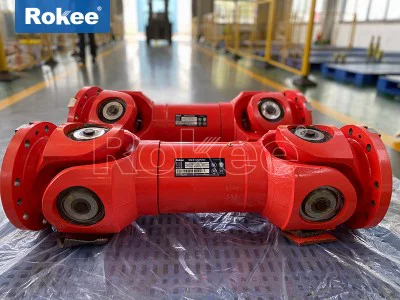
Universal shaft coupling is a key mechanical component used to connect two shafts (active shaft and passive shaft) in different mechanisms. Its main function is to rotate the two shafts together to transmit torque and motion.
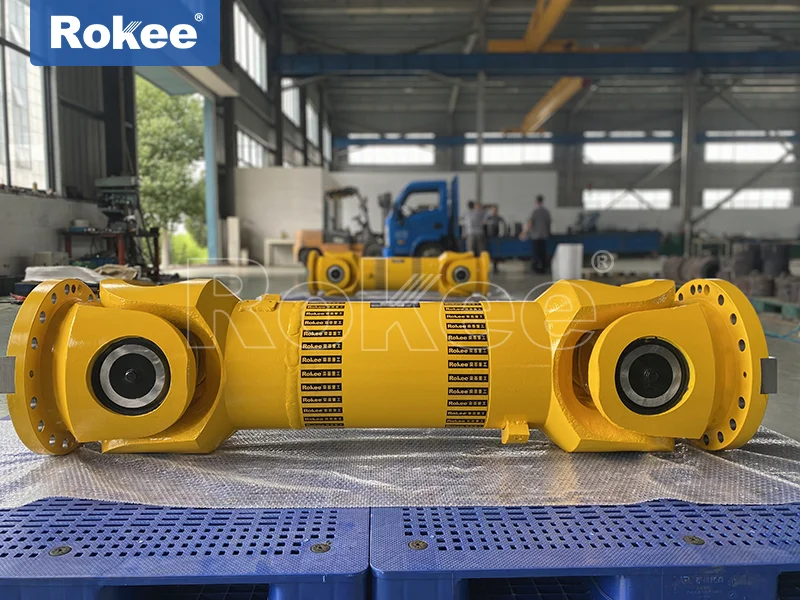
Compared with ordinary couplings, the most prominent feature of universal couplings is the ability to achieve reliable transmission when the two shafts are not on the same axis and there is an angle between the axes, with a large angular compensation capability. According to industry standards, the allowable angle between the two axes for universal couplings of different structural types is usually between 5 ° -45 °, which enables them to adapt to various complex installation environments and working conditions.
The basic working principle of universal shaft coupling is based on the theory of spatial linkage mechanism. Taking the most common cross axis universal shaft coupling as an example, it uses a special structure composed of cross axis, bearings, and fork head components to convert the rotational motion of the input shaft into the swinging motion of the cross axis, and then transmit the swinging motion to the output shaft, thereby achieving torque transmission. When there is an angle between the two axes, the cross axis will continuously adjust its angle as it rotates, allowing power to be transmitted continuously. It is worth noting that the single universal shaft coupling may experience speed fluctuations during transmission, and the output shaft speed may vary periodically, which may cause problems in certain precision transmission scenarios. To solve this problem, a double joint form is usually adopted in practical applications, which ensures the synchronization of the main and driven shafts and eliminates the influence of speed fluctuations by reasonably arranging the spatial geometric relationship between the two universal shaft couplings.
From a material perspective, universal shaft coupling couplings are mainly made of high-quality alloy steels such as 45 steel, 45 forged steel, and 40 chromium. These materials have high strength, wear resistance, and fatigue life after appropriate heat treatment. Heavy duty universal couplings will also use alloy cast steel or forged steel parts to meet the demand for high torque transmission. With the advancement of materials science, new materials such as high-strength stainless steel and special alloys have also been applied in some special working conditions, further expanding the application scope of universal shaft couplings.
In terms of its role in industrial transmission systems, universal couplings not only have the basic function of power transmission, but also play an important role in buffering, vibration reduction, and improving the dynamic performance of shaft systems. It can effectively compensate for shaft misalignment caused by manufacturing errors, installation deviations, load deformation, and temperature changes, reduce vibration and noise, and protect the transmission system from damage. Especially in high-speed and heavy-duty power transmission, the reasonable selection and use of universal couplings can significantly improve the reliability and service life of the entire transmission system.
The development of universal couplings has formed various structural types, each with unique performance characteristics and applicable scenarios. According to the transmission principle and structural characteristics, the commonly used universal couplings in the industrial field are mainly divided into three categories: cross shaft type, ball cage type, and ball fork type. Each type can be further subdivided into multiple different forms, forming a series of universal coupling products that meet various industrial needs.
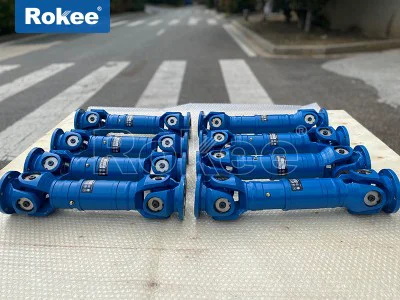
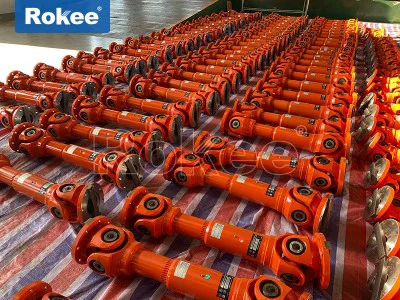
The cross axis universal shaft coupling is currently the most widely used type, and its typical structure consists of two fork joints, a cross axis, and four sets of needle roller bearings. This type of coupling can be divided into various forms, such as SWC type integral fork head, SWP type partial bearing seat, and SWZ type integral bearing seat, according to the different designs of bearing seat and cross head. The main advantages of the cross axis universal shaft coupling are its simple and reliable structure, high load-bearing capacity, and easy maintenance, making it particularly suitable for heavy-duty and low-speed working conditions. For example, in metallurgical rolling mill equipment, the SWC heavy-duty universal shaft coupling has a rotating diameter of up to 1600mm, a torque transmission distance of over 30 meters, and a nominal torque of up to 8000kN · m. However, this type of coupling experiences speed fluctuations during transmission and must be used in pairs and arranged correctly to ensure constant speed transmission. At the same time, its allowable axis angle usually does not exceed 15 ° -20 °, which may be limited in some large angle transmission scenarios.
The ball cage universal shaft coupling achieves true constant speed transmission through precise ball path design and steel ball arrangement, fundamentally solving the problem of speed fluctuations. The ball cage coupling consists of key components such as a spherical outer ring, a star shaped inner ring, a cage, and a force transmitting steel ball. The centers of all steel balls are always located on the bisector of the angle between the two axis lines, ensuring synchronous rotation of the input and output shafts. According to structural characteristics, ball cage couplings can be divided into two categories: fixed type (such as disc, cup, bell, cylinder) and sliding type (such as DOX series). Compared with the cross axis type, the ball cage universal shaft coupling has significant advantages such as high transmission efficiency (up to 98% -99.8%), large swing angle range (up to 75 °), compact structure, and good dynamic balance performance. It is particularly suitable for high-speed precision transmission applications, such as machine tools, packaging machinery, textile machinery, and other equipment. But its manufacturing accuracy requirements are extremely high, the cost is relatively high, and the requirements for sealing and lubrication are also more stringent.
The ball fork universal shaft coupling is another common type of constant velocity universal shaft coupling, which has a relatively simple structure and is mainly composed of two fork shaped parts and a force transmitting steel ball. Compared with the cage type, the fork type has a larger load-bearing capacity but allows for a smaller axis angle, usually not exceeding 30 °, and its performance is not as stable as the cage type under high-speed conditions. Ball fork universal couplings are commonly used in transmission applications with medium to low speeds and heavy loads, such as engineering machinery, agricultural machinery, and other equipment.
In addition to the three categories mentioned above, universal couplings also include various special structural forms such as three pin type, convex block type, ball joint plunger type, etc., each designed for specific application needs. For example, the three pin universal shaft coupling is particularly suitable for situations where the axis angle is large and axial movement is required, while the convex block type is more suitable for working conditions that require absorption of large impact loads. In practical applications, universal couplings can be classified into four levels based on the magnitude of the transmitted torque: heavy, medium, light, and small, corresponding to different industrial application scenarios.
A universal shaft coupling, also commonly referred to as a universal joint or U-joint, is a critical mechanical component designed to connect two rigid shafts whose axes are inclined to each other, enabling the reliable transmission of rotational motion and torque even when the shafts are not perfectly aligned. Unlike rigid couplings that require precise coaxial alignment between connected shafts, universal shaft couplings offer a high degree of flexibility, making them indispensable in a wide range of mechanical and industrial systems where misalignment is inevitable due to manufacturing tolerances, installation constraints, or dynamic operational conditions. The core functionality of a universal shaft coupling lies in its ability to accommodate angular, axial, and in some cases radial misalignment between the driving and driven shafts while maintaining efficient power transmission, reducing stress on connected components, and ensuring smooth operational performance. Over time, advancements in materials science, mechanical design, and manufacturing technologies have refined the structure and performance of universal shaft couplings, expanding their application scope across diverse industries, from automotive and aerospace to heavy machinery and industrial equipment.
The basic structure of a universal shaft coupling is relatively intuitive, yet its design is engineered to balance flexibility, strength, and durability to meet the demands of different operational environments. At its most fundamental level, a standard universal shaft coupling consists of three primary components: two yokes (also known as forks), a cross shaft (or spider), and bearings. The yokes are typically cylindrical or fork-shaped components that are attached to the ends of the driving and driven shafts, respectively. Each yoke features a pair of opposing holes that are aligned to accommodate the cross shaft, which serves as the central connecting element. The cross shaft is a cruciform-shaped component with four cylindrical trunnions, one extending from each end of the cross, that fit into the holes of the yokes. Bearings are installed between the trunnions of the cross shaft and the holes in the yokes to reduce friction and enable smooth articulation, allowing the yokes to rotate relative to each other at varying angles without causing excessive wear or damage. The bearings used in universal shaft couplings are often needle bearings or ball bearings, selected based on the load capacity, speed requirements, and environmental conditions of the application. Needle bearings are particularly common due to their compact design, high load-carrying capacity, and ability to operate efficiently in limited space, which is essential for many universal coupling configurations. In addition to these core components, some universal shaft couplings may include additional elements such as seals to protect the bearings from contaminants like dust, dirt, and moisture, or lubrication fittings to ensure proper lubrication of the moving parts, extending the service life of the coupling.
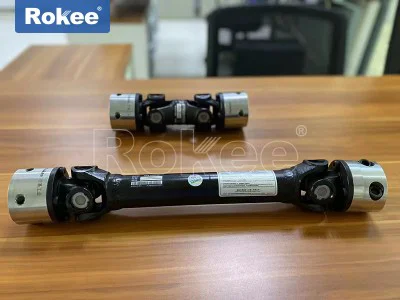
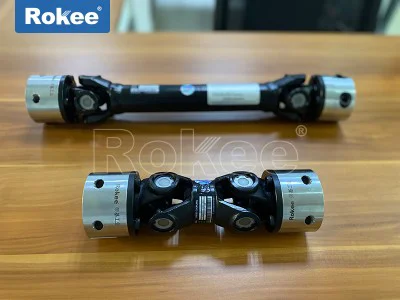
While the basic structure remains consistent across most universal shaft couplings, variations in design are implemented to enhance performance, accommodate specific misalignment requirements, or suit particular application needs. For example, some couplings feature a telescopic design, which incorporates a splined shaft within one of the yokes, allowing for axial movement between the connected shafts in addition to angular misalignment. This telescopic functionality is particularly useful in applications where the distance between the driving and driven shafts may change during operation, such as in automotive driveshafts, where suspension movement can alter the shaft length. Another design variation involves the use of a double universal joint, which consists of two single universal couplings connected by an intermediate shaft. This configuration is used to eliminate the speed fluctuations that can occur with a single universal joint, ensuring constant velocity transmission between the driving and driven shafts. In a double universal joint setup, the two couplings are aligned such that the angular displacements of one cancel out the fluctuations of the other, resulting in smooth, uniform rotation of the driven shaft regardless of the angle between the input and output shafts. The materials used in the construction of universal shaft couplings are carefully selected based on the performance requirements of the application, with a focus on strength, durability, wear resistance, and corrosion resistance. Common materials include high-strength carbon steels, alloy steels, stainless steel, and in some cases, lightweight materials such as aluminum or titanium for applications where weight reduction is critical, such as aerospace systems. The yokes and cross shaft are typically manufactured using forging or machining processes to ensure high structural integrity, while the bearings are made from hardened steel or other wear-resistant materials to withstand the forces and friction generated during operation.
The performance of a universal shaft coupling is defined by a set of key parameters that determine its suitability for a given application, including torque capacity, angular misalignment capability, speed range, transmission efficiency, and durability. Torque capacity is one of the most critical performance metrics, referring to the maximum amount of torque that the coupling can transmit without suffering damage or failure. This parameter is influenced by the size of the coupling, the materials used, the design of the cross shaft and yokes, and the type of bearings employed. Universal shaft couplings are available in a wide range of torque capacities, from small couplings capable of transmitting just a few newton-meters of torque for light-duty applications, to heavy-duty couplings designed to handle hundreds of thousands of newton-meters for large industrial machinery such as steel mills, mining equipment, and power generation systems. Angular misalignment capability refers to the maximum angle between the driving and driven shafts that the coupling can accommodate while maintaining efficient torque transmission. Most standard universal shaft couplings can handle angular misalignments between 5° and 45°, depending on the design, with some specialized couplings capable of accommodating even larger angles for extreme applications. It is important to note that operating a universal coupling beyond its maximum allowable angular misalignment can lead to increased wear, reduced transmission efficiency, and premature failure.
Another key performance parameter is the speed range, which refers to the maximum rotational speed at which the coupling can operate safely and efficiently. The speed range of a universal shaft coupling is influenced by factors such as the balance of the components, the type of bearings, and the centrifugal forces generated during rotation. High-speed applications, such as those found in aerospace or precision machinery, require couplings that are carefully balanced to minimize vibration and ensure smooth operation, as excessive vibration can cause damage to both the coupling and the connected components. Transmission efficiency is also an important consideration, particularly in energy-sensitive applications, as it measures the percentage of input torque that is successfully transmitted to the driven shaft. Universal shaft couplings typically have high transmission efficiencies, ranging from 98% to 99.9%, with minimal energy loss due to friction in the bearings. This high efficiency makes them an ideal choice for applications where energy conservation is a priority, such as in electric vehicles or renewable energy systems. Durability, or service life, is another critical performance factor, referring to the length of time the coupling can operate under normal conditions before requiring maintenance or replacement. The durability of a universal shaft coupling is influenced by the materials used, the quality of manufacturing, the level of lubrication, and the operating conditions (such as temperature, humidity, and exposure to contaminants). Proper maintenance, including regular lubrication and inspection, can significantly extend the service life of a universal coupling, reducing downtime and maintenance costs for the overall system.
There are several different types of universal shaft couplings, each designed to suit specific application requirements based on factors such as misalignment needs, torque capacity, speed, and environmental conditions. The most common type is the cross-axis universal coupling, also known as the Hooke’s joint or Cardan joint, which is the basic design described earlier, consisting of two yokes, a cross shaft, and bearings. This type of coupling is widely used in a variety of applications due to its simplicity, reliability, and cost-effectiveness. Cross-axis universal couplings are ideal for applications where moderate angular misalignment is required, such as in automotive driveshafts, agricultural machinery, and small industrial equipment. However, a single cross-axis universal coupling has a limitation: it causes speed fluctuations in the driven shaft when the angle between the input and output shafts is large. This is because the rotational velocity of the driven yoke varies periodically as the cross shaft rotates, resulting in a non-uniform output speed. To address this issue, the double cross-axis universal coupling is often used, which as mentioned earlier, consists of two single couplings connected by an intermediate shaft, ensuring constant velocity transmission by canceling out the speed fluctuations.
Another common type of universal shaft coupling is the ball cage universal coupling, also known as the constant velocity (CV) joint. Unlike the cross-axis universal coupling, the ball cage universal coupling is designed to transmit torque at a constant velocity regardless of the angular misalignment between the shafts, making it ideal for applications where smooth, uniform rotation is critical. The ball cage universal coupling consists of an outer race (with a spherical inner surface and grooves), an inner race (connected to the driven shaft, with matching grooves), a cage (which holds a series of steel balls), and the steel balls themselves. The grooves in the inner and outer races are designed such that the steel balls always lie in the plane that bisects the angle between the two shafts, ensuring that the rotational speed of the driven shaft is the same as the driving shaft at all angles. Ball cage universal couplings are commonly used in front-wheel-drive automobiles, where they connect the transmission to the front wheels, as well as in other high-speed, precision applications such as aerospace systems, robotics, and medical equipment. There are several variations of the ball cage universal coupling, including the Rzeppa joint and the tripod joint, each with slight design differences to suit specific application needs.
Other types of universal shaft couplings include the ball fork universal coupling, the convex block universal coupling, and the telescopic universal coupling. The ball fork universal coupling is a simpler design that consists of two ball forks with raceways and steel balls, suitable for light-duty applications with small angular misalignments, such as in some types of agricultural machinery or small tools. This type of coupling is relatively inexpensive and easy to manufacture but has lower torque capacity and misalignment capability compared to cross-axis or ball cage couplings. The convex block universal coupling uses a convex block as the central connecting element instead of a cross shaft, offering higher torque capacity and better resistance to shock loads, making it suitable for heavy-duty applications such as mining equipment, steel mills, and construction machinery. Telescopic universal couplings, as mentioned earlier, incorporate a splined shaft to allow for axial movement between the connected shafts, making them ideal for applications where the distance between the shafts varies during operation, such as in automotive driveshafts, telescopic cranes, and conveyor systems. In addition to these standard types, there are also specialized universal shaft couplings designed for specific environments, such as corrosion-resistant couplings made from stainless steel or non-metallic materials for use in chemical processing or marine applications, and high-temperature couplings designed to operate in extreme heat environments such as furnaces or power plants.
The versatility of universal shaft couplings makes them suitable for a wide range of applications across numerous industries, each with unique requirements that the coupling is engineered to meet. One of the most common applications is in the automotive industry, where universal shaft couplings are used extensively in both passenger cars and commercial vehicles. In rear-wheel-drive and four-wheel-drive vehicles, cross-axis universal couplings are used in the driveshaft to connect the transmission to the rear differential, allowing for angular misalignment between the two components due to the vehicle’s suspension movement. In front-wheel-drive vehicles, ball cage universal couplings (CV joints) are used to connect the transmission to the front wheels, as they provide constant velocity transmission, ensuring smooth handling and reduced vibration at high speeds. Universal couplings are also used in the steering systems of some vehicles, allowing for the transmission of rotational motion from the steering wheel to the steering rack or box, even with angular misalignment between the components.
The industrial machinery sector is another major user of universal shaft couplings, with applications ranging from small precision equipment to large heavy-duty machinery. In steel mills, for example, heavy-duty universal couplings are used to connect the motors to the rolling mills, handling high torque loads and accommodating angular misalignment between the shafts due to the large size and weight of the equipment. Mining equipment, such as excavators, bulldozers, and conveyor systems, also relies on universal shaft couplings to transmit torque between components, as they can withstand the harsh operating conditions (including dust, dirt, and shock loads) while maintaining reliable performance. Industrial pumps and compressors often use universal couplings to connect the motor to the pump or compressor shaft, accommodating minor misalignments that may occur during installation or operation, and reducing stress on the bearings and other components. Precision machinery, such as machine tools (lathes, milling machines, grinders), uses high-precision universal couplings to ensure accurate torque transmission and smooth operation, as any vibration or speed fluctuation could affect the quality of the finished product.
The aerospace and defense industries also utilize universal shaft couplings in a variety of applications, where reliability, lightweight design, and high performance are critical. In aircraft, universal couplings are used in the landing gear systems, flight control systems, and engine components, where they must operate efficiently under extreme conditions such as high altitude, temperature variations, and high speeds. The lightweight design of these couplings is essential to reduce the overall weight of the aircraft, improving fuel efficiency and performance. In defense applications, such as military vehicles, tanks, and artillery systems, universal shaft couplings are used to transmit torque between components in harsh, rugged environments, requiring high durability and resistance to shock and vibration.
Marine applications also benefit from the use of universal shaft couplings, particularly in ships and boats where misalignment between shafts is common due to the flexibility of the hull. Universal couplings are used to connect the ship’s engine to the propeller shaft, accommodating angular and axial misalignments caused by hull movement or thermal expansion, while ensuring reliable torque transmission to propel the vessel. Corrosion-resistant universal couplings, made from stainless steel or other non-corrosive materials, are used in marine environments to withstand exposure to saltwater and other corrosive elements, extending the service life of the coupling.
Other applications of universal shaft couplings include renewable energy systems, such as wind turbines and solar trackers. In wind turbines, universal couplings are used to connect the rotor to the gearbox or generator, accommodating misalignments caused by wind loads and thermal expansion, while transmitting the high torque generated by the rotor. Solar trackers use small, precision universal couplings to adjust the angle of the solar panels, ensuring maximum exposure to sunlight, and requiring smooth, reliable movement to maintain efficiency. Medical equipment, such as MRI machines, surgical robots, and diagnostic tools, also uses universal shaft couplings in precision motion control systems, where smooth, accurate torque transmission is essential to ensure the safety and effectiveness of the equipment.
In conclusion, universal shaft couplings are essential mechanical components that play a critical role in enabling reliable torque and motion transmission between misaligned shafts across a wide range of applications. Their simple yet robust structure, combined with high performance characteristics such as high torque capacity, angular misalignment capability, and transmission efficiency, makes them indispensable in industries ranging from automotive and aerospace to heavy machinery and renewable energy. The various types of universal shaft couplings, each designed to suit specific application needs, ensure that there is a coupling solution available for nearly any misalignment or torque transmission requirement. As manufacturing technologies and materials science continue to advance, universal shaft couplings are likely to become even more efficient, durable, and versatile, expanding their application scope and contributing to the improved performance and reliability of mechanical systems worldwide. Proper selection, installation, and maintenance of universal shaft couplings are essential to ensure their optimal performance and longevity, reducing downtime and maintenance costs for the overall system, and ensuring the smooth operation of the equipment they serve.
Coupling Categories
Links:
Related Articles
- Aug 10, 2026Universal Shaft Coupling Manufacturer
- Aug 10, 2026Long Universal Shaft Coupling
- Aug 10, 2026Flexible Universal Shaft Coupling
- Aug 10, 2026Heavy Duty Universal Shaft Coupling
- Aug 4, 2026Splined Telescopic Universal Shaft Coupling
- Jul 30, 2026Heavy Duty Universal Shaft Coupling Manufacturer In China
- Jul 23, 2026Universal Shaft Coupling With Cross Bearing Spider
- May 7, 2026Angle Compensation Advantage Of Universal Shaft Coupling Adapting To PIR Sandwich Panel Production Line
- Apr 27, 2026Universal Shaft Coupling Empowers Sandwich Panel Production Machine To Improve Quality And Efficiency
- Apr 27, 2026Special Universal Shaft Coupling For Sandwich Panel Manufacturing Machine With Higher Transmission Efficiency