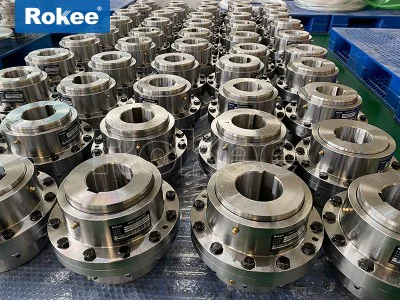
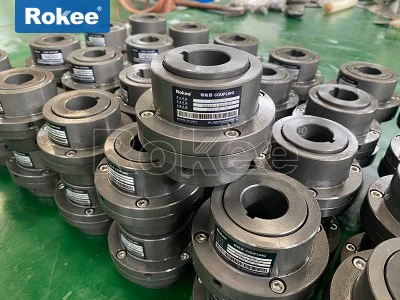
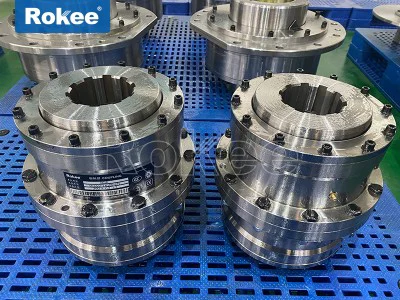
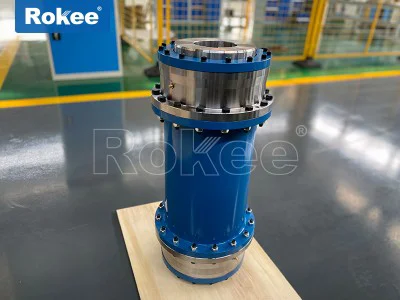
Face Gear Couplings
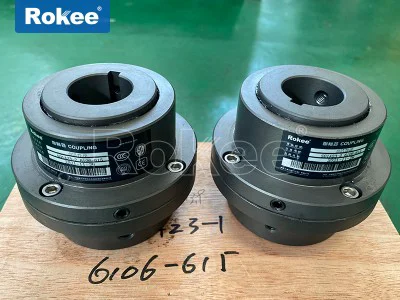
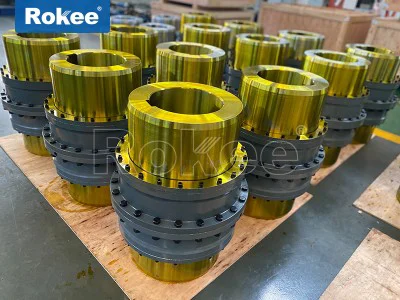
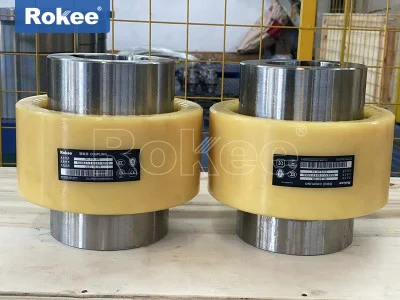
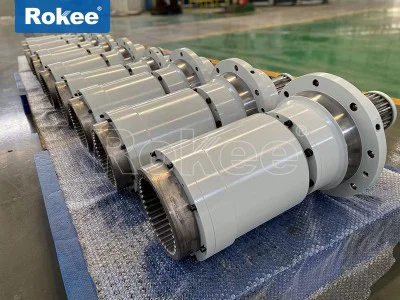
Face gear coupling is a mechanical device that transmits torque through gear meshing and belongs to the category of flexible couplings.
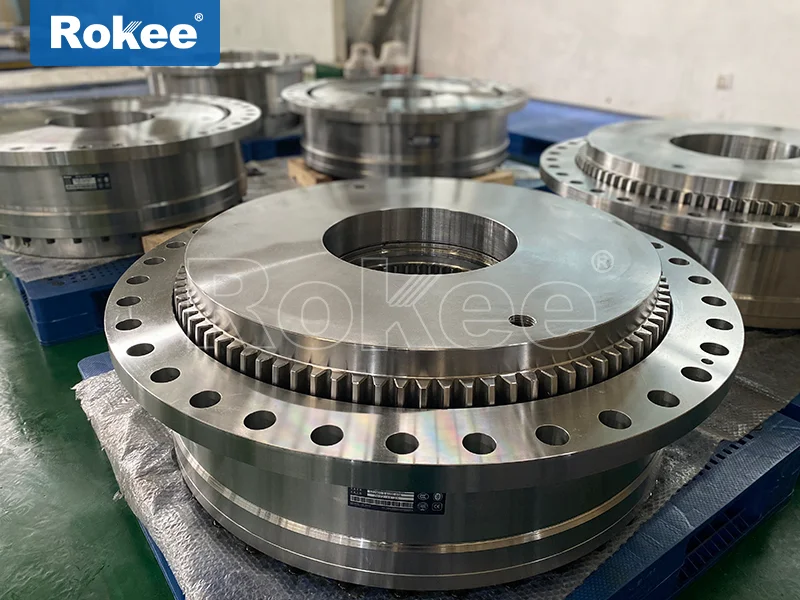
Core structure:
External gear shaft sleeve: fixed on the driving shaft or driven shaft, usually with straight teeth or drum teeth.
Internal gear ring: combined with the outer sleeve to form a meshing pair, allowing for a certain degree of shaft deviation compensation.
Sleeve components: divided into two forms: flange sleeves (connected by bolts) and continuous sleeves (surrounding the shaft end as a whole), with materials available in metal or nylon.
According to tooth design, it can be divided into:
Straight tooth type: simple structure, limited compensation ability.
Drum shaped tooth profile: The tooth tip is designed with a spherical surface, allowing for greater angular displacement and increasing load-bearing capacity by 15% -30%. It is widely used in heavy-duty scenarios.
Working principle and performance characteristics
Power transmission: Synchronous rotation is achieved through precise meshing of inner and outer teeth, with a transmission efficiency of up to 99.7%.
Deviation compensation: It can absorb axial, radial, and angular displacements, reducing installation accuracy requirements.
Load capacity: Wide torque range, up to 4500kN · m, suitable for low-speed heavy-duty (such as metallurgical rolling mills) or high-speed precision (such as gas turbines) scenarios.
Lubrication requirement: Regular maintenance with lithium based grease is required to avoid tooth wear and overheating.
Typical application areas
Heavy industry: steel rolling mills, mining crushing equipment.
Energy and ships: generator shaft system, offshore platform transmission system.
General machinery: equipment such as pumps and compressors that require high torque synchronous transmission.
Selection factors:
Consider torque load, speed, deviation type (parallel/angle), ambient temperature, and lubrication conditions.
Fault prevention:
Regularly check the contact area of the tooth surface (tooth height ≥ 50%, tooth width ≥ 70%).
Monitor vibration and noise to prevent abnormal wear caused by poor lubrication.
Dynamic balance verification is required in high-speed scenarios to avoid failure caused by centrifugal force.
From the above analysis, it can be seen that the face gear coupling occupies an irreplaceable position in complex industrial transmissions due to its high load-bearing capacity and high compensation ability. Reasonable selection and maintenance can significantly extend the service life of the equipment.
In the realm of mechanical power transmission, face gear couplings stand as a pivotal category of flexible coupling devices, engineered to bridge two rotating shafts, transmit torque efficiently, and accommodate various forms of shaft misalignment simultaneously. Unlike rigid couplings that demand flawless shaft alignment and offer no tolerance for positional deviations, face gear couplings blend robust torque transmission capabilities with adaptive flexibility, making them indispensable across a vast spectrum of industrial machinery and engineering systems.
At its core, the structural design of a face gear coupling is meticulously crafted to balance mechanical strength, meshing precision, and misalignment compensation, with a modular configuration that consists of several key integrated components. The primary elements include two external gear hubs, an internal gear sleeve assembly, fastening hardware, and sealing components, each engineered to fulfill a distinct functional role in power transmission. The external gear hubs are the foundational connecting parts, typically forged from high-strength alloy steel or carbon steel to withstand extreme torsional loads and cyclic stresses; these hubs are securely mounted onto the driving and driven shafts via interference fits, keyways, or tapered locking assemblies, ensuring zero slippage during torque transmission and maintaining rigid connection with the shaft surfaces. The external teeth machined onto these hubs are the core torque-transmitting elements, with profiles tailored to optimize meshing contact and load distribution, avoiding concentrated stress that could lead to premature tooth failure.
Complementing the external gear hubs is the internal gear sleeve, a critical component that encases the external teeth and forms a closed meshing pair to facilitate power transfer. This sleeve is typically constructed in a two-part flanged design, connected by high-strength threaded fasteners to enable easy installation, disassembly, and maintenance; in some compact variants, a single-piece continuous sleeve is utilized to enhance structural integrity and shield internal gear surfaces from external contaminants such as dust, moisture, and abrasive particles. The internal teeth of the sleeve are precision-machined to match the profile of the external hub teeth, ensuring full-face contact during meshing to distribute load evenly across the tooth surfaces. Sealing elements, typically high-performance elastomeric gaskets or labyrinth seals, are integrated at the junction of the sleeve and hubs to retain lubricant within the meshing cavity and prevent ingress of harmful substances, preserving the smooth operation and extending the service life of the gear surfaces.
Beyond the basic modular framework, the geometric design of the gear teeth is a defining structural feature that shapes the overall performance of face gear couplings. The two predominant tooth profiles—straight teeth and drum-shaped crown teeth—dictate the coupling’s misalignment tolerance, load-bearing capacity, and operational smoothness. Straight tooth face gear couplings feature linear, parallel tooth profiles on both external hubs and internal sleeves, with a simplified machining process and compact structural layout. While this design offers reliable torque transmission for applications with minimal shaft misalignment, it has limited capacity to compensate for angular, radial, or axial deviations, making it suitable for stationary machinery with highly aligned shaft systems. In contrast, drum-shaped crown tooth face gear couplings feature a spherical contour on the external hub teeth, with the center of the spherical surface aligned with the shaft axis; this curved profile allows for greater angular displacement between the meshing teeth, enabling the coupling to accommodate significant combined misalignments without compromising torque transmission efficiency or inducing excessive wear on tooth surfaces. The crown tooth design also enhances load distribution across the tooth width, boosting the coupling’s torque-carrying capacity by a substantial margin compared to straight tooth variants, making it the preferred choice for heavy-duty and high-load operational environments.
The operational principle of face gear couplings revolves around the precise meshing of internal and external gear teeth to transfer rotational motion and torque between shafts, while leveraging the geometric flexibility of the gear profiles to absorb shaft misalignment and mechanical vibrations. When the driving shaft rotates, the external gear hub fixed to it synchronously rotates, and the meshed internal gear sleeve transfers this rotational force to the external hub on the driven shaft, creating a seamless power transmission loop. Unlike friction-based couplings that rely on surface friction for torque transfer, face gear couplings use positive gear meshing, eliminating backlash and ensuring synchronous rotation between the driving and driven shafts, a critical trait for precision-driven machinery. The inherent flexibility of the gear meshing interface allows the coupling to compensate for three primary forms of shaft misalignment: angular misalignment caused by non-parallel shaft axes, radial misalignment resulting from lateral shaft offset, and axial misalignment due to thermal expansion or mechanical displacement of shafts during operation. This adaptive misalignment compensation reduces the stringent requirements for precision installation, lowers the risk of excessive bearing stress and shaft fatigue caused by forced alignment, and minimizes vibration and noise transmission across the mechanical system.
The performance characteristics of face gear couplings are tailored to meet the rigorous demands of industrial power transmission, combining high torque density, operational durability, and adaptive versatility. One of the most prominent performance advantages is their exceptional torque-transmission capacity, with the ability to handle extremely high torsional loads across a wide range of rotational speeds, from low-speed heavy machinery to high-speed rotating equipment. This high torque density stems from the full-tooth contact meshing design, which distributes load evenly and maximizes the effective load-bearing area of the gear teeth, enabling the coupling to perform reliably under intermittent shock loads and continuous steady-state loads alike. Transmission efficiency is another standout performance metric, with face gear couplings achieving near-peak efficiency levels due to minimal frictional loss between precision-machined gear surfaces; when properly lubricated, frictional heat generation is significantly reduced, preventing thermal degradation of components and maintaining stable operational performance even during prolonged continuous use.
Durability and operational resilience further solidify the performance value of face gear couplings, as they are engineered to withstand harsh industrial environments, including extreme temperatures, high humidity, and exposure to mild chemical contaminants. The use of high-strength, heat-treated metallic materials ensures resistance to tooth wear, pitting, and fatigue fracture, common failure modes in power transmission components. Additionally, the sealed structural design protects internal gear surfaces from abrasive particles and corrosive agents, reducing the frequency of maintenance interventions and extending the operational lifespan of the coupling. While face gear couplings require regular lubrication to sustain optimal performance—typically with high-performance grease or gear oil to reduce friction and dissipate heat—this maintenance demand is offset by their long service life and minimal risk of catastrophic failure under normal operating conditions. It is important to note that performance can be tailored through material selection and tooth profile design; for instance, couplings used in high-speed applications often undergo precision dynamic balancing to minimize centrifugal force and vibration, while those for heavy-duty industries feature reinforced gear teeth and thicker hub walls to enhance load resistance.
Face gear couplings are classified into distinct variants based on multiple practical criteria, including tooth profile, structural configuration, application-specific design, and misalignment compensation capacity, each optimized to address unique operational requirements and machinery setups. The most fundamental classification is based on tooth profile, dividing couplings into straight tooth face gear couplings and drum-shaped crown tooth face gear couplings, as previously outlined. Straight tooth models are lauded for their simple structure, cost-effective machining, and suitability for low-misalignment, light-to-medium load applications, while crown tooth models excel in heavy-duty, high-misalignment scenarios, offering superior flexibility and load-bearing performance.
Classification by structural configuration yields three primary categories: full gear face couplings, half gear face couplings, and floating shaft face gear couplings. Full gear face couplings feature two external gear hubs and one internal gear sleeve, providing uniform flexibility and misalignment compensation on both shaft ends; this is the most widely used configuration, ideal for general industrial machinery where balanced torque transmission and deviation accommodation are required. Half gear face couplings combine one external gear hub with one rigid non-gear hub, offering flexibility only on one side of the connection, making them suitable for systems where one shaft is fixed and only minor misalignment compensation is needed on the driving end. Floating shaft face gear couplings incorporate an extended intermediate shaft between two sets of gear hub and sleeve assemblies, designed to bridge large distances between driving and driven shafts; this variant is essential for machinery layouts where shafts are separated by significant gaps, such as long-distance conveyor systems and remote drive units, maintaining efficient torque transmission across extended spans without sacrificing misalignment tolerance.
Further classification based on application-specific design includes sealed face gear couplings, brake wheel-integrated face gear couplings, and electrically insulated face gear couplings, each adapted for specialized operational scenarios. Sealed variants feature enhanced multi-layer sealing systems to withstand extremely harsh environments with heavy dust, moisture, or chemical exposure, such as mining, construction, and marine engineering. Brake wheel-integrated models incorporate a brake wheel into the gear hub or sleeve assembly, enabling seamless integration with mechanical braking systems for equipment that requires rapid deceleration or emergency stopping, such as cranes, hoists, and rolling mills. Electrically insulated face gear couplings are fitted with insulating layers between gear components to prevent the transmission of electrical current between shafts, protecting sensitive electronic control systems and precision instrumentation from electrical interference, a critical feature for power generation equipment and automated industrial machinery.
The versatility of face gear couplings, rooted in their robust structure and adaptable performance, has led to their widespread adoption across nearly every major industrial sector, serving as a critical link in mechanical power transmission systems for diverse types of machinery. In heavy industry, including steel manufacturing, mining, and metallurgy, face gear couplings are extensively used in high-load equipment such as rolling mills, crushers, ball mills, and conveyor systems. These applications demand couplings that can transmit extreme torque, absorb shock loads from material processing, and compensate for significant shaft misalignment caused by heavy machinery vibration and structural deformation; crown tooth face gear couplings are the predominant choice here, delivering the necessary load capacity and flexibility to maintain uninterrupted operation in harsh working conditions.
In the energy and power generation sector, face gear couplings play a vital role in connecting drive shafts for turbines, generators, pumps, and compressors, both in conventional thermal power plants and renewable energy systems. The high transmission efficiency and reliable misalignment compensation of these couplings ensure stable power transfer, minimize energy loss, and reduce wear on bearings and shafts, even under variable load conditions and thermal expansion-induced shaft displacement. Marine engineering is another key application area, where face gear couplings are utilized in ship propulsion systems, deck machinery, and auxiliary equipment; their sealed, corrosion-resistant design withstands the humid, saline marine environment, while their ability to absorb vibration and misalignment ensures smooth operation of marine propulsion shafts and auxiliary drive systems.
General manufacturing and machinery industries rely on face gear couplings for a vast array of equipment, including centrifugal pumps, fans, mixers, agitators, machine tools, and printing machinery. For light-to-medium load applications with moderate speed requirements, straight tooth face gear couplings offer a cost-effective, compact solution, while crown tooth variants cater to high-precision machine tools and heavy-duty manufacturing equipment that demands zero backlash and precise torque transmission. In the transportation and heavy machinery sector, face gear couplings are integrated into construction equipment, agricultural machinery, and railway vehicles, providing durable power transmission for mobile machinery that operates under variable load and terrain conditions, withstanding shock loads and frequent misalignment fluctuations.
Beyond these core sectors, face gear couplings find specialized applications in aerospace support equipment, chemical processing machinery, and food and beverage production lines, adapted to meet sector-specific operational standards. In aerospace ground support systems, they deliver precise, reliable torque transmission for testing equipment and positioning mechanisms; in chemical plants, corrosion-resistant material variants ensure safe operation in corrosive process environments; in food processing, hygienic, easy-to-clean sealed designs comply with strict sanitary requirements while maintaining efficient power transfer. Across all these applications, the selection of a specific face gear coupling variant is guided by key operational parameters: required torque capacity, rotational speed, type and magnitude of shaft misalignment, environmental conditions, and space constraints, ensuring optimal compatibility and performance with the host machinery.
In summary, face gear couplings represent a cornerstone of modern mechanical power transmission, distinguished by their robust structural design, exceptional torque transmission capabilities, adaptive misalignment compensation, and remarkable operational versatility. Their modular construction, diverse classification options, and ability to perform reliably across extreme operating conditions make them a preferred choice for engineers and designers seeking durable, efficient shaft connection solutions. From heavy industrial machinery to precision manufacturing equipment, face gear couplings fulfill a critical role in ensuring seamless power transfer, reducing mechanical wear, and enhancing the overall reliability and longevity of rotating machinery systems. As industrial engineering continues to advance toward higher loads, greater precision, and more resilient machinery, the inherent advantages of face gear couplings will ensure their enduring relevance and widespread adoption across global industrial applications, solidifying their status as an indispensable component in the landscape of mechanical power transmission technology.