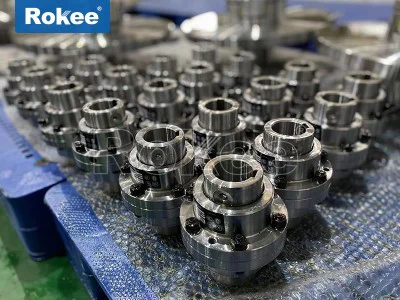
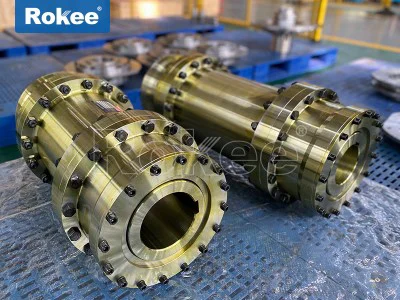
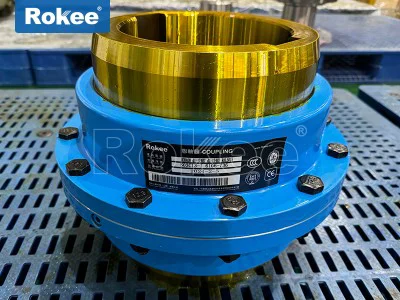
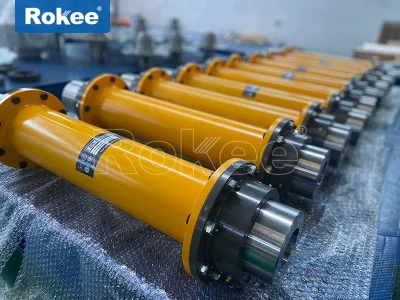
Teeth Couplings
Teeth couplings achieve power transmission through gear meshing and have high torque bearing and deviation compensation capabilities.
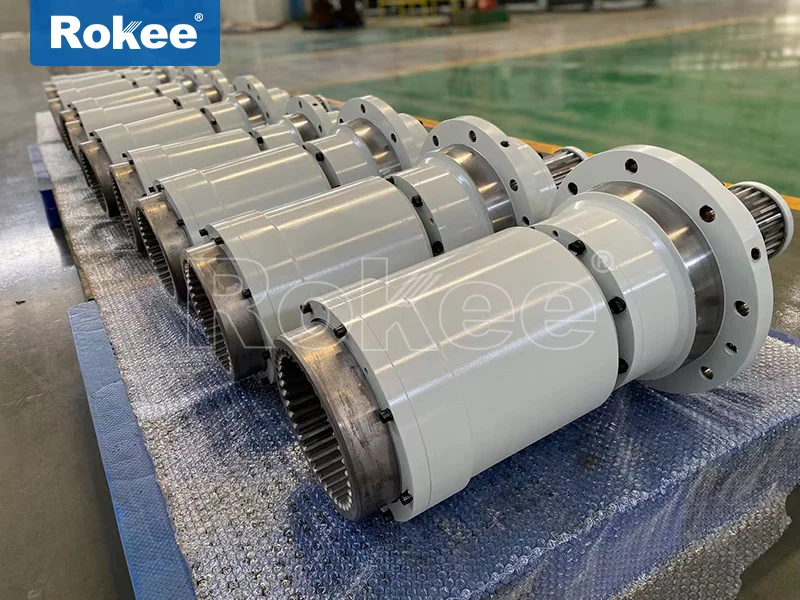
They can be divided into three types:
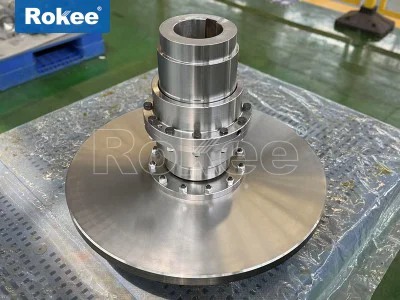
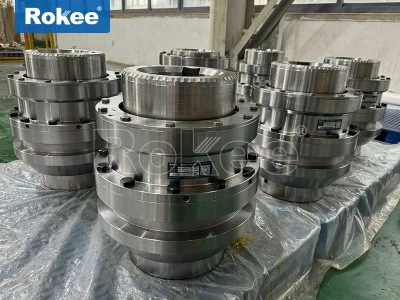
Drum gear coupling
Spherical tooth design: The outer gear shaft sleeve adopts a spherical drum structure, with a 50% increase in tooth clearance compared to straight teeth, and an angular displacement compensation capability of 1 ° 30 '
Adopting a three-dimensional curved tooth design, allowing for an angle deviation of ± 1.5 °, the torque is increased by 40% compared to traditional straight tooth structures
Typical application: Metallurgical rolling mill
Nylon internal gear coupling (such as NL series)
Material innovation: using glass fiber reinforced nylon composite material, with a wear resistance coefficient of 0.12 (under dry friction conditions), suitable for temperature range of -40 ℃~120 ℃
Nylon inner gear sleeve for vibration and noise reduction, with a nominal torque coverage of 40N · m~3150N · m (NL1-NL10 models)
Advantages: lubrication free, corrosion-resistant, suitable for water pumps and hydraulic systems
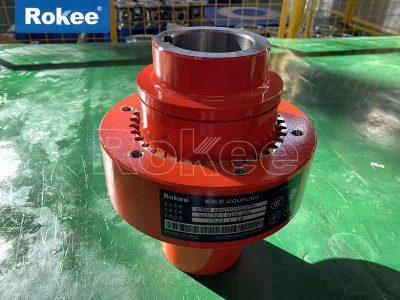
Elastic pin toothed coupling
Buffer design: The elastic modulus of the nylon column pin is 3.2GPa, which can absorb 15% of the impact load (reducing vibration by 60% compared to rigid couplings)
Nylon column pin buffers impact load, with axial compensation of ± 0.7mm
Economical selection, commonly seen in conveyor and fan equipment
Teeth coupling is a mechanical connection device that transmits torque through the meshing of internal and external gears, and belongs to the category of rigid movable couplings. This type of coupling occupies an important position in modern industrial transmission systems due to its excellent torque transmission capability, good compensation performance, and high reliability.
The core of a toothed coupling lies in its unique gear meshing design. When the driving shaft rotates, power is transmitted to the driven shaft through the meshing effect of the external gear and the internal gear, while allowing for certain radial, axial, and angular deviations between the two shafts. Unlike ordinary couplings, the tooth profile design of teeth couplings enables them to maintain efficient power transmission even in the presence of misalignment.
A typical teeth coupling consists of the following key components:
External gear sleeve: usually installed at the shaft end, with an external tooth structure
Internal gear ring: an internal gear component that matches with an external gear sleeve
Connecting flange: used to fix and connect various components
Sealing device: prevents lubricant leakage and contamination from entering
Fasteners: Ensure that all components are securely connected
Teeth couplings exhibit multiple outstanding performances in industrial applications:
High torque density: The ability to transmit torque per unit size is superior to most types of couplings
Good compensation capability: can simultaneously compensate for radial, axial, and angular deviations
High transmission efficiency: usually up to 98-99.5%
Long service life: can reach tens of thousands of hours with proper maintenance
Smooth operation: The gear meshing characteristics make the transmission smoother
The widespread application of teeth couplings is reflected in multiple industries:
Heavy industry: rolling mills, mining machinery, heavy-duty machine tools
Energy sector: generator sets, turbomachinery, compressors
Shipbuilding industry: propulsion systems, auxiliary machinery
Petrochemical industry: pump sets, compressors, mixing equipment
Transportation: locomotive transmission, special vehicles
Reasonable selection of teeth couplings requires consideration of key factors:
Transmission torque magnitude and characteristics (constant/impact)
Shaft diameter size and connection method
Expected deviation range of two axes (radial, axial, angular)
Working environment (temperature, corrosiveness, humidity)
Speed range and critical speed
Space limitations and installation methods
As a key component in the industrial transmission field, the technological development of teeth couplings will continue to meet the modern industrial demand for efficient and reliable transmission, especially in high-power, heavy-duty, and harsh environmental applications, maintaining an irreplaceable position.
In the field of mechanical power transmission, teeth couplings play an indispensable role as a key connection component, widely applied in various industrial sectors due to their unique structural advantages and reliable working performance. Unlike other types of couplings that rely on friction or elastic deformation to transmit torque, teeth couplings achieve power transmission through the precise meshing of internal and external gears, which enables them to adapt to complex working conditions such as heavy load, high speed and shaft misalignment.
The basic structure of a teeth coupling is relatively compact and reasonable, consisting of several core components that work together to ensure stable power transmission and displacement compensation. The core components mainly include external gear sleeves, internal gear rings, connecting flanges, sealing devices and fasteners, and some small-sized teeth couplings integrate the end cover and internal gear ring into an integral structure to simplify the structure while ensuring connection reliability. The external gear sleeve is usually installed at the end of the transmission shaft, with external teeth processed on its surface, and the number of teeth, modulus and tooth profile parameters are precisely designed according to the actual transmission requirements. The internal gear ring is an annular component with internal teeth matching the external gear sleeve, and the meshing of internal and external teeth is the key to torque transmission. The connecting flange is used to fix and connect various components, ensuring that the external gear sleeve and internal gear ring maintain a stable relative position during operation. The sealing device is an essential part to prevent lubricant leakage and external impurities such as dust and moisture from entering the meshing surface of the gears, which can avoid tooth surface wear, corrosion and other damage, and ensure the long-term stable operation of the coupling. Fasteners such as bolts and nuts are used to firmly connect all components, preventing loosening caused by vibration during operation and ensuring the safety and reliability of the coupling.
The structural design of teeth couplings has obvious characteristics. The meshing gap between internal and external teeth is strictly controlled to ensure both sufficient torque transmission capacity and a certain degree of displacement compensation capacity. The tooth profile of the gear is usually designed with a reasonable pressure angle, which can effectively improve the bearing capacity of the tooth surface, reduce stress concentration, and avoid tooth breakage or excessive wear under heavy load conditions. In addition, the overall structure of the teeth coupling is compact, with small radial size and light weight under the same torque transmission capacity, which is conducive to installation in limited space and reduces the overall weight of the mechanical equipment. For some special application scenarios, the teeth coupling can also be designed with a spacer structure, which is convenient for the installation, disassembly and maintenance of the equipment, and can also adapt to the connection requirements of long-distance shafts.
The performance characteristics of teeth couplings are closely related to their structural design, and they have many outstanding advantages that make them widely used in various industrial fields. High torque transmission capacity is one of the most prominent advantages of teeth couplings. Due to the meshing transmission mode of internal and external gears, the force is uniform on the tooth surface, and the torque can be transmitted efficiently without obvious power loss. Compared with other types of couplings, teeth couplings can transmit larger torque under the same structural size, and can adapt to the transmission requirements of heavy-duty mechanical equipment. The specific torque transmission capacity is related to factors such as the material of the coupling, tooth profile design, and processing accuracy. Generally speaking, the torque transmission range of teeth couplings can cover a wide range, from dozens of newton-meters to tens of thousands of newton-meters, which can meet the needs of different specifications of mechanical equipment.
Good displacement compensation capacity is another important performance characteristic of teeth couplings. In actual industrial operation, due to factors such as installation errors, thermal expansion of equipment during operation, and load fluctuations, there will inevitably be relative displacements between the two connected shafts, mainly including angular displacement, radial displacement and axial displacement. The teeth coupling can compensate for these displacements within a certain range through the relative sliding between the internal and external teeth, avoiding the occurrence of jamming, vibration or component damage caused by displacement. The displacement compensation capacity of the teeth coupling is related to the tooth profile design. For example, the drum-shaped tooth coupling can achieve a larger angular displacement compensation due to its special spherical tooth profile design, while the straight-tooth coupling has a relatively limited displacement compensation capacity. Generally speaking, the angular displacement compensation capacity of teeth couplings can reach 0.5° to 6°, the radial displacement compensation capacity can reach several millimeters, and the axial displacement compensation capacity can reach dozens of millimeters, which can effectively adapt to the working environment with shaft misalignment.
High transmission efficiency is also a notable advantage of teeth couplings. The meshing transmission between internal and external gears has small friction coefficient, and the power loss during operation is small. The transmission efficiency can usually reach more than 99%, which is higher than that of many other types of couplings. High transmission efficiency can not only save energy consumption of equipment, but also reduce the heat generation during operation, which is conducive to extending the service life of the coupling and related components. In addition, teeth couplings have good working reliability and long service life. The core components are made of high-strength materials and processed through precision machining processes, which have high structural strength and wear resistance. Under the condition of proper lubrication and maintenance, the service life of teeth couplings can reach several years even in harsh working environments such as high temperature, high humidity and heavy dust.
In addition to the above advantages, teeth couplings also have the characteristics of wide speed adaptation range. They can work stably at both low and high speeds. For low-speed and heavy-duty working conditions, such as metallurgical rolling mills and mining crushers, teeth couplings can transmit large torque stably; for high-speed working conditions, such as gas turbines and high-speed motors, after precision dynamic balance treatment, teeth couplings can also avoid excessive vibration caused by high-speed rotation, ensuring the stable operation of equipment. However, teeth couplings also have certain limitations. For example, their manufacturing and processing accuracy requirements are relatively high, which leads to relatively high production costs. At the same time, during operation, the meshing surface of the gears needs good lubrication. If the lubrication is insufficient, it will easily lead to increased tooth surface wear, reduced transmission efficiency and shortened service life. In addition, the installation accuracy of teeth couplings also has certain requirements. If the installation is not in place, it will affect the displacement compensation capacity and torque transmission performance of the coupling, and even cause damage to the coupling and related components.
According to the different tooth profile designs, structural forms and application scenarios, teeth couplings can be divided into many types, each with unique structural characteristics and performance advantages, which are suitable for different working conditions. Straight-tooth coupling is one of the most basic types of teeth couplings. Its external gear sleeve has a straight tooth profile, and the tooth direction is parallel to the axis of the shaft. The structure of the straight-tooth coupling is simple, the manufacturing process is relatively mature, and the cost is relatively low. It can compensate for a small amount of radial and axial displacement through the meshing gap between the internal and external teeth. However, the angular displacement compensation capacity of the straight-tooth coupling is relatively limited, and the tooth end is prone to stress concentration under the condition of angular misalignment, which leads to accelerated tooth surface wear. Therefore, the straight-tooth coupling is mainly suitable for working conditions with small shaft misalignment, low speed and light load, such as the connection between small pumps, fans and motors.
Drum-shaped tooth coupling is a widely used type of teeth coupling at present, which is improved on the basis of straight-tooth coupling. Its biggest feature is that the external gear sleeve adopts a spherical drum-shaped tooth profile design, and the center of the spherical surface is on the axis of the gear. Compared with the straight-tooth coupling, the drum-shaped tooth coupling has a larger tooth side gap, which can not only improve the angular displacement compensation capacity, but also improve the contact condition between the tooth surfaces, avoid the edge extrusion phenomenon of the tooth ends, and reduce the stress concentration. The angular displacement compensation capacity of the drum-shaped tooth coupling can reach 1°30′ to 6°, which is 50% higher than that of the straight-tooth coupling. At the same time, the torque transmission capacity of the drum-shaped tooth coupling is also 15% to 30% higher than that of the straight-tooth coupling, and the transmission efficiency can reach up to 99.7%. The external gear sleeve of the drum-shaped tooth coupling is usually designed with a trumpet-shaped tooth end, which is convenient for installation and disassembly. In addition, the drum-shaped tooth coupling has good wear resistance and long service life, and is suitable for various complex working conditions such as heavy load, high speed and large shaft misalignment. According to the different structural forms, drum-shaped tooth couplings can also be divided into different subtypes, such as spacer-type drum-shaped tooth couplings, vertical-installed drum-shaped tooth couplings and torsion-protection drum-shaped tooth couplings, which are suitable for different installation forms and working requirements.
Nylon internal gear coupling is a special type of teeth coupling with material innovation, which uses glass fiber reinforced nylon composite material to make the internal gear sleeve. This type of coupling has unique performance advantages due to the characteristics of the nylon material. The nylon internal gear sleeve has good wear resistance, and its wear resistance coefficient is as low as 0.12 under dry friction conditions. At the same time, the nylon material has good elasticity, which can play a certain role in shock absorption and noise reduction, reducing the vibration and noise generated during the operation of the coupling. The nylon internal gear coupling is suitable for a wide temperature range, usually from -40℃ to 120℃, and can adapt to different environmental temperature requirements. In addition, the nylon internal gear coupling does not need lubrication during operation, which simplifies the maintenance work and reduces the maintenance cost. It also has good corrosion resistance, which can adapt to working environments with certain corrosive media, such as water pumps and hydraulic systems. The nominal torque coverage of the nylon internal gear coupling is usually from 40N·m to 3150N·m, which is suitable for medium and small power transmission scenarios.
Elastic pin toothed coupling is another special type of teeth coupling, which adds an elastic pin structure on the basis of the traditional teeth coupling. The elastic pin is usually made of nylon material with a certain elasticity, and its elastic modulus is about 3.2GPa. This elastic pin structure can absorb 15% of the impact load, and reduce the vibration by 60% compared with rigid couplings, which has good shock absorption and buffering performance. The elastic pin toothed coupling can compensate for a small amount of axial displacement, usually ±0.7mm, and also has a certain radial and angular displacement compensation capacity. This type of coupling has the advantages of simple structure, low cost, convenient installation and maintenance, and is an economical choice for many general mechanical equipment. It is commonly used in conveyor belts, fans, pumps and other equipment that have certain requirements for shock absorption and low maintenance costs. However, the torque transmission capacity of the elastic pin toothed coupling is relatively limited, and it is not suitable for heavy-duty transmission scenarios.
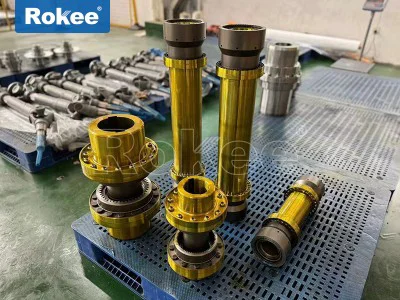
In addition to the above common types, there are also some special types of teeth couplings designed for specific working conditions. For example, serrated tooth couplings have serrated edges on the tooth surface, which can form a tighter connection between the coupling halves even under misalignment stress, preventing slippage and wear, and are suitable for high-torque applications such as turbines and crushers. Tapered tooth couplings have teeth that gradually increase in width from the base to the tip, which can improve the meshing effect under severe misalignment conditions and are suitable for heavy equipment and industrial machinery. Disengageable toothed couplings can be divided into non-automatically engaging and automatically engaging types, which are suitable for scenarios that need to be frequently engaged and disengaged during operation. These special types of teeth couplings expand the application range of teeth couplings, making them able to adapt to more complex and special industrial transmission requirements.
Due to their excellent performance characteristics, teeth couplings are widely used in various industrial fields, covering metallurgy, mining, petroleum, chemical industry, machinery manufacturing, power generation, marine engineering, transportation and other fields, and have become an important part of the mechanical transmission system. In the metallurgical industry, teeth couplings are widely used in rolling mills, blast furnaces, converters and other key equipment. Rolling mills need to transmit large torque during operation, and there is a certain degree of shaft misalignment due to thermal expansion and other factors. The drum-shaped tooth coupling, with its high torque transmission capacity and good displacement compensation capacity, can ensure the stable operation of the rolling mill, improve the production efficiency and product quality. For example, in hot rolling and cold rolling production lines, teeth couplings are used to connect the motor, reducer and rolling mill rolls, realizing the efficient transmission of power and the stable operation of the equipment.
In the mining industry, teeth couplings are widely applied in crushers, conveyors, hoists and other equipment. The mining environment is harsh, with large vibration, heavy load and large dust. Teeth couplings, with their high structural strength, good wear resistance and reliable working performance, can adapt to this harsh working environment. Crushers need to transmit large impact torque during operation, and the elastic pin toothed coupling and drum-shaped tooth coupling can absorb impact load and compensate for shaft misalignment, avoiding equipment damage caused by impact and misalignment. Conveyors, whether belt conveyors or scraper conveyors, need stable power transmission. Teeth couplings can ensure the continuous and stable operation of conveyors, improving the efficiency of ore transportation.
In the petroleum and chemical industry, teeth couplings are used in pumps, compressors, reactors and other equipment. These equipment often work in harsh environments such as high temperature, high pressure and corrosive media. The nylon internal gear coupling, with its good corrosion resistance and high temperature resistance, and the drum-shaped tooth coupling, with its reliable sealing performance and stable transmission performance, can adapt to the working requirements of these equipment. For example, in oil pipelines, centrifugal pumps need to transmit power stably for a long time. Teeth couplings can ensure the efficient operation of centrifugal pumps, avoiding leakage and other failures caused by unstable transmission. In chemical reactors, teeth couplings are used to connect the motor and the stirrer, realizing the uniform stirring of materials and ensuring the reaction effect.
In the power generation industry, teeth couplings are widely used in thermal power, hydropower, wind power and other power generation equipment. Thermal power units have large generators and turbines, which need to transmit large torque and operate at high speed. After precision dynamic balance treatment, teeth couplings can ensure stable power transmission at high speed, reduce vibration and noise, and improve the efficiency and safety of power generation units. Hydropower units have large shaft diameters and long transmission distances. The spacer-type teeth coupling can adapt to the connection requirements of long-distance shafts, and its good displacement compensation capacity can compensate for the shaft misalignment caused by water flow impact and other factors. In wind power generation equipment, teeth couplings are used to connect the wind turbine and the generator. Due to the instability of wind speed, there is a certain degree of impact load and shaft misalignment. Teeth couplings can absorb impact load and compensate for displacement, ensuring the stable operation of wind power generation equipment and improving power generation efficiency.
In the marine engineering field, teeth couplings are used in marine main engines, auxiliary engines, propellers and other equipment. Marine equipment needs to work in a high-humidity and corrosive environment, and has high requirements for the reliability and corrosion resistance of the coupling. The drum-shaped tooth coupling and nylon internal gear coupling, with their good corrosion resistance, high structural strength and reliable transmission performance, can adapt to the marine environment. For example, the marine main engine is connected to the propeller through a teeth coupling, which realizes the transmission of power and drives the ship to sail. The teeth coupling can compensate for the shaft misalignment caused by the deformation of the ship hull during navigation, ensuring the stable operation of the marine main engine.
In the machinery manufacturing industry, teeth couplings are used in various machine tools, reducers, motors and other equipment. Machine tools, especially precision machine tools, have high requirements for transmission accuracy and stability. Teeth couplings, with their high transmission efficiency and small transmission error, can ensure the precision of machine tool processing. Reducers are important power transmission components, and teeth couplings are used to connect the reducer with the motor and the working machine, realizing the adjustment of speed and torque. Motors of different specifications need to be connected with different working machines, and teeth couplings of different types and specifications can adapt to these connection requirements, ensuring the stable transmission of power.
In addition to the above fields, teeth couplings are also used in transportation, construction machinery, aerospace and other fields. In the transportation field, teeth couplings are used in automobile drivetrains, railway locomotives and other equipment, realizing the transmission of power and the adaptation to different working conditions. In the construction machinery field, teeth couplings are used in excavators, loaders, cranes and other equipment, withstanding large impact load and ensuring stable power transmission. In the aerospace field, high-precision teeth couplings are used in aircraft engines, spacecraft and other equipment, requiring extremely high transmission accuracy and reliability to ensure the safe operation of aerospace equipment.
In practical application, the selection of teeth couplings needs to be based on the actual working conditions, including torque transmission requirements, working speed, shaft misalignment, environmental temperature, corrosion conditions and other factors. For heavy-duty, high-speed and large shaft misalignment working conditions, drum-shaped tooth couplings should be preferred; for medium and small power, low maintenance cost and certain shock absorption requirements, nylon internal gear couplings or elastic pin toothed couplings can be selected; for working conditions with small shaft misalignment, low speed and light load, straight-tooth couplings can be selected. At the same time, attention should be paid to the matching between the teeth coupling and the connected shaft, including the matching of shaft diameter, keyway size and other parameters, to ensure the reliability of the connection. In addition, the installation, lubrication and maintenance of teeth couplings are also important links to ensure their long-term stable operation. During installation, the installation accuracy should be guaranteed to reduce shaft misalignment; during operation, appropriate lubricants should be selected according to the working conditions to ensure good lubrication of the gear meshing surface; regular inspection and maintenance should be carried out to find and solve potential faults in time, such as tooth surface wear, seal damage and fastener loosening.
With the continuous development of industrialization and the continuous improvement of mechanical equipment performance requirements, teeth couplings are also constantly developing and innovating. In terms of material selection, more high-strength, wear-resistant and corrosion-resistant materials are used to improve the performance and service life of the coupling; in terms of structural design, the tooth profile is optimized through finite element analysis and other technologies to improve the torque transmission capacity and displacement compensation capacity of the coupling; in terms of processing technology, precision machining, heat treatment and other technologies are adopted to improve the processing accuracy and surface quality of the coupling, reducing transmission error and wear. At the same time, with the development of intelligent manufacturing, the intelligent monitoring of teeth couplings is also gradually realized. Through the installation of sensors, the working state of the coupling, such as temperature, vibration and torque, is monitored in real time, which is conducive to timely finding potential faults and realizing predictive maintenance, improving the reliability and service life of the coupling, and reducing the maintenance cost and downtime of the equipment.
In conclusion, teeth couplings, as an important mechanical power transmission component, have the advantages of high torque transmission capacity, good displacement compensation capacity, high transmission efficiency, reliable operation and wide application range. Their unique structural design and performance characteristics make them play an irreplaceable role in various industrial fields. With the continuous progress of science and technology and the continuous improvement of industrial requirements, the structure and performance of teeth couplings will be further optimized and improved, and their application range will be further expanded, making greater contributions to the development of the industrial field. The in-depth understanding of the structure, performance, types and applications of teeth couplings is of great significance for the rational selection, use and maintenance of teeth couplings, improving the reliability and efficiency of mechanical equipment, and reducing production costs.