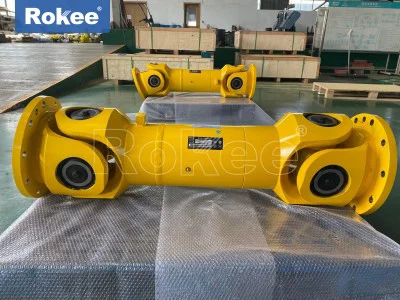
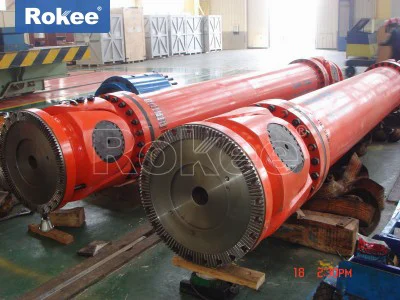
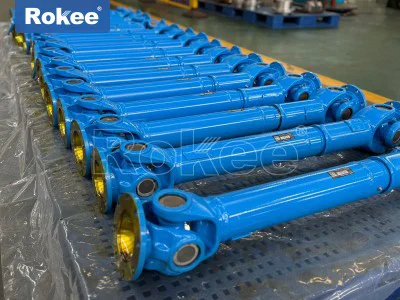
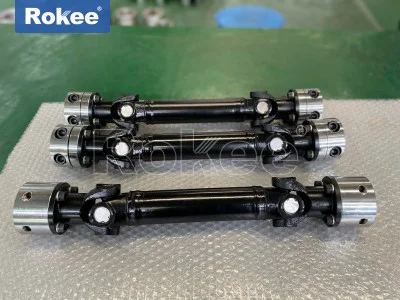
Ball Cage Cardan Drive Shaft

The ball cage cardan drive shaft is a sophisticated constant-velocity transmission component widely adopted in modern mechanical and power transmission systems, distinguished from traditional cross-type cardan shafts by its innovative ball-and-cage structural design. This mechanical device is engineered to deliver stable, uniform torque and rotational speed transmission while accommodating significant angular misalignment between driving and driven shafts, effectively resolving the speed fluctuation and vibration issues that plague conventional universal transmission structures. Composed of precision-machined inner race, outer spherical race, retaining cage, and high-strength steel balls, the drive shaft relies on the pure rolling motion of steel balls in curved raceways to realize power transfer. It integrates the advantages of large deflection adaptability, low operational noise, and high-speed operation stability, making it applicable to diverse scenarios ranging from automotive power systems to precision industrial machinery. As a core upgraded transmission component, it optimizes mechanical transmission efficiency and durability, laying a solid foundation for the stable operation of high-precision and high-speed mechanical equipment.
The structural composition of the ball cage cardan drive shaft is highly refined and synergistic, with each core component undertaking an exclusive functional role to support efficient constant-velocity transmission. The inner race features a star-shaped contour with precisely polished curved raceways that match the radian of steel balls, serving as the core torque input carrier and fixing the inner end of the transmission steel balls. The outer spherical race forms a closed protective and guiding structure, with corresponding arc grooves on the inner wall that cooperate with the inner race to limit the movement track of steel balls. The hollowed-out retaining cage acts as a key positioning component, evenly spacing multiple steel balls in the optimal transmission plane and preventing offset, stacking or eccentric movement during high-speed rotation. The high-precision chrome steel balls are the direct force-transmitting medium, achieving friction-reducing rolling contact between the inner and outer races. All components undergo strict precision machining and surface treatment to ensure microscopic fit clearance uniformity, which eliminates jitter and stagnation during power transmission. This integrated structural layout not only simplifies the power transmission path but also enhances the overall structural compactness, allowing the drive shaft to adapt to narrow installation spaces while maintaining excellent transmission performance.
The working principle of the ball cage cardan drive shaft centers on geometric constant-velocity transmission and pure rolling mechanical motion, enabling consistent rotational speed output under variable angular deflection conditions. When the driving shaft rotates, torque is transmitted to the inner race, which drives the embedded steel balls to roll along the matched raceways of the outer race. The retaining cage always keeps all steel balls positioned on the angular bisector plane between the input and output shafts, a core geometric principle that ensures the instantaneous angular velocity of the two shafts remains identical at any deflection angle. Unlike traditional cardan shafts that produce periodic speed changes and mechanical impact under angular misalignment, the ball cage structure eliminates intermittent sliding friction through pure rolling motion. As the deflection angle between shafts changes during equipment operation, the steel balls can freely adjust their rolling position along the curved raceways, automatically adapting to spatial angle changes without interrupting power transmission. This adaptive rolling adjustment mechanism ensures continuous, smooth and uniform torque output, fundamentally reducing transmission vibration and rotational speed deviation, and realizing true constant-velocity power transmission in dynamic working environments.
The ball cage cardan drive shaft boasts prominent performance advantages over conventional universal drive shafts, making it a superior choice for high-standard transmission scenarios. Its most notable merit is stable constant-velocity transmission under large angular misalignment, with an adaptable deflection range far exceeding traditional structures, allowing flexible layout of mechanical power systems without sacrificing transmission accuracy. The pure rolling friction mode of steel balls drastically reduces mechanical friction resistance and wear loss compared to the sliding friction of cross shaft structures, effectively extending the service life of transmission components and lowering long-term operational wear and tear. In terms of high-speed performance, the balanced structural design and uniform force distribution enable the drive shaft to operate stably at ultra-high rotational speeds, with no obvious vibration or noise resonance. Additionally, the integrated compact structure reduces overall mechanical volume and weight, optimizing the dynamic balance of the transmission system. It also exhibits excellent torsional rigidity and impact resistance, capable of withstanding instantaneous torque fluctuations and variable load impacts during equipment startup, shutdown and operation, ensuring long-term reliable operation of the transmission system under complex working conditions.
The application scenarios of the ball cage cardan drive shaft cover multiple high-precision and high-demand mechanical fields, relying on its excellent comprehensive transmission performance. In automotive power transmission systems, it serves as a key component of chassis drive systems, adapting to the angle changes of suspension travel and steering movement to ensure stable power output during vehicle acceleration, deceleration and driving on complex road surfaces, improving driving smoothness and handling stability. In precision industrial machinery such as numerical control machine tools and automated production equipment, it provides high-precision constant-velocity transmission, avoiding processing errors caused by transmission speed fluctuation and ensuring the dimensional accuracy and surface quality of processed workpieces. In engineering machinery and mobile power equipment, it adapts to harsh working environments with frequent load changes and large structural deflection, maintaining efficient power transmission under complex motion states. Furthermore, it is widely applied in aerospace auxiliary transmission systems, intelligent logistics handling equipment and high-speed rotating mechanical systems, gradually replacing traditional drive shaft structures in high-end mechanical manufacturing fields due to its superior stability and precision.
Material selection and precision manufacturing processes are critical determinants of the service performance and durability of ball cage cardan drive shafts. Core components including inner and outer races, retaining cages and steel balls are mostly made of high-strength alloy steel with excellent hardness, toughness and wear resistance, which can resist long-term rolling friction, torsional load and mechanical fatigue. After integral forging and fine turning, key components undergo high-precision grinding and surface strengthening treatment to improve surface smoothness and hardness, reducing contact friction and preventing surface abrasion and deformation during long-term operation. The steel balls are screened with strict dimensional consistency to ensure uniform stress on each ball during transmission and avoid local overload failure. The assembly process adopts micro-gap precision matching technology to control the fit clearance between components within a reasonable range, preventing transmission jitter caused by excessive clearance or component jamming caused by insufficient clearance. Advanced dynamic balance calibration technology is also applied in production to eliminate rotational unbalance, ensuring zero-vibration stable operation of the drive shaft at high speeds and laying a process foundation for its high-precision and long-life performance.
Daily maintenance and fault prevention of ball cage cardan drive shafts are essential to maintain long-term stable transmission performance and extend service life. Regular lubrication maintenance is the core of daily upkeep, as high-quality lubricating grease can form a uniform protective film on the rolling contact surface of steel balls and raceways, reducing friction wear, isolating dust and moisture, and preventing component oxidation and corrosion. It is necessary to regularly check the sealing performance of the drive shaft structure to avoid lubricant leakage and foreign particle intrusion, which may cause abrasive wear and transmission jitter. During equipment operation, abnormal vibration, noise or power transmission lag should be monitored in real time, which usually indicates excessive component wear, loose assembly or lubrication failure. Regular disassembly and inspection of internal component wear degree and structural deformation can effectively eliminate potential faults in advance. Avoiding long-term overload operation and excessive angular deflection beyond the adaptive range can prevent permanent structural damage such as raceway deformation and steel ball fatigue failure. Scientific and standardized maintenance can maximize the transmission efficiency and service life of the ball cage cardan drive shaft, ensuring the continuous and stable operation of the entire mechanical transmission system.
With the continuous upgrading of modern mechanical manufacturing technology, the optimization and development of ball cage cardan drive shafts are moving towards higher precision, stronger adaptability and longer service life. Current optimization directions mainly include structural lightweight improvement, adopting optimized hollow structures and high-performance composite alloy materials to reduce self-weight while ensuring structural rigidity, improving the dynamic response speed of the transmission system. Structural bionic and geometric optimization design further optimize the raceway curve contour, enhancing the adaptive capacity of angular deflection and load impact resistance. In terms of manufacturing technology, intelligent precision processing and automated assembly technology further improve component matching accuracy and product consistency, reducing performance differences between individual products. Meanwhile, the application of new surface modification technologies effectively improves the wear resistance, corrosion resistance and high-temperature resistance of components, enabling the drive shaft to adapt to more extreme working environments such as high temperature, high humidity and heavy dust. In the future, with the development of intelligent mechanical equipment and high-end manufacturing industry, ball cage cardan drive shafts will achieve broader application prospects and continuous performance iteration.