Cardan Shaft Matched With PU Sandwich Panel Machine For Multiple Working Conditions

In the field of modern industrial manufacturing, the continuous innovation of mechanical equipment has promoted the efficiency and quality of production, and the coordinated operation between key components has become the core factor to ensure stable production under multiple working conditions. The PU sandwich panel machine, as an important equipment for producing composite building materials, is widely used in industrial workshops, warehouses, cold storage and other fields due to its ability to produce panels with excellent thermal insulation, sound insulation and structural strength. However, the complex working environment and diverse production requirements put forward high requirements for the transmission system of the equipment. The cardan shaft, as a key transmission component with strong adaptability and reliable performance, has become an indispensable matching part of the PU sandwich panel machine, which effectively solves the problems of power transmission under non-coaxial conditions, angle deviation and variable load, ensuring the stable and efficient operation of the equipment under various working conditions.
To understand the close matching relationship between the cardan shaft and the PU sandwich panel machine, it is first necessary to clarify the working characteristics of the two and the core demands of their cooperative operation. The PU sandwich panel machine is a continuous automatic production equipment that integrates mechanical, electrical control, hydraulic system and chemical reaction technology, and its production process involves multiple links such as uncoiling, roll forming, preheating, foaming, laminating, cooling and cutting. Each link has different power requirements and working conditions: the uncoiling and roll forming links need stable low-speed and high-torque transmission to ensure the smooth feeding and shaping of metal sheets; the foaming and laminating links require uniform speed transmission to ensure the uniform distribution of PU foam and the tight bonding between the core material and the surface layer; while in the cutting link, the transmission system needs to have certain flexibility to adapt to the slight position adjustment during the cutting process without affecting the overall production rhythm. In addition, the PU sandwich panel machine may face changes in production specifications, such as adjusting the width and thickness of the panel, which requires the transmission system to have good adjustability and adaptability. At the same time, the working environment of the equipment may vary, including temperature changes, dust interference and slight vibration of the production site, which puts forward higher requirements for the stability and durability of the transmission components.
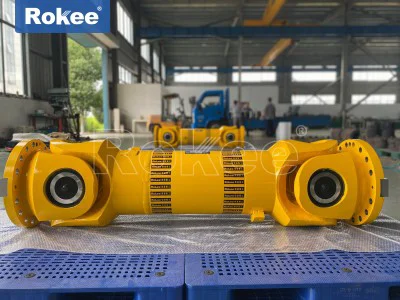
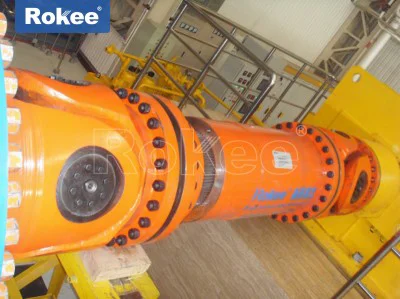
The cardan shaft, also known as the universal joint shaft, is a mechanical component designed to connect two non-coaxial shafts and transmit rotational motion and torque. Its core advantage lies in its ability to compensate for angular deviation, axial displacement and radial displacement between the driving shaft and the driven shaft, ensuring continuous and stable power transmission even when the two shafts are not perfectly aligned. This characteristic is particularly important for the PU sandwich panel machine, because due to the structural layout of the equipment, the driving shafts of each functional unit (such as uncoiler, roll forming machine, foaming system and cutting machine) cannot be completely coaxial, and there will be a certain angle deviation and position change during operation. For example, the roll forming system of the PU sandwich panel machine needs to adjust the position of the roller according to the different thickness of the panel, which will lead to the change of the angle between the driving shaft and the driven shaft; the foaming system may produce slight vibration during operation, resulting in the axial displacement of the transmission shaft. If a rigid coupling is used, it will not only fail to transmit power smoothly, but also cause excessive wear of the shaft and bearing, and even lead to equipment failure in serious cases. The cardan shaft solves this problem well through its unique articulated structure, which can flexibly adapt to the position and angle changes between the shafts, ensuring the stable operation of each functional unit of the PU sandwich panel machine.
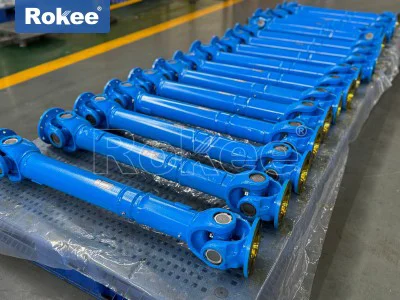
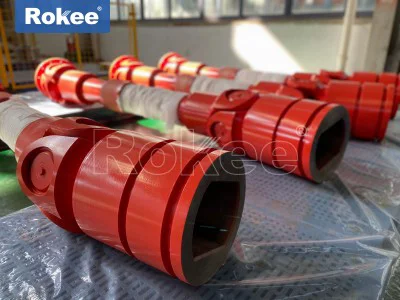
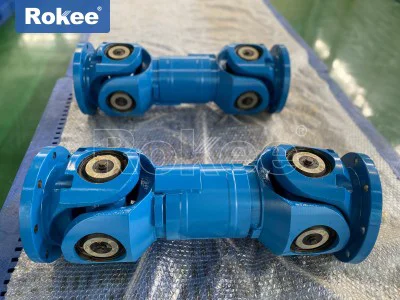
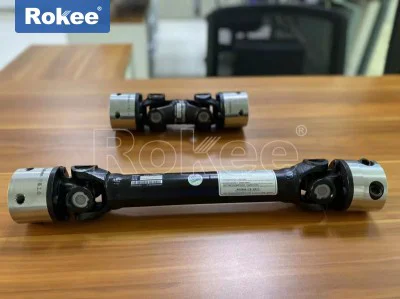
The matching between the cardan shaft and the PU sandwich panel machine is not a simple assembly, but needs to be optimized according to the specific working conditions and production requirements to achieve the best transmission effect. In terms of structural design, the cardan shaft used in the PU sandwich panel machine is usually designed as a cross shaft type or a ball cage type, which is selected according to the different working links of the equipment. The cross shaft type cardan shaft has the characteristics of large torque transmission capacity, compact structure and convenient maintenance, which is suitable for the uncoiling and roll forming links of the PU sandwich panel machine that require low-speed and high-torque transmission. Its structure is composed of two fork-shaped joints and a cross shaft, and the bearings installed at the four ends of the cross shaft can ensure the flexible rotation of the joint, allowing the two shafts to deflect within an angle range of 5° to 45° while maintaining the continuity of motion. The ball cage type cardan shaft has the advantages of smooth transmission and high speed, which is suitable for the foaming and cutting links that require high-speed and stable transmission. Its spherical shell contains steel balls and a cage, which transmits torque through the ball path, effectively reducing the speed fluctuation during transmission and ensuring the uniformity of the panel production process.
In addition to the selection of structural types, the size and material of the cardan shaft also need to be strictly matched with the PU sandwich panel machine. The torque capacity of the cardan shaft must be consistent with the power output of the equipment's driving motor to avoid insufficient torque leading to transmission failure or excessive torque causing waste of resources. For example, the roll forming link of the PU sandwich panel machine needs to bear a large load when shaping the metal sheet, so the cardan shaft used here needs to be made of high-strength materials such as alloy steel, through heat treatment and other processes to improve its bearing capacity and wear resistance. The length of the cardan shaft should be determined according to the distance between the driving shaft and the driven shaft of the equipment, and the spline connection is usually adopted to compensate for the axial displacement, ensuring that the cardan shaft can still transmit power stably when the equipment is adjusted or vibrated. At the same time, the surface of the cardan shaft is usually treated with anti-corrosion and anti-wear processes, such as galvanizing or spraying, to adapt to the harsh working environment of the PU sandwich panel machine, such as dust and temperature changes, and extend the service life of the component.
The matching of the cardan shaft and the PU sandwich panel machine is more reflected in the adaptability to multiple working conditions, which is also the key to ensuring the stable operation of the equipment in different production scenarios. One of the common working conditions is the change of production specifications. When the PU sandwich panel machine needs to produce panels of different widths and thicknesses, the position and working parameters of each functional unit will be adjusted accordingly, which will lead to changes in the angle and position between the driving shaft and the driven shaft. The cardan shaft can automatically adapt to these changes through its own angle and displacement compensation capacity, without the need for manual adjustment of the transmission system, which greatly improves the flexibility and efficiency of production. For example, when adjusting the width of the panel, the roll forming machine needs to move horizontally, which will cause the angle between the driving shaft of the motor and the driven shaft of the roll to change. The cardan shaft can flexibly adjust the angle between the two shafts to ensure that the power is transmitted smoothly, so that the roll forming process can be carried out normally, and the consistency of the panel size is guaranteed.
Another common working condition is the fluctuation of load during production. In the production process of PU sandwich panels, the load of the equipment will change due to factors such as the uneven thickness of the metal sheet, the unstable viscosity of the PU foam and the change of the cutting speed. If the transmission system cannot adapt to these load fluctuations, it will lead to unstable operation of the equipment, affecting the quality of the panel. The cardan shaft has good load adaptability. Its flexible structure can absorb the impact load generated by load fluctuation, reduce the vibration of the transmission system, and protect the motor, bearing and other components from damage. For example, when the thickness of the metal sheet is uneven, the roll forming machine will bear additional load, which will be transmitted to the cardan shaft. The cardan shaft can buffer the impact through the rotation of the cross shaft and the bearing, avoid the sudden increase of torque, and ensure that the power transmission is still stable, so that the shaping effect of the panel is not affected.
The harsh working environment is also a key challenge for the matching of the cardan shaft and the PU sandwich panel machine. In many production workshops, there will be a lot of dust and debris, which may enter the internal structure of the cardan shaft, causing wear of the cross shaft and bearing, and affecting the transmission performance. In addition, the temperature of the production site may vary greatly, especially in the foaming link of the PU sandwich panel machine, the surrounding temperature will be relatively high, which will affect the performance of the lubricating oil of the cardan shaft and reduce the service life of the component. To solve this problem, the cardan shaft matched with the PU sandwich panel machine is usually equipped with a good sealing device, which can effectively prevent dust and debris from entering the internal structure, ensure the clean operation of the cross shaft and bearing. At the same time, the lubricating system of the cardan shaft is optimized. High-temperature resistant lubricating oil is used to ensure that the cardan shaft can still maintain good lubrication performance under high temperature conditions, reduce friction and wear, and extend the service life. In addition, the cardan shaft is made of materials with good high-temperature resistance and corrosion resistance, which can adapt to the temperature change of the production site and ensure stable transmission under harsh environment.
The stable operation of the cardan shaft is crucial to the production efficiency of the PU sandwich panel machine, so the daily maintenance and inspection of the cardan shaft is an important part of ensuring the matching effect. Regular maintenance can not only extend the service life of the cardan shaft, but also avoid equipment failure caused by the damage of the cardan shaft, ensuring the continuity of production. The maintenance of the cardan shaft mainly includes lubrication, inspection and cleaning. In terms of lubrication, the cross shaft bearing of the cardan shaft should be lubricated regularly according to the working conditions of the equipment. Generally, when the equipment is in continuous production, the cross shaft bearing should be lubricated once every two months, and the spline shaft should be lubricated once every three months. When refueling, new oil should be squeezed from the T-shaped oil seal until the new lubricating oil overflows from all lubrication points, ensuring that all parts are fully lubricated. At the same time, it is necessary to regularly check the color and state of the lubricating oil. If the lubricating oil turns black or contains metal chips, it indicates that there is internal wear, and the cardan shaft should be disassembled, inspected and cleaned in time, and the lubricating oil should be replaced, and the damaged parts should be replaced if necessary.
In terms of inspection, the cardan shaft should be regularly checked during the operation of the equipment. The inspection content mainly includes whether there is abnormal noise during the operation of the cardan shaft, whether there is axial movement of the cross shaft package, whether the radial runout is normal, and whether the connecting bolts are loose. These inspections should be carried out at a distance from the side to avoid safety accidents. If abnormal phenomena are found, the equipment should be stopped in time to find out the cause and take repair measures. In addition, the cardan shaft should be overhauled once every six months. The overhaul items include checking the wear of the cross shaft pin journal, bearing outer ring and short cylindrical roller, measuring the radial clearance, observing whether there are indentations, pitting, peeling, cracking and other phenomena on the contact surface; checking whether the spline shaft slides flexibly. If the spline teeth are worn, the fit clearance is too large or there is torsion deformation, the spline shaft should be replaced or repaired. In terms of cleaning, the cardan shaft should be cleaned regularly, but high-pressure cleaners or steam jets should not be used to avoid damaging the sealing device and the surface of the cardan shaft. If such cleaning is unavoidable, the cardan shaft should be lubricated again after cleaning until fresh grease overflows from the bearing seal.
The matching of the cardan shaft and the PU sandwich panel machine not only improves the stability and efficiency of the equipment, but also reduces the maintenance cost and extends the service life of the equipment. In practical application, according to the specific working conditions and production requirements of the PU sandwich panel machine, selecting the appropriate type, size and material of the cardan shaft, and doing a good job in daily maintenance and inspection can maximize the matching effect between the two, ensure the stable operation of the equipment under multiple working conditions, and improve the quality and output of PU sandwich panels. With the continuous development of the PU sandwich panel industry, the requirements for equipment performance are getting higher and higher, which also promotes the continuous optimization of the cardan shaft. In the future, the cardan shaft matched with the PU sandwich panel machine will be more intelligent and efficient, with better adaptability and durability, which will provide more reliable support for the development of the PU sandwich panel industry.
In the process of matching the cardan shaft with the PU sandwich panel machine, it is also necessary to pay attention to the installation accuracy to ensure the normal operation of the transmission system. When installing the cardan shaft, the two fork ears at both ends should be kept in the same plane to ensure the correct "phase" of the universal joint. For multi-section cardan shafts, the working angles of adjacent universal joints should be as close as possible and in opposite directions to reduce secondary vibration. At the same time, the connection between the cardan shaft and the driving shaft and the driven shaft should be firm, and the connecting bolts should be tightened regularly to avoid loosening during operation, which will affect the transmission effect. In addition, the installation position of the cardan shaft should be avoided from being affected by the vibration of other components of the equipment, and appropriate shock absorption measures can be taken if necessary to further improve the stability of the transmission system.
Another important aspect of the matching between the cardan shaft and the PU sandwich panel machine is the adaptability to the speed change. The PU sandwich panel machine needs to adjust the speed according to different production links and production specifications. For example, the uncoiling speed needs to be matched with the roll forming speed, and the foaming speed needs to be coordinated with the cooling speed. The cardan shaft can adapt to the speed change of the equipment well, and can maintain stable power transmission under different speed conditions. The ball cage type cardan shaft is particularly outstanding in this regard. Its smooth transmission performance can effectively reduce the speed fluctuation during the speed change process, avoid the impact on the equipment and the product quality, and ensure the stability of the production process.
In summary, the cardan shaft, as a key transmission component, has an irreplaceable role in the operation of the PU sandwich panel machine. Its unique angle and displacement compensation capacity, stable transmission performance and good adaptability to multiple working conditions make it an ideal matching part of the PU sandwich panel machine. Through reasonable selection, correct installation and regular maintenance, the cardan shaft can effectively solve the problems of power transmission under non-coaxial conditions, load fluctuation and harsh environment in the production process of the PU sandwich panel machine, ensure the stable and efficient operation of the equipment, and promote the sustainable development of the PU sandwich panel industry. With the continuous progress of mechanical manufacturing technology, the matching technology between the cardan shaft and the PU sandwich panel machine will be further optimized, bringing more significant economic and social benefits to the production of PU sandwich panels.