Universal Joint Coupling For Crusher

Universal joint couplings serve as indispensable transmission components for crusher equipment, undertaking the core task of stable torque and power transmission in harsh crushing working environments. As a key connecting part between the driving device and the crushing execution structure, this coupling effectively solves the transmission problems caused by shaft misalignment, vibration displacement and angular deviation during crusher operation. Different from ordinary coupling products, it is specially optimized to adapt to the high-load, high-vibration and impact-prone working conditions of mining and aggregate crushing industries. It can maintain continuous and efficient power transmission even when the input shaft and output shaft produce regular deflection and position changes due to material impact and mechanical operation. By buffering instantaneous impact force and compensating for shaft system displacement errors, it reduces transmission wear, improves the overall operation stability of the crusher, and extends the service life of the entire transmission system, becoming a reliable guarantee for the long-term and efficient operation of crushing equipment.
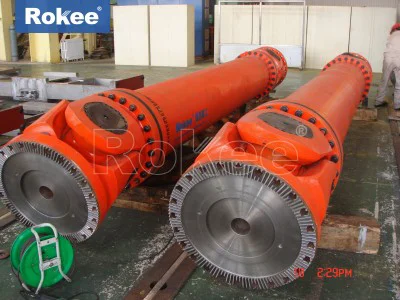
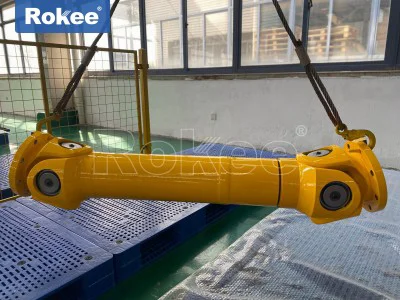
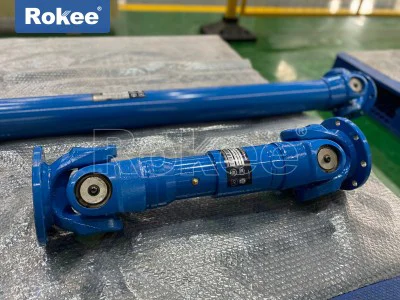
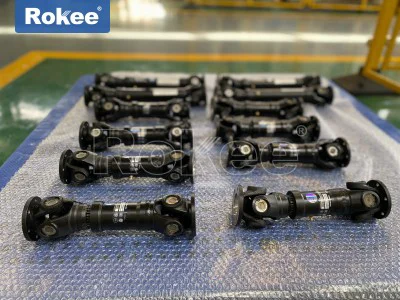
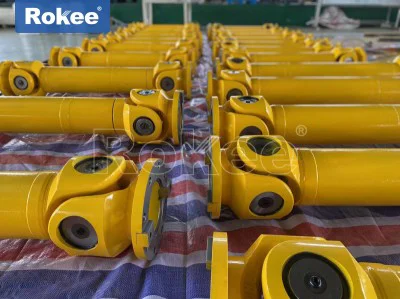
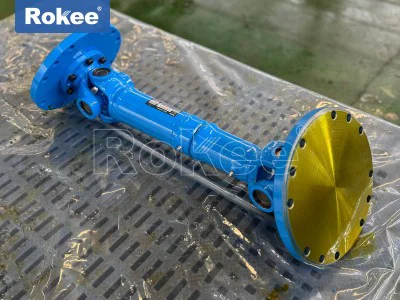
The structural design of universal joint couplings for crushers is scientifically tailored to the extreme working characteristics of crushing equipment, forming a robust and flexible mechanical transmission structure. The core structure mainly consists of two symmetrical fork-shaped yokes, a central cross spider and four precision needle roller bearings, which together build a spatial hinge transmission mechanism suitable for heavy-duty operation. The two fork-shaped yokes are respectively fixed to the driving shaft and driven shaft of the crusher, while the cross spider is installed between the two yokes through bearings to realize flexible movable connection. This unique structural combination breaks through the limitation of rigid shaft connection, allowing the two connected shafts to produce a certain range of angular deflection, axial displacement and radial deviation during operation. The needle roller bearings at the four ends of the cross spider can reduce friction resistance during rotational movement, ensuring flexible synchronous rotation of the yokes on both sides. All structural components adopt high-strength wear-resistant materials, which can resist long-term mechanical friction, impact extrusion and metal fatigue caused by frequent start-stop operation of the crusher, avoiding structural deformation and damage under high-load working conditions.
The working principle of crusher-specific universal joint couplings is based on spatial linkage kinematics, realizing stable power transmission under dynamic misalignment conditions. When the crusher starts to operate, the driving shaft drives the connected active yoke to perform fixed-axis rotational motion, and the rotational torque is transmitted to the cross spider through the bearing structure. Driven by the active yoke, the cross spider generates composite spatial motion combining rotation and swing, and then transmits the torque to the driven yoke and the connected driven shaft. This motion conversion mechanism effectively offsets the angular deviation between the driving and driven shafts caused by crusher vibration, material impact and installation errors. Although a single-section universal joint has the characteristic of instantaneous non-uniform speed transmission, the structural matching design for crushers optimizes the speed fluctuation range, ensuring that the overall transmission speed remains stable during continuous operation. For working conditions with large deflection angles, the combined structural form can balance the speed difference, realize consistent input and output angular velocity, and avoid transmission jitter and power loss caused by uneven rotation.
Universal joint couplings show unique environmental adaptability in the complex and harsh working scenarios of crusher operation. Crushing equipment usually works in open-air mining sites, stone processing yards and other environments, facing multiple adverse factors such as heavy dust, humid air, frequent mechanical impact and long-term high-load operation. ordinary transmission couplings are prone to jamming, wear and failure in such environments, while crusher-dedicated universal joint couplings are optimized for environmental resistance. The compact internal structural design reduces the accumulation of dust and debris, and the matching bearing protection structure prevents particulate impurities from entering the friction pair, effectively avoiding bearing abrasion and transmission failure. Meanwhile, the structural flexibility of the coupling can well adapt to the regular vibration and displacement of the crusher during material crushing. When the crusher strikes hard materials such as ore and stone, the instantaneous impact force will cause the shaft system to deflect instantly, and the universal joint can absorb and buffer the impact energy through its flexible hinge movement, protecting the motor, reducer and other core transmission components from impact damage.
The performance advantages of universal couplings make them the preferred transmission component for various types of crusher equipment. First of all, they have excellent misalignment compensation capability, which can simultaneously compensate for angular, axial and radial misalignment of the shaft system, solving the transmission instability problem caused by installation deviation and mechanical deformation of crushers after long-term operation. Secondly, the product has super high load-bearing capacity, which can withstand the large torque output required by heavy-duty crushing operations and maintain stable power transmission without slipping or torque attenuation. In addition, the flexible transmission characteristics of the coupling can effectively reduce mechanical vibration and noise during crusher operation, optimize the overall operating state of the equipment, and reduce the resonance damage of the transmission system. Compared with rigid couplings, it has stronger impact resistance and fatigue resistance, and can adapt to the frequent start-stop and intermittent impact working mode of crushers. Its simple and compact structural form also brings outstanding space adaptability, which can be flexibly installed in various compact crusher transmission structures without occupying extra equipment space.
Scientific daily maintenance and regular inspection are crucial to prolonging the service life of universal joint couplings for crushers and ensuring stable equipment operation. In the daily operation process, the most important maintenance work is to keep the internal bearing and hinge structure well lubricated. Long-term high-speed operation and heavy load friction will consume lubricating grease, and insufficient lubrication will lead to increased bearing wear, increased operating temperature and even jamming failure. It is necessary to regularly supplement and replace special lubricating grease suitable for heavy-duty mechanical operation to ensure full lubrication of all friction parts. At the same time, regular visual inspection and disassembly inspection should be carried out to check whether there are wear marks, deformation and looseness on the cross spider, yoke and bearings. For crushers operating in high-dust environments, regular cleaning of the coupling surface and internal residual debris is required to prevent impurities from affecting the flexible movement of the hinge structure. In addition, the operating state of the coupling should be monitored during equipment operation. Once abnormal vibration, noise or transmission lag is found, the equipment should be shut down for inspection in time to avoid small faults evolving into large-scale equipment failures.
The correct selection of universal joint couplings directly affects the operating efficiency and service life of crusher equipment, and the selection needs to be comprehensively judged based on actual working conditions. First of all, the matching torque level should be determined according to the model, processing capacity and actual load of the crusher. Heavy-duty crushers with large processing volume need couplings with higher torque bearing capacity to avoid overload damage. Secondly, the maximum deflection angle of the coupling should match the operating vibration amplitude of the crusher. According to the dynamic displacement range of the shaft system during material crushing, a coupling with a suitable deflection range should be selected to ensure sufficient misalignment compensation space. In addition, the structural form of the coupling needs to be matched with the installation space and transmission form of the crusher. Single-section universal joints are suitable for working conditions with small angular deviation, while double-section combined structures are more suitable for scenarios with large shaft deflection and high stability requirements. It is also necessary to consider the environmental adaptability of the product, and select couplings with enhanced wear resistance and dust resistance for long-term outdoor and high-dust crushing sites.
With the continuous upgrading of crushing equipment towards high efficiency, intelligence and large scale, the technical optimization and application prospects of universal joint couplings for crushers are becoming increasingly broad. Modern crushing equipment puts forward higher requirements for transmission stability, energy-saving performance and durability of components, which promotes the continuous iterative upgrading of universal joint coupling technology. New high-strength alloy materials and precision processing technologies are applied to coupling production, further improving the structural strength, wear resistance and fatigue resistance of products, enabling them to adapt to more severe heavy-duty crushing working conditions. At the same time, the optimized structural design further reduces transmission friction and power loss, improving the overall energy utilization efficiency of crusher equipment. In the future, with the continuous development of the mining and construction aggregate industry, the market demand for high-performance crusher supporting transmission components will continue to grow, and universal joint couplings will continue to play an irreplaceable core role in the field of crushing equipment transmission with their excellent comprehensive performance.