Anti-interference Of Cardan Coupling Adapting To The Working Conditions Of Sandwich Panel Line
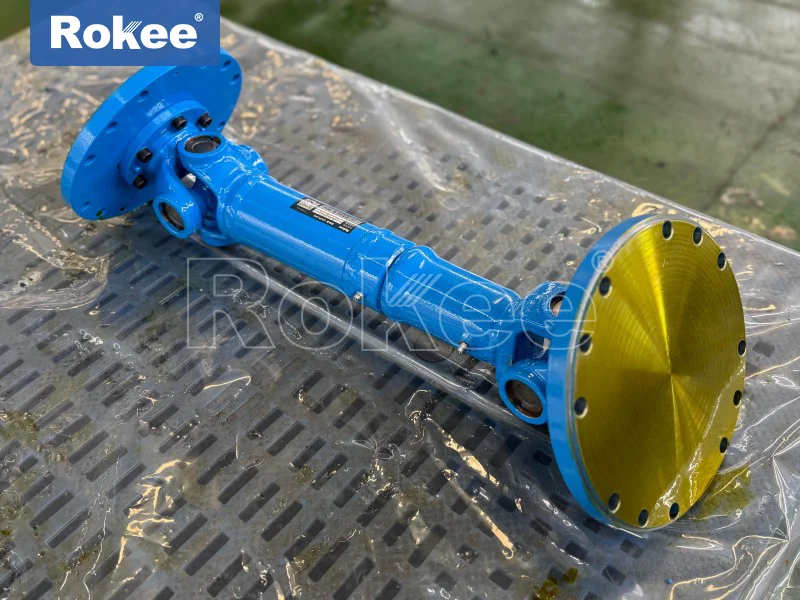
In the modern construction industry, sandwich panel lines play an increasingly pivotal role, serving as core equipment for the efficient production of essential building components. These production lines are engineered to meet the rigorous demands of industrial manufacturing, integrating multiple processes such as material feeding, pressing, cutting, and conveying to achieve continuous and high-precision production. As the key mechanical transmission component in sandwich panel lines, the cardan coupling undertakes the critical task of transmitting torque and rotational motion between non-coaxial shafts, ensuring the coordinated operation of various equipment units in the production line. However, the working environment of sandwich panel lines is complex and harsh, characterized by continuous mechanical vibration, variable load impacts, dust pollution, and temperature fluctuations, all of which pose severe challenges to the anti-interference performance of cardan couplings. Once the anti-interference capability of the cardan coupling is insufficient, it will lead to transmission instability, increased wear of components, reduced equipment operational efficiency, and even unexpected shutdowns, seriously affecting the normal progress of the production process and the quality of sandwich panel products. Therefore, in-depth research on the anti-interference performance of cardan couplings adapting to the working conditions of sandwich panel lines is of great practical significance for improving the reliability and stability of the production line, reducing maintenance costs, and ensuring the smooth operation of industrial production.
The working conditions of sandwich panel lines are inherently complex, and the interference factors affecting the operation of cardan couplings are diverse and interrelated, mainly manifesting in mechanical vibration interference, load fluctuation interference, environmental pollution interference, and temperature variation interference. Mechanical vibration is one of the most prominent interference factors in sandwich panel lines. During the production process, the operation of motors, hydraulic systems, pressing rollers, and conveying mechanisms will generate continuous vibration, which is transmitted to the cardan coupling through the connecting shafts and equipment frames. These vibrations not only cause the cardan coupling to produce forced vibration, leading to misalignment between the cross shaft and the fork head, but also exacerbate the friction and wear between the needle bearings and the trunnions, reducing the transmission accuracy and service life of the coupling. In addition, the resonance phenomenon caused by the consistency between the vibration frequency of the production line equipment and the natural frequency of the cardan coupling will further amplify the vibration amplitude, resulting in severe damage to the coupling components and even affecting the overall stability of the production line. Load fluctuation is another important interference factor. In the process of sandwich panel production, the thickness, density, and material of the panel will change according to the production requirements, which will lead to the periodic or sudden change of the load on the conveying mechanism and the pressing mechanism. The sudden change of the load will cause the torque transmitted by the cardan coupling to fluctuate sharply, resulting in impact loads on the cross shaft, fork head, and other components. These impact loads will not only cause elastic deformation of the coupling components but also lead to the loosening of the connection parts, thereby affecting the transmission stability of the coupling and generating additional vibration and noise.
Environmental pollution in sandwich panel lines also poses a serious threat to the anti-interference performance of cardan couplings. During the production process, a large amount of dust, metal debris, and adhesive residues will be generated, which are easy to enter the internal structure of the cardan coupling, such as the gap between the needle bearings and the trunnions, and the spline connection part. The accumulation of these pollutants will increase the friction resistance between the moving components, leading to unsmooth rotation of the coupling, increased energy consumption, and accelerated wear of the components. In severe cases, the pollutants will cause jamming of the coupling, making it impossible to transmit torque normally, thus causing the production line to shut down. Temperature variation is another non-negligible interference factor. The working environment of sandwich panel lines often has large temperature fluctuations, especially in the curing and drying processes of the panels, where the local temperature can reach a relatively high level. The change of temperature will cause thermal expansion and contraction of the cardan coupling components, leading to changes in the fit clearance between the components. If the fit clearance is too small due to thermal expansion, it will cause interference between the components, affecting the rotation flexibility of the coupling; if the fit clearance is too large due to thermal contraction, it will lead to increased vibration and reduced transmission accuracy. In addition, long-term high-temperature environment will accelerate the aging of the lubricating oil in the coupling, reduce the lubrication effect, and further exacerbate the wear of the components.
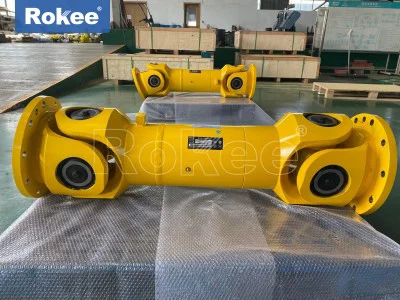
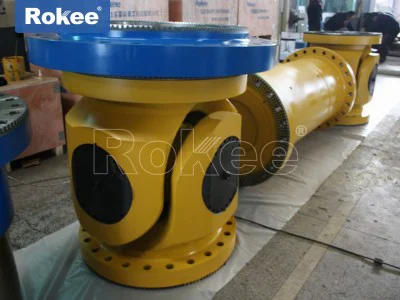
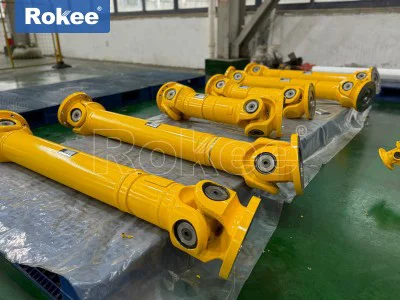
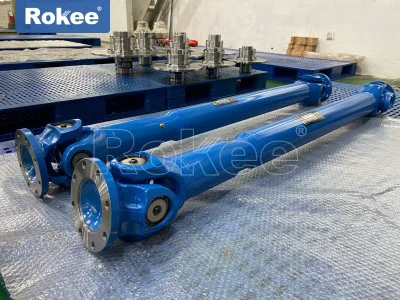
To improve the anti-interference performance of cardan couplings adapting to the working conditions of sandwich panel lines, it is necessary to start from the design, material selection, manufacturing process, and maintenance and management, and adopt a comprehensive optimization strategy to effectively resist various interference factors. In terms of structural design, the rational design of the cardan coupling structure is the foundation to improve its anti-interference performance. The traditional single cardan coupling is prone to speed fluctuation during transmission, which will amplify the vibration interference in the production line. Therefore, for sandwich panel lines with high requirements for transmission stability, double cardan couplings can be adopted. The double cardan coupling consists of two universal joints mounted back to back with a centre yoke, and when the angle between the input shaft and the centre yoke is equal to the angle between the centre yoke and the output shaft, the second cardan joint can cancel the velocity errors introduced by the first cardan joint, achieving constant velocity transmission and effectively reducing the vibration caused by speed fluctuation. In addition, the structural parameters of the cardan coupling should be optimized according to the working parameters of the sandwich panel line, such as the transmission torque, rotation speed, and shaft misalignment angle. For example, the length and diameter ratio of the coupling should be adjusted to change its natural frequency, avoiding resonance with the vibration frequency of the production line equipment. At the same time, the design of the fork head and cross shaft should be strengthened to improve their rigidity and impact resistance, so as to resist the interference of load fluctuations. The spline connection part of the cardan coupling should adopt a telescopic structure with appropriate clearance, which can not only compensate for the axial displacement caused by temperature variation and load fluctuation but also reduce the impact of misalignment on the transmission performance.
Material selection is another key factor affecting the anti-interference performance of cardan couplings. The components of the cardan coupling, such as the fork head, cross shaft, and needle bearings, need to have high strength, wear resistance, and corrosion resistance to adapt to the harsh working environment of sandwich panel lines. For the fork head and cross shaft, alloy steels with excellent mechanical properties, such as 40CrNiMoA and 20CrMnTi, can be selected. These alloy steels have high tensile strength, yield strength, and toughness, which can effectively resist the impact of load fluctuations and reduce the risk of component damage. After heat treatment processes such as quenching and tempering, the hardness and wear resistance of the components can be further improved, extending their service life. For the needle bearings, high-precision bearing steel with good wear resistance and fatigue resistance should be selected, and the surface of the bearings should be subjected to grinding and polishing processes to reduce friction resistance. In addition, considering the corrosion caused by dust and other pollutants in the production environment, the surface of the cardan coupling components can be treated with anti-corrosion measures such as galvanizing, chrome plating, or spraying anti-corrosion coatings, which can effectively prevent the components from rusting and corrosion, ensuring the stability of their mechanical properties.
The manufacturing process of cardan couplings also has a significant impact on their anti-interference performance. High-precision manufacturing processes can ensure the dimensional accuracy and geometric accuracy of the components, reducing the fit errors between the components, which is crucial for improving the transmission accuracy and anti-vibration performance of the coupling. In the manufacturing process of the fork head and cross shaft, precision forging and CNC machining technologies should be adopted to ensure the accuracy of the shape and size of the components, especially the accuracy of the hole position and the fit surface. The coaxiality and perpendicularity of the cross shaft trunnions should be strictly controlled to avoid the misalignment of the components during assembly, which will cause additional vibration during transmission. The needle bearings should be manufactured with high precision, and the clearance between the bearings and the trunnions should be strictly controlled to ensure the smooth rotation of the bearings. In addition, the assembly process of the cardan coupling should be standardized. During assembly, the components should be cleaned thoroughly to remove pollutants such as dust and metal debris, and the appropriate lubricating oil should be applied to the moving parts to reduce friction. The torque of the connecting bolts should be controlled within the specified range to avoid the loosening of the bolts due to vibration, which will affect the transmission stability of the coupling.
Effective lubrication and regular maintenance are important guarantees for maintaining the anti-interference performance of cardan couplings in the long-term operation of sandwich panel lines. Lubrication can reduce the friction between the moving components of the coupling, reduce wear, and absorb vibration, thereby improving the transmission efficiency and anti-interference performance. According to the working conditions of the sandwich panel line, such as temperature, load, and speed, an appropriate type of lubricating oil should be selected. For example, in high-temperature environments, high-temperature resistant lubricating oil should be used to ensure that the lubricating oil can maintain good lubrication performance at high temperatures. The lubrication interval should be determined according to the working intensity of the production line. Generally, the lubricating oil should be replaced regularly, and the lubrication points should be checked and refueled in a timely manner to avoid insufficient lubrication caused by oil shortage or oil deterioration. Regular maintenance of the cardan coupling is also essential. During the operation of the production line, the cardan coupling should be inspected regularly, including checking the wear of the components, the tightness of the connecting bolts, the leakage of the lubricating oil, and the accumulation of pollutants. If any abnormal situation is found, such as excessive vibration, abnormal noise, or oil leakage, it should be handled in a timely manner. For worn components, they should be replaced promptly to avoid further damage to the coupling and the production line equipment. In addition, the cardan coupling should be cleaned regularly to remove the accumulated dust and debris, ensuring the smooth operation of the moving components.
In addition to the above measures, the anti-interference performance of cardan couplings can also be improved by adopting advanced monitoring and control technologies. With the development of industrial automation technology, real-time monitoring systems can be installed on the sandwich panel line to monitor the operating parameters of the cardan coupling, such as vibration amplitude, temperature, and torque, in real time. Wireless vibration sensors can be used to collect the vibration data of the coupling, and FFT analysis can be used to identify the characteristic frequency of the vibration, so as to timely find the potential faults of the coupling, such as the wear of the cross shaft and the loosening of the bolts. Temperature sensors can be used to monitor the temperature of the coupling components, and when the temperature exceeds the specified range, an alarm signal can be sent to remind the staff to handle it in a timely manner, avoiding the damage of the components caused by overheating. In addition, active vibration control technologies can be adopted, such as installing magnetic rheological dampers or vibration absorbers on the cardan coupling, which can adjust the damping force according to the vibration situation, effectively absorbing the vibration energy and reducing the impact of vibration interference on the coupling.
The adaptability of cardan couplings to the working conditions of sandwich panel line and their anti-interference performance are directly related to the operational efficiency and stability of the entire production line. Through the comprehensive application of structural optimization design, reasonable material selection, high-precision manufacturing processes, standardized assembly, effective lubrication and maintenance, and advanced monitoring and control technologies, the anti-interference performance of cardan couplings can be significantly improved, enabling them to effectively resist the interference of vibration, load fluctuation, environmental pollution, and temperature variation in the working environment of sandwich panel lines. In practical application, it is necessary to comprehensively consider the specific working conditions of the sandwich panel line, such as the production speed, the type of sandwich panel, the working environment temperature, and the load characteristics, and customize the cardan coupling with appropriate structure and parameters to ensure that it can adapt to the working requirements of the production line. At the same time, continuous research and innovation should be carried out to explore new anti-interference technologies and methods, further improving the performance of cardan couplings, and providing a reliable guarantee for the efficient and stable operation of sandwich panel lines.
In the long-term practice of sandwich panel production, it has been proved that the cardan coupling with excellent anti-interference performance can significantly reduce the failure rate of the production line, improve the production efficiency, and reduce the maintenance cost. For example, in a large-scale sandwich panel production enterprise, after optimizing the structure of the cardan coupling, selecting high-performance materials, and strengthening the lubrication and maintenance work, the failure rate of the cardan coupling was reduced by more than 60%, the average service life of the coupling was extended by 1.5 times, and the annual maintenance cost was saved by a considerable amount. This fully shows that the research and optimization of the anti-interference performance of cardan couplings have important practical value and economic benefits. With the continuous development of sandwich panel production technology, the requirements for the performance of cardan couplings will become higher and higher. In the future, it is necessary to combine the development of new materials, new processes, and new technologies to further improve the anti-interference performance and reliability of cardan couplings, making them better adapt to the complex and changing working conditions of sandwich panel lines, and promote the sustainable development of the sandwich panel production industry.
It should be noted that the anti-interference performance of cardan couplings is a systematic problem, which requires the close cooperation of design, manufacturing, installation, operation, and maintenance links. Only by doing a good job in each link can the overall anti-interference performance of the cardan coupling be ensured. In the design stage, it is necessary to fully consider the interference factors in the working conditions of the sandwich panel line and carry out targeted structural design and parameter optimization; in the manufacturing stage, it is necessary to strictly control the manufacturing accuracy and quality of the components to ensure that the components meet the design requirements; in the installation stage, it is necessary to standardize the assembly process to avoid the misalignment of the components and the loosening of the connections; in the operation stage, it is necessary to strictly follow the operating procedures to avoid overload operation and abnormal operation; in the maintenance stage, it is necessary to carry out regular inspection and maintenance to find and solve problems in a timely manner. Only in this way can the cardan coupling play a stable and reliable role in the sandwich panel line, ensure the smooth progress of the production process, and promote the high-quality development of the construction material manufacturing industry.