Lubrication Technology And Maintenance Points Of Universal Coupling In Continuous PU Sandwich Panel Line

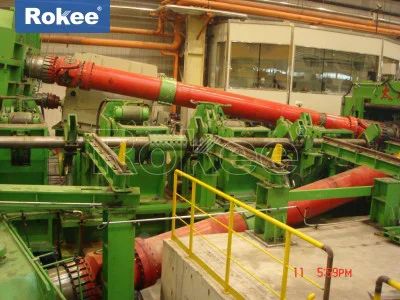
In the modern construction and industrial fields, continuous PU sandwich panel lines have become an indispensable core equipment for producing high-performance composite building materials, thanks to their efficient continuous production capacity and stable product quality. These production lines integrate multiple processes such as uncoiling of facing materials, roll forming, preheating, PU foaming, lamination, curing, and cutting, requiring precise and synchronized power transmission between each functional unit to ensure the consistency of product specifications and performance. Among the numerous transmission components in the continuous PU sandwich panel line, the universal coupling plays a crucial role as a key connecting part that bridges the power transmission between misaligned shafts. It is widely used in the connection between motors, reducers, and various working rollers in the production line, effectively compensating for angular, axial, and radial deviations caused by equipment installation errors, thermal expansion during operation, and structural layout limitations, thereby ensuring the smooth transfer of torque and rotational motion. However, due to the harsh working environment of the continuous PU sandwich panel line—characterized by long-term continuous operation, high load, frequent start-stop cycles, and exposure to dust, foam residues, and variable temperature conditions—the universal coupling is prone to wear, corrosion, and lubrication failure, which can lead to increased equipment vibration, noise, reduced transmission efficiency, and even sudden shutdowns, seriously affecting the normal operation of the entire production line and increasing maintenance costs. Therefore, mastering scientific lubrication technology and standardized maintenance points for universal couplings in continuous PU sandwich panel lines is of great practical significance for extending the service life of the coupling, ensuring the stable and efficient operation of the production line, and reducing production losses.
The working characteristics of the continuous PU sandwich panel line determine the special requirements for the lubrication and maintenance of universal couplings. Unlike universal couplings used in general industrial equipment, those in PU sandwich panel lines need to adapt to the continuous operation mode that runs 24 hours a day for a long time, with almost no downtime except for regular maintenance. This long-term continuous operation means that the moving parts of the universal coupling, such as cross shafts, bearings, and spline connections, are in constant frictional contact, generating a large amount of heat and accelerating wear. At the same time, the production line involves PU foaming links, and the foam residues and volatile substances generated during the foaming process are easy to adhere to the surface of the universal coupling, penetrate into the internal gaps of the coupling, and mix with lubricating grease, resulting in the deterioration of lubricating performance, blockage of lubrication channels, and even corrosion of metal components. In addition, the temperature of the production line during operation varies significantly: the preheating and curing links will cause the ambient temperature around the coupling to rise, while the feeding and cutting links are in a normal temperature environment. This temperature change will affect the viscosity and stability of the lubricating grease, requiring the selected lubricating materials to have good high-temperature resistance and temperature adaptability. Moreover, the universal coupling in the production line bears variable loads during operation. When the production line adjusts the thickness, width, or speed of the PU sandwich panel, the torque transmitted by the coupling will change accordingly, which puts higher requirements on the load-carrying capacity and anti-wear performance of the lubricating grease. Therefore, the lubrication technology of universal couplings in continuous PU sandwich panel lines must be targeted, combining the working environment and load characteristics of the production line to select appropriate lubricating materials, formulate scientific lubrication methods and cycles, and effectively reduce friction and wear, prevent corrosion and failure, and ensure the reliable operation of the coupling.
The selection of lubricating materials is the foundation of the lubrication technology for universal couplings in continuous PU sandwich panel lines, and the correct choice directly determines the lubrication effect and service life of the coupling. According to the working characteristics of the coupling in the production line, the selected lubricating grease should meet multiple performance requirements. Firstly, it should have excellent anti-wear and load-carrying capacity. Since the universal coupling bears high torque and variable loads during operation, the lubricating grease must form a stable oil film between the friction surfaces to separate the metal surfaces, reduce frictional resistance, and prevent direct metal contact that leads to wear, scratches, and even seizing. Lubricating greases containing anti-wear additives such as molybdenum disulfide or graphite are particularly suitable for this scenario, as these additives can form a solid lubricating film on the friction surface, enhancing the anti-wear performance and load-carrying capacity of the grease, even under heavy load and shock load conditions. Secondly, the lubricating grease should have good high-temperature stability and oxidation resistance. The ambient temperature around the universal coupling in the continuous PU sandwich panel line can reach 60-120°C during the preheating and curing stages, and long-term exposure to high temperatures will cause the lubricating grease to thin, volatilize, or oxidize and deteriorate, losing its lubricating performance. Therefore, the selected lubricating grease should have a high dropping point (generally not less than 180°C) and good oxidation stability, which can maintain stable viscosity and lubricating performance under high-temperature conditions, and not easily generate carbon deposits, colloids, or other impurities that block the lubrication channels. Thirdly, the lubricating grease should have strong water resistance and corrosion resistance. The production line may generate a small amount of water vapor during the cooling process, and the foam residues may also have a certain corrosive effect on the metal components of the coupling. Therefore, the lubricating grease should be able to resist the erosion of water and corrosive substances, prevent the metal surfaces from rusting and corroding, and protect the internal components of the coupling. In addition, the lubricating grease should have good fluidity and permeability, which can easily penetrate into the small gaps of the coupling, such as the fit between the cross shaft and the bearing, and the spline connection, ensuring that all friction surfaces are fully lubricated. Based on these requirements, high-performance lithium-based grease, synthetic grease, or molybdenum disulfide grease are commonly used in practical applications. Lithium-based grease has good mechanical stability, corrosion resistance, and temperature adaptability, and is suitable for general working conditions of universal couplings in production lines. Synthetic grease, with PAO or ester as the base material, has better high-temperature stability and oxidation resistance, and is suitable for couplings working in high-temperature environments. Molybdenum disulfide grease, with its excellent anti-wear and load-carrying capacity, is suitable for couplings bearing heavy loads and shock loads.
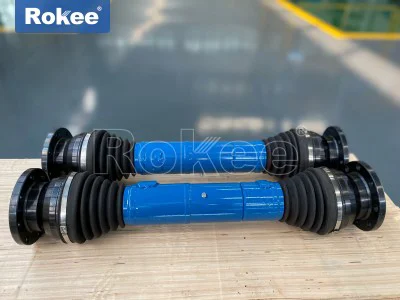
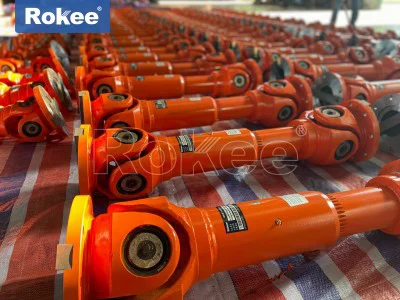
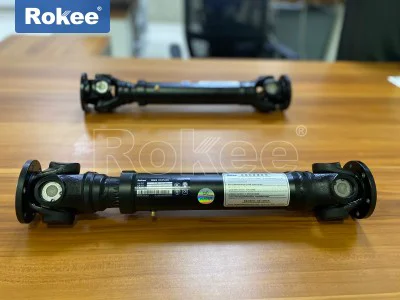
In addition to selecting the appropriate lubricating material, scientific lubrication methods and strict control of lubrication cycles are also key links to ensure the lubrication effect of universal couplings. The lubrication method of the universal coupling in the continuous PU sandwich panel line should be determined according to the structural type of the coupling and the installation position. For most universal couplings used in production lines, such as cross-axis universal couplings and ball cage universal couplings, manual grease injection lubrication is the most common and practical method. Before lubrication, it is necessary to thoroughly clean the grease injection port and the surface around the coupling to prevent dust, foam residues, and other impurities from mixing into the lubricating grease and causing secondary pollution. When injecting grease, a grease gun should be used to slowly inject the lubricating grease into the grease injection port until the old grease overflows from the oil discharge port or the gap of the coupling. This ensures that the old grease, which has deteriorated and mixed with impurities, is completely discharged, and the internal friction surfaces of the coupling are fully covered by new grease. It should be noted that the injection speed should not be too fast to avoid excessive pressure inside the coupling, which may damage the seals or cause grease leakage. For some universal couplings installed in narrow spaces or difficult-to-reach positions, centralized lubrication systems can be adopted to realize automatic lubrication, which not only improves the lubrication efficiency but also ensures the uniformity and timeliness of lubrication, reducing the labor intensity of manual operation. The lubrication cycle of the universal coupling should be formulated according to the working intensity, ambient temperature, and load conditions of the production line. In general, for continuous PU sandwich panel lines that operate 24 hours a day, the lubrication cycle should be controlled at 250-500 operating hours. If the production line is in a high-temperature, high-load, or dusty environment, the lubrication cycle should be appropriately shortened to 150-300 operating hours to ensure that the lubricating grease can always maintain good performance. In addition, after the new coupling is installed and runs for the first 50-100 hours, it is necessary to perform the first lubrication in advance, because the new coupling will have a certain amount of running-in wear during the initial operation, and the lubricating grease will be quickly contaminated, so timely lubrication replacement is required to protect the coupling components. During the lubrication process, it is necessary to record the lubrication time, type of lubricating grease, and injection amount in detail, so as to track the lubrication status of the coupling and adjust the lubrication cycle and method in a timely manner according to the actual operation.
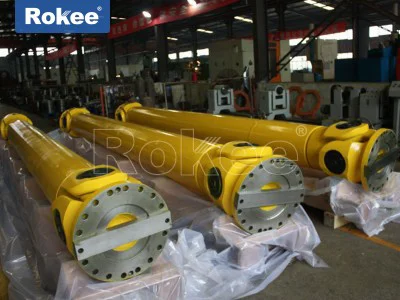
While doing a good job in lubrication, standardized daily maintenance and regular inspection are also essential to ensure the long-term stable operation of the universal coupling in the continuous PU sandwich panel line. Daily maintenance mainly focuses on the visual inspection and simple inspection of the coupling before and after the operation of the production line. Before the production line starts, the operator should check the surface of the universal coupling for obvious damage, such as cracks, deformation, or loose fasteners. At the same time, check whether there is grease leakage at the grease injection port, oil discharge port, and seal of the coupling. If leakage is found, it is necessary to find out the cause in time, such as seal damage or excessive grease injection, and take corresponding measures to repair or adjust. During the operation of the production line, the operator should pay attention to observing the operation status of the universal coupling, listen for abnormal noises such as friction sound, impact sound, or vibration sound, and check whether the temperature of the coupling is too high. If abnormal phenomena are found, the production line should be stopped in time for inspection to avoid further damage to the coupling and other components. After the production line stops working, the surface of the universal coupling should be cleaned in time to remove dust, foam residues, and other impurities adhering to the surface, so as to prevent the impurities from entering the internal of the coupling and affecting the lubrication effect and component wear. Regular inspection is a more in-depth maintenance work, which is generally carried out every 1-2 months or every 500-1000 operating hours. The content of regular inspection includes disassembly and inspection of the coupling components, such as checking the wear of the cross shaft, bearing, and spline, the elasticity of the seal, and the tightness of the fasteners. For the cross shaft and bearing, it is necessary to check whether there is wear, pitting, or rust on the surface, and measure the clearance between the bearing and the cross shaft. If the wear exceeds the allowable range or there are obvious defects, the components should be replaced in time to avoid affecting the transmission performance. For the spline connection part, it is necessary to check whether the spline teeth are worn, deformed, or stuck, and ensure that the spline can slide smoothly. At the same time, reapply lubricating grease to the spline connection to prevent jamming due to lack of lubrication. For the fasteners such as bolts and nuts, it is necessary to check whether they are loose, and retighten them if necessary to ensure that the coupling is firmly connected and avoids vibration and damage during operation. In addition, the dynamic balance of the universal coupling should be checked regularly. Due to long-term operation and wear, the dynamic balance of the coupling may be damaged, leading to increased vibration and noise of the equipment, and accelerating the wear of the coupling and other transmission components. If the dynamic balance is found to be unqualified, it should be corrected in time to restore the normal operation status of the coupling.
In addition to daily maintenance and regular inspection, it is also necessary to pay attention to the correct installation and use of the universal coupling to reduce unnecessary wear and failure. During the installation process of the universal coupling, it is necessary to ensure the alignment accuracy of the connected shafts as much as possible. Although the universal coupling can compensate for a certain degree of shaft misalignment, excessive initial centering error will increase the additional load on the coupling, leading to uneven stress on the components, accelerated wear, and reduced service life. Generally, the angular deviation between the driving shaft and the driven shaft should not exceed ±30°, and the radial and axial deviations should be controlled within the allowable range of the coupling. During installation, special tools should be used to measure the alignment accuracy, and adjustments should be made in time if deviations are found. At the same time, the installation process should be standardized to avoid collision and damage to the coupling components. When the production line is started or stopped, it should be carried out smoothly to avoid sudden start-stop, which will generate large impact torque and damage the coupling components. In addition, the load borne by the universal coupling should be strictly controlled within the design range. Overloading will cause deformation, cracking, or even fracture of the coupling components, leading to serious failure. When the production line adjusts the production parameters, it is necessary to ensure that the torque transmitted by the coupling does not exceed the rated load. If abnormal load increases are found, the cause should be investigated in time, such as equipment jamming or material blockage, and solved in time to protect the universal coupling.
The handling of common faults of universal couplings in continuous PU sandwich panel lines is also an important part of maintenance work. In the process of long-term operation, the universal coupling may have various faults due to lubrication, wear, installation, and other reasons. Common faults include abnormal vibration and noise, grease leakage, coupling jamming, and component damage. For abnormal vibration and noise, the main causes are usually shaft misalignment, unbalanced coupling dynamic balance, worn components, or loose fasteners. When such faults occur, the production line should be stopped first, and the alignment accuracy of the shafts, the dynamic balance of the coupling, the wear of the components, and the tightness of the fasteners should be checked one by one. After finding the cause, corresponding measures should be taken, such as adjusting the shaft alignment, correcting the dynamic balance, replacing worn components, or retightening fasteners. For grease leakage, the main causes are seal damage, excessive grease injection, or damage to the grease injection port. It is necessary to check the seal status of the coupling, replace the damaged seal in time, adjust the injection amount of lubricating grease, and repair the damaged grease injection port to prevent further leakage. For coupling jamming, the main causes are lack of lubrication, excessive wear of spline or bearing, or blockage of impurities. It is necessary to disassemble the coupling, clean the internal components, check the wear status, replace worn components, and reapply lubricating grease to ensure that the coupling can rotate flexibly. For component damage such as cross shaft fracture and bearing damage, it is usually caused by overloading, severe wear, or material fatigue. At this time, the damaged components should be replaced in time, and the cause of the damage should be investigated to avoid similar faults from happening again. In the process of fault handling, it is necessary to strictly follow the operation specifications, avoid blind disassembly and assembly, and prevent secondary damage to the coupling and other equipment components. At the same time, the fault handling process and results should be recorded in detail for future reference and summary of maintenance experience.
In conclusion, the universal coupling is a key transmission component in the continuous PU sandwich panel line, and its lubrication and maintenance directly affect the stable operation and production efficiency of the entire production line. In view of the harsh working environment and special working characteristics of the universal coupling in the production line, it is necessary to establish a scientific and standardized lubrication and maintenance system. This includes selecting appropriate lubricating materials according to the working conditions, formulating reasonable lubrication methods and cycles, carrying out daily maintenance and regular inspection in a timely manner, ensuring correct installation and use, and handling common faults promptly and effectively. By doing a good job in the lubrication and maintenance of the universal coupling, we can effectively extend the service life of the coupling, reduce the frequency of equipment failures and downtime, lower maintenance costs, and ensure the continuous, stable, and efficient operation of the continuous PU sandwich panel line. With the continuous development of the PU sandwich panel industry, the requirements for the performance and reliability of production line equipment are getting higher and higher. Therefore, it is necessary to continuously summarize and improve the lubrication technology and maintenance experience of universal couplings, combine advanced maintenance concepts and methods, and provide strong guarantee for the high-quality development of the PU sandwich panel production industry.