Steel Rolling Mill Cardan Shaft

In the complex and high-demand field of steel rolling, the cardan shaft serves as a critical mechanical component that enables the seamless transmission of power between non-collinear shafts, playing an indispensable role in ensuring the stable and efficient operation of rolling mill systems. Unlike ordinary transmission components that require precise coaxial alignment, the cardan shaft is specifically engineered to accommodate angular misalignment, axial displacement, and radial deviation, making it uniquely suited to the harsh working environment of steel rolling mills—where heavy loads, high temperatures, continuous vibration, and metal debris are common challenges. As the backbone of power transmission in rolling processes, the cardan shaft directly influences the efficiency of production, the quality of finished steel products, and the overall operational reliability of the rolling equipment.
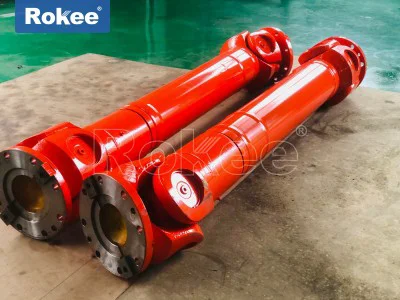
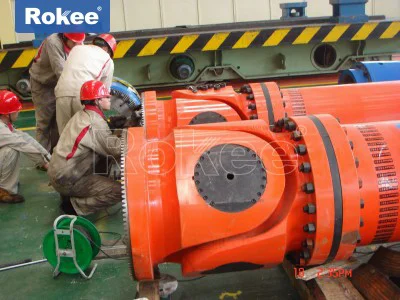
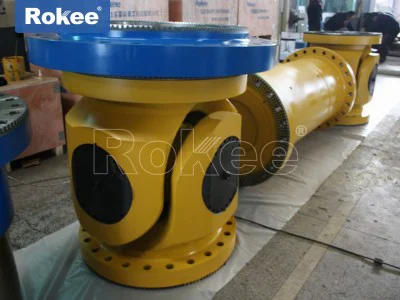
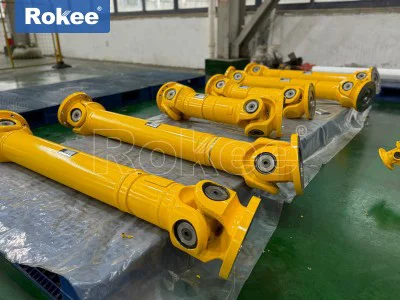
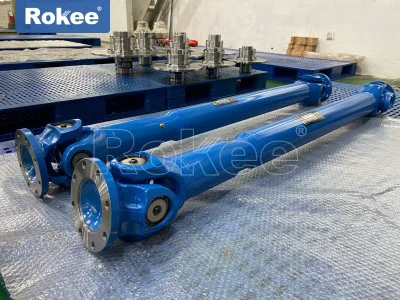
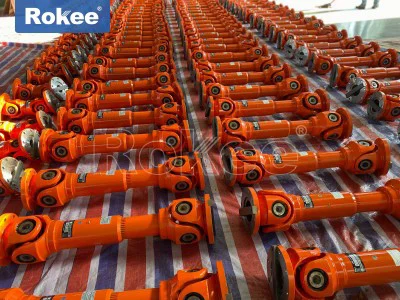
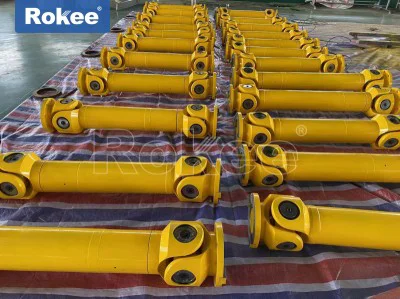
The structure of a steel rolling mill cardan shaft is a sophisticated assembly of interconnected components, each designed to withstand the extreme conditions of rolling operations while ensuring efficient torque transfer. At its core, a typical cardan shaft consists of universal joint heads (also known as U-joints), a central shaft body, yoke assemblies, bearing components, splined connections, and protective elements—all working in harmony to achieve flexible and reliable power transmission. The universal joint heads, which are the key flexible components, are composed of two fork-shaped yokes and a central cross-shaped member called a spider or cross shaft. Each yoke is securely attached to the driving shaft and the driven shaft respectively, usually through rigid connections such as splines, flanges, or keyed joints that eliminate slippage and ensure full torque transfer. The spider, positioned at the junction of the two yokes, features four perpendicular arms that fit precisely into bearing housings machined into the open ends of each yoke. These bearing interfaces, often equipped with needle roller bearings, minimize friction and wear between the spider and the yokes, enabling smooth rotational and oscillatory movement even under heavy loads. The central shaft body, which connects the two universal joint heads, can be either solid or tubular depending on the torque requirements; tubular shafts are often preferred for their lighter weight and higher torsional rigidity, which helps reduce rotational inertia and improve energy efficiency. Splined connections are integrated into the shaft body to allow for axial adjustment, compensating for changes in distance between the driving and driven shafts caused by thermal expansion, load-induced deformation, or installation deviations. Additionally, protective covers are often installed around the universal joints and splined connections to prevent the ingress of metal debris, dust, and lubricant contamination, which can significantly extend the service life of the components. The structural design of the cardan shaft is meticulously optimized to balance strength, flexibility, and durability, ensuring it can withstand the dynamic and static loads encountered in steel rolling processes.
The performance of a steel rolling mill cardan shaft is defined by a set of key characteristics that determine its ability to adapt to the demanding conditions of rolling operations. One of the most critical performance attributes is angular compensation capability, which refers to the shaft’s ability to transmit torque between two shafts that are not aligned on the same axis. Unlike rigid couplings that can only work under minimal misalignment, cardan shafts for steel rolling mills are designed with strong angular compensation, typically allowing an allowable angle between the two connected shafts ranging from 5° to 45° depending on the structural type. This unique feature enables them to adapt to the complex layout of rolling mill systems, where the driving shaft and the roll shaft often need to be installed at different angles to meet the operational requirements of the rolling process. Another essential performance characteristic is torque-carrying capacity, which is the maximum torque that the shaft can transmit without permanent deformation or failure. Steel rolling mills operate under high torque conditions, especially during the rolling of thick steel plates, bars, and profiles, so the cardan shaft must be engineered with high-strength materials and robust structural design to handle these loads. The torque-carrying capacity is influenced by factors such as the material of the shaft body and universal joints, the cross-sectional area of the shaft, and the quality of the bearings and connections. Transmission efficiency is also a key performance metric, as any loss of efficiency can lead to increased energy consumption and reduced production output. High-quality cardan shafts typically have a transmission efficiency of over 98%, ensuring that most of the power from the driving mechanism is transferred to the rolling rolls with minimal energy loss. Additionally, the cardan shaft must exhibit excellent fatigue resistance and durability, as it operates under continuous cyclic loads and high-frequency vibrations. Fatigue failure is a common issue in mechanical components subjected to repeated stress, so the materials used in the cardan shaft are carefully selected and heat-treated to enhance their fatigue strength. High-temperature resistance is another critical performance requirement, as steel rolling mills often operate at elevated temperatures, which can degrade the mechanical properties of materials. The components of the cardan shaft, particularly the bearings and lubricants, are designed to withstand high temperatures without losing their functionality. Vibration damping is also an important performance feature, as excessive vibration can cause noise, accelerate component wear, and affect the quality of the rolled products. The cardan shaft’s structural design, including the use of flexible bearings and balanced components, helps to attenuate vibration and ensure smooth operation.
There are several types of cardan shafts used in steel rolling mills, each designed to meet specific operational requirements based on factors such as torque load, angular misalignment, axial displacement, and the type of rolling mill. The most common classification is based on the structure of the universal joints and the presence of telescopic components. One of the primary types is the single cardan shaft, which consists of a single universal joint at each end connected by a central shaft body. This type is suitable for applications where the angular misalignment between the driving and driven shafts is relatively small, typically up to 15°, and where axial displacement is minimal. Single cardan shafts are often used in light to medium-duty rolling mills, such as wire rod mills and small section mills, where the torque requirements are not excessively high. Another common type is the double cardan shaft, which features two universal joints connected by an intermediate shaft, with the two joints arranged in a way that cancels out the velocity fluctuations inherent in single cardan shafts. This type is ideal for applications where the angular misalignment is larger, up to 45°, and where constant velocity transmission is required to ensure the stability of the rolling process. Double cardan shafts are widely used in heavy-duty rolling mills, such as hot strip mills and plate mills, where high torque and large angular misalignment are common. Telescopic cardan shafts are another important type, which incorporate a splined connection that allows the length of the shaft to adjust axially. This adjustment capability is critical for compensating for changes in distance between the driving and driven shafts caused by thermal expansion, load-induced deformation, or installation errors. Telescopic cardan shafts are further divided into long telescopic and short telescopic types, depending on the range of axial adjustment required. Long telescopic cardan shafts are used in applications where the axial displacement is significant, such as continuous casting machines and large rolling mills, while short telescopic types are suitable for applications with minimal axial movement. Non-telescopic cardan shafts, on the other hand, have a fixed length and are used in applications where there is no need for axial adjustment, such as in some cold rolling mills where the alignment of the shafts is relatively stable. Additionally, there are cross-pin type cardan shafts, which feature a cross-pin structure in the universal joint that enhances the torque-carrying capacity and stability of the shaft. These types are often used in high-torque applications, such as billet shears and crop shears in steel rolling mills. The selection of the appropriate cardan shaft type depends on the specific operational conditions of the rolling mill, including torque requirements, angular misalignment, axial displacement, and the type of rolled product.
The applications of steel rolling mill cardan shafts are extensive and cover all aspects of the steel rolling process, from raw material processing to finished product formation. One of the primary applications is in hot rolling mills, which are used to produce steel sheets, plates, bars, and profiles by rolling heated steel billets at high temperatures. In hot rolling mills, cardan shafts are used to connect the main drive motor to the rolling rolls, transmitting the high torque required to deform the heated steel. The cardan shafts in hot rolling mills must withstand high temperatures, heavy loads, and large angular misalignments, making double cardan shafts and telescopic cardan shafts the preferred choices. For example, in hot strip mills, cardan shafts with rotational diameters ranging from 780 mm to 1300 mm are used to drive the work rolls and backup rolls, operating at rotational speeds of 40 to 120 min⁻¹ under high reversing torques. These shafts are designed with spindle stools and double flange joints to ensure stability and reliability. Cold rolling mills, which are used to produce high-precision steel products with smooth surfaces, also rely heavily on cardan shafts. Unlike hot rolling mills, cold rolling mills operate at room temperature and require high torsional rigidity to ensure precise rolling. Non-telescopic cardan shafts are often used in cold rolling mills, as the alignment of the shafts is more stable and axial displacement is minimal. These shafts typically have rotational diameters ranging from 390 mm to 780 mm and operate at higher rotational speeds, between 200 to 800 min⁻¹. Continuous casting plants, which are an integral part of modern steel production, also use cardan shafts to support the continuous casting process. The cardan shafts in continuous casting plants are designed with length compensation and high flexibility to accommodate the low rotational speeds (3 to 7 min⁻¹) and fluctuating torques encountered in the casting process. These shafts typically have rotational diameters ranging from 180 mm to 350 mm and are often equipped with fixed and sliding parts, as well as profile protection to prevent damage from molten steel splashes. Cardan shafts are also used in wire and profile rolling mills, which produce wire rods, reinforcing bars, and various profiles. In these mills, the cardan shafts are designed to handle moderate torques and angular misalignments, with rotational diameters ranging from 180 mm to 490 mm and rotational speeds of 100 to 600 min⁻¹. Additionally, cardan shafts are used in auxiliary equipment of steel rolling mills, such as billet shears, crop shears, and coiler drives. In coiler drives, for example, cardan shafts are used to transmit torque to the coiler, which winds the rolled steel into coils. These shafts must withstand fluctuating torques and strong radial shocks, so they are designed with cross keys and additional bearing security covers to ensure reliability. The versatility of cardan shafts makes them an essential component in all types of steel rolling equipment, enabling the efficient and reliable transmission of power in even the most demanding conditions.
The design and selection of steel rolling mill cardan shafts are influenced by a variety of factors, including the type of rolling mill, the torque and speed requirements, the degree of angular misalignment and axial displacement, and the working environment. Material selection is a critical aspect of cardan shaft design, as the materials must possess high strength, fatigue resistance, and high-temperature resistance. Common materials used for the shaft body and universal joints include high-strength alloy steels, such as 40Cr, 45CrNiMoV, and 20CrMnTi, which are heat-treated to enhance their mechanical properties. The bearings used in the universal joints are typically needle roller bearings or spherical roller bearings, which offer high load-carrying capacity and low friction. Lubrication is also an important factor in ensuring the long service life of cardan shafts, as it reduces friction between moving components and prevents corrosion. High-temperature lubricants are used in hot rolling mills to ensure that the bearings and other moving parts remain lubricated even at elevated temperatures. Regular maintenance and inspection of cardan shafts are essential to prevent unexpected failures, which can lead to costly production interruptions. Maintenance activities include checking the lubrication level, inspecting the bearings for wear, checking the splined connections for backlash, and ensuring that the protective covers are intact. Any signs of wear, damage, or misalignment should be addressed promptly to avoid further damage to the cardan shaft and other components of the rolling mill.
As the steel industry continues to evolve, with increasing demands for higher production efficiency, better product quality, and lower energy consumption, the role of cardan shafts in steel rolling mills becomes even more important. Technological advancements in materials science and mechanical design are leading to the development of more efficient and durable cardan shafts. For example, the use of advanced heat treatment processes, such as quenching and tempering, is improving the fatigue strength and durability of cardan shaft components. The integration of sensors and monitoring systems is also enabling real-time monitoring of the cardan shaft’s performance, allowing for predictive maintenance and reducing the risk of unexpected failures. Additionally, the development of lightweight yet high-strength materials is helping to reduce the weight of cardan shafts, which in turn reduces rotational inertia and improves energy efficiency. These advancements are ensuring that cardan shafts can meet the growing demands of modern steel rolling mills, providing reliable and efficient power transmission for years to come.
In conclusion, the steel rolling mill cardan shaft is a vital mechanical component that plays a crucial role in the power transmission system of rolling mills. Its sophisticated structure, which includes universal joints, a central shaft body, yoke assemblies, and protective elements, enables it to accommodate angular misalignment, axial displacement, and radial deviation, making it uniquely suited to the harsh working environment of steel rolling. Its core performance characteristics, such as high angular compensation capability, high torque-carrying capacity, high transmission efficiency, and excellent durability, ensure that it can withstand the extreme conditions of rolling operations. The diverse types of cardan shafts, including single, double, telescopic, and non-telescopic types, allow for their application in a wide range of rolling mill systems, from light-duty wire rod mills to heavy-duty hot strip mills. As the steel industry continues to advance, the cardan shaft will remain an essential component, driving the efficiency and reliability of steel rolling processes and contributing to the production of high-quality steel products that are essential to modern society.