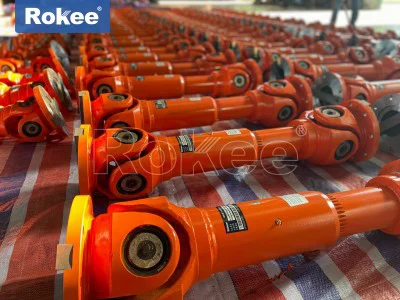
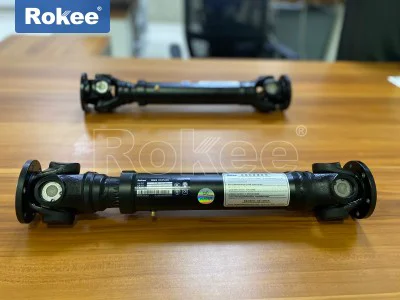
Industrial Universal Joint Coupling
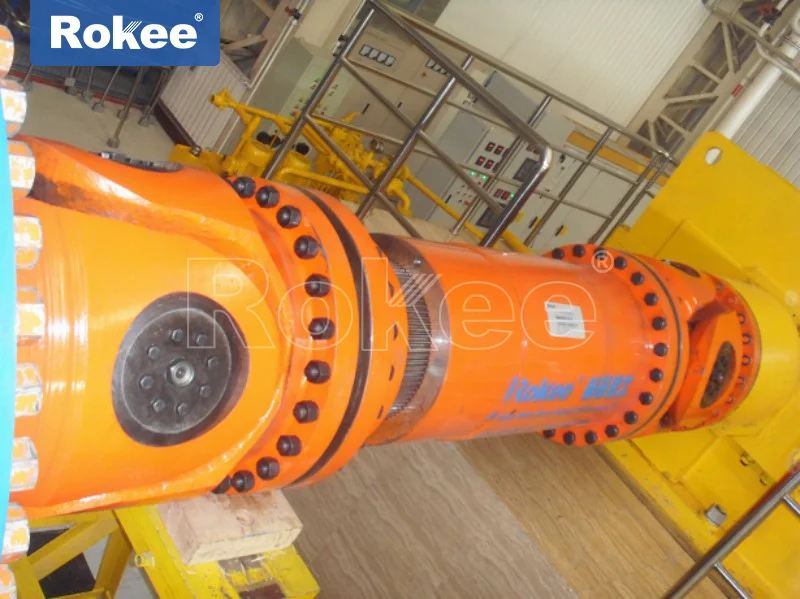
Industrial universal joint coupling, commonly known as a U-joint or cardan joint, is an indispensable mechanical transmission component widely adopted in modern industrial mechanical systems. Its core functional advantage lies in its ability to stably transmit torque and continuous rotational motion between two shafts that are not strictly collinear, effectively adapting to angular misalignment, axial displacement and minor radial deviation generated during equipment operation. Composed of precision-machined yokes, a cross-shaped spider and flexible bearing assemblies, this coupling breaks the limitations of rigid connection structures, which require absolute shaft alignment. It can operate steadily under dynamic working conditions with changing shaft angles and mechanical vibrations. Featured with simple structural logic, strong load adaptability and excellent motion flexibility, it serves as a key connecting part for power transmission in mechanical equipment ranging from general industrial machinery to special engineering devices, providing reliable basic support for the normal and efficient operation of various transmission systems.
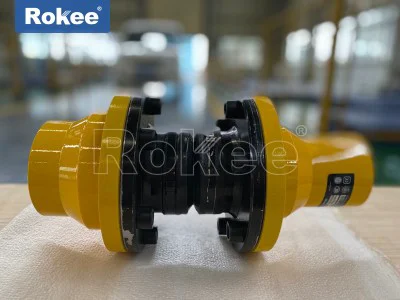
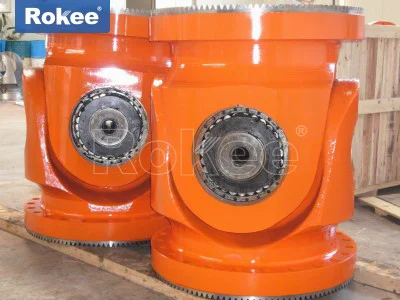
The basic structural composition of industrial universal coupling lays a solid foundation for its flexible transmission performance, and each component undertakes irreplaceable mechanical functions in the power transmission process. The core of the coupling is the cross-shaped spider, whose four ends are equipped with independent bearing structures that can rotate freely, forming two mutually perpendicular pivot motion systems. The two grooved yokes are respectively fixed on the driving shaft and the driven shaft, with the grooved structures tightly clamped on the bearing parts at the four ends of the cross spider. This assembly method enables the cross spider to perform dual-axis swinging and rotating movements inside the yokes, rather than fixed rigid connection. Auxiliary locking structures such as retaining clips and sealing gaskets are configured on the yoke parts, which can effectively fix the bearing and spider components, preventing displacement and vibration deviation under high-speed rotation and heavy load working conditions. All structural parts are designed with mechanical tolerance matching, ensuring smooth coordination between components, reducing motion friction, and enabling the coupling to maintain stable transmission states under complex dynamic displacement conditions.
The working principle of industrial universal joint coupling is based on spatial linkage mechanical motion logic, realizing efficient torque transmission under misalignment states. When the driving shaft starts to rotate, it drives the connected active yoke to perform synchronous circular motion, and the motion torque is transmitted to the cross spider through the bearing contact surface. Relying on the free rotation of the bearing structure, the cross spider converts the single-axis rotational motion of the active yoke into flexible spatial motion, and further drives the passive yoke and the driven shaft to rotate synchronously. Different from rigid couplings that can only transmit torque under collinear conditions, the universal joint coupling uses the swinging and rotating compensation characteristics of the cross spider to adapt to angular deviation between shafts. Even if the two connected shafts form a certain included angle or produce real-time angle changes during operation, the continuous output of rotational power will not be interrupted. Although a single universal joint will produce slight speed fluctuation in the transmission process under large-angle misalignment, this inherent mechanical characteristic can be effectively optimized and eliminated through structural matching in practical industrial applications.
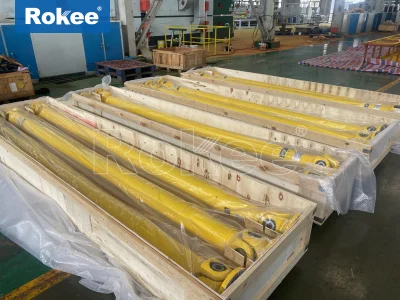
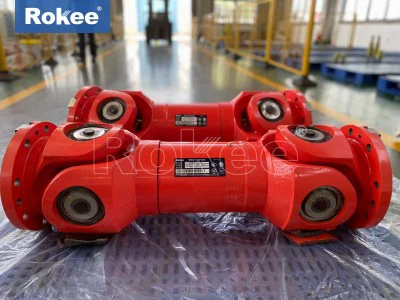
Industrial universal joint couplings can be divided into different structural types according to transmission forms and motion compensation characteristics, with single-joint and double-joint structures being the most widely used in industrial scenarios. The single universal joint features a compact overall structure and small installation space occupation, suitable for working conditions with small angular misalignment and stable load changes. It can quickly complete torque transmission between offset shafts and is often applied in simple and compact mechanical transmission units. The double universal joint is composed of two single-joint structures and an intermediate connecting shaft, with the two groups of yoke structures arranged in a 90-degree phase difference state. This optimized structural design can completely offset the speed fluctuation defect of single-joint transmission, realizing constant-speed and stable torque output. The double-joint structure can adapt to larger shaft misalignment angles and stronger dynamic load impacts, making it more suitable for high-speed operation, heavy-load transmission and frequent angle-change working scenarios. In addition, there are enhanced structural types optimized for special working conditions, such as high-toughness wear-resistant structures and high-speed silent structures, to meet the differentiated operation needs of diverse industrial equipment.
The outstanding performance advantages of industrial universal joint couplings make them stand out among various mechanical coupling products and become the preferred connecting part for most industrial transmission systems. First of all, it has excellent angular compensation capability, which can stably cope with the angular misalignment generated by equipment installation errors, mechanical vibration, thermal expansion and contraction and other factors, avoiding transmission jamming and component damage caused by shaft deviation. Secondly, it has strong load adaptability, which can bear alternating load, impact load and continuous heavy load in industrial operation, with stable torque transmission efficiency and no obvious power loss. In terms of operation adaptability, it can normally operate in a wide speed range, and the flexible motion structure can effectively buffer mechanical vibration and reduce the resonance phenomenon of the transmission system. Moreover, the overall structure of the coupling is simple and easy to disassemble and maintain, with low failure rate and long service life. Compared with elastic couplings and diaphragm couplings, it has stronger mechanical rigidity and motion stability, and can adapt to harsher industrial working environments.
Industrial universal joint couplings are widely applied in multiple industrial fields, covering conventional mechanical manufacturing, engineering machinery, agricultural equipment and automated production lines, becoming a universal core transmission component. In general mechanical processing equipment, it is used for the power connection of transmission shafts of machine tools, conveyors and sorting equipment, solving the transmission problem of offset shafts in compact equipment layout. In engineering machinery and transportation equipment, it undertakes the power transmission work of movable mechanical arms, walking transmission systems and steering structures, adapting to the frequent angle changes during equipment operation. In agricultural machinery and field operation equipment, it can resist complex working conditions such as dust, vibration and uneven load, ensuring stable power output of field operation machinery. In modern automated industrial production lines, the coupling’s precise and flexible transmission characteristics meet the high-precision and high-stability operation requirements of automated transmission mechanisms, providing reliable power connection guarantee for continuous and efficient production of industrial equipment.
In the long-term industrial operation process, standardized maintenance and correct use methods are crucial to prolong the service life and maintain the transmission performance of universal joint couplings. During equipment installation, the alignment state of the connecting shafts should be reasonably adjusted to avoid long-term operation under excessive misalignment angles, so as to reduce the abrasion loss of bearings and cross spider components. Daily maintenance mainly focuses on the lubrication of internal moving parts. Sufficient and regular lubrication can effectively reduce mechanical friction and wear, avoid high-temperature aging of components caused by long-term high-speed operation, and suppress vibration and noise generated by motion friction. At the same time, it is necessary to regularly check the fastening state of locking parts and the sealing performance of the coupling, prevent foreign matter such as dust and impurities from entering the internal moving gap, and avoid component looseness and displacement caused by long-term load operation. Timely replacement of worn and aging parts can ensure that the coupling always maintains efficient and stable transmission performance and avoids equipment failure caused by component aging.
With the continuous upgrading of modern industrial manufacturing technology and the gradual improvement of equipment operation requirements, the industrial universal joint coupling industry is constantly evolving towards high precision, high durability and intelligent adaptation. Traditional coupling products are continuously optimized in structural design and material application, with improved wear resistance, impact resistance and fatigue resistance, enabling them to adapt to more extreme industrial working conditions such as high temperature, high humidity and strong corrosion. At the same time, combined with the development trend of intelligent industrial equipment, new universal joint coupling structures with vibration monitoring and wear early warning functions are gradually emerging, which can realize real-time perception of operating state and provide data support for equipment predictive maintenance. In the future, with the continuous expansion of industrial equipment application scenarios, universal joint couplings will further expand their functional advantages, continuously optimize transmission stability and environmental adaptability, and provide more reliable and efficient basic component support for the upgrading and development of modern industrial mechanical transmission systems.