Universal Joint Coupling Helps Polyurethane Sandwich Panel Production Line Achieve Automatic Transmission

The modern manufacturing sector for building energy-saving materials is undergoing profound transformation driven by intelligent production and continuous automated upgrading, and polyurethane sandwich panels have emerged as one of the most indispensable core materials in the fields of industrial factory building construction, cold chain storage engineering, and modern commercial building thermal insulation and enclosure. These composite panels integrate excellent thermal insulation performance, structural stability, fire resistance and weather resistance, and their production quality and manufacturing efficiency directly determine the construction progress, energy consumption level and long-term service performance of various engineering projects. As market demand for high-quality and customized polyurethane sandwich panels continues to expand, traditional semi-manual and semi-mechanical production modes can no longer meet the requirements of large-scale batch production, precise dimensional control and continuous stable operation. The entire polyurethane sandwich panel production process involves multiple interconnected processing links, including raw material automatic feeding, continuous foam pouring, composite plate surface pressing, constant-temperature curing, fixed-length cutting, edge trimming and finished product conveying and stacking. Each production link relies on coordinated and synchronous mechanical transmission to ensure the continuity of material transportation and the consistency of processing actions, and any instability or deviation in the transmission process will directly lead to panel surface dislocation, uneven foam filling, inconsistent overall dimensions and other product quality defects, and even cause frequent equipment shutdowns, production line stagnation and increased production and maintenance costs. In the core mechanical transmission system of the fully automatic polyurethane sandwich panel production line, the universal joint coupling has become a key flexible transmission component that cannot be replaced by rigid transmission parts. It effectively solves various shaft connection and power transmission problems faced by the production line in long-term continuous operation, perfectly adapts to complex installation deviations, mechanical operation vibration and dynamic position changes of transmission shafts in the production process, and provides reliable and stable power transmission guarantee for the full-process automatic operation of the entire polyurethane sandwich panel production line.
Polyurethane sandwich panel production is a highly continuous and integrated industrial manufacturing process with extremely high requirements for the synchronization accuracy and operation stability of each transmission node inside the production line. The whole production line is composed of dozens of mechanical transmission units, which are responsible for driving different production equipment and material conveying mechanisms respectively. From the initial raw material mixing and conveying equipment to the intermediate composite pressing and curing forming equipment, and then to the subsequent finished product cutting and finished product conveying equipment, each piece of equipment needs to obtain stable rotational power and linear power output through the connection of transmission shafts. In the actual installation and long-term operation of the production line, it is difficult to achieve absolute coaxial alignment between the driving shaft and the driven shaft of each transmission unit due to various objective factors. On the one hand, there are inevitable tiny position deviations and angle deviations in the process of equipment frame processing and on-site assembly and installation, and these deviations cannot be completely eliminated by precise debugging and calibration alone. On the other hand, the polyurethane sandwich panel production line will generate continuous mechanical vibration during high-load long-term operation, and the equipment frame and transmission shaft components will produce slight thermal deformation due to long-term continuous operation temperature rise and mechanical stress accumulation. These subtle changes will further expand the misalignment and angular deviation between the connected transmission shafts. If rigid connection transmission parts are used for shaft connection, the rigid structure cannot adapt to any angular deviation and position displacement, which will lead to excessive mechanical stress concentration at the shaft connection parts, accelerated wear of shaft heads and bearing components, increased transmission operation noise, and even frequent shaft jamming and equipment failure in serious cases. Once the transmission link fails, the entire continuous production line will have to stop running, resulting in production interruption, reduced output, and increased subsequent maintenance time and labor costs, which seriously affects the continuous production efficiency and stable product quality of polyurethane sandwich panels. The universal joint coupling is designed and manufactured based on the spatial linkage transmission principle, with a special cross shaft and fork-shaped structural design, which fundamentally breaks through the transmission limitation of rigid connection parts and can maintain stable and continuous torque and rotational motion transmission under the condition of inevitable angular deviation and tiny axial displacement between the driving shaft and the driven shaft.
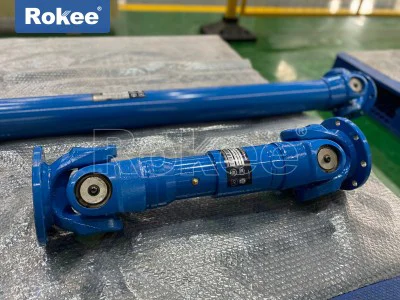
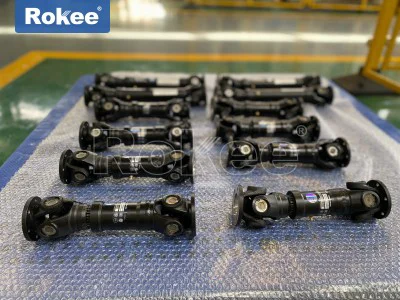
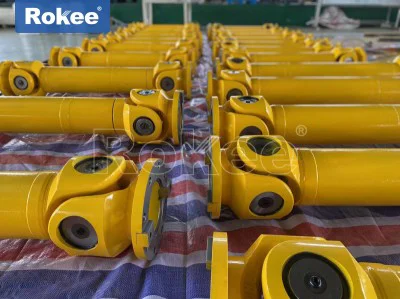
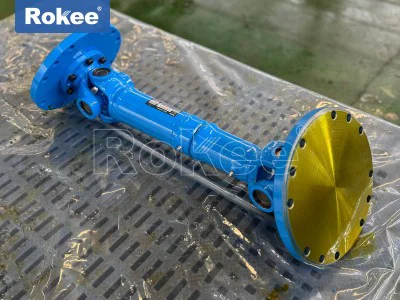
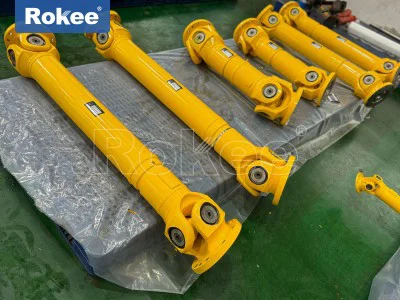
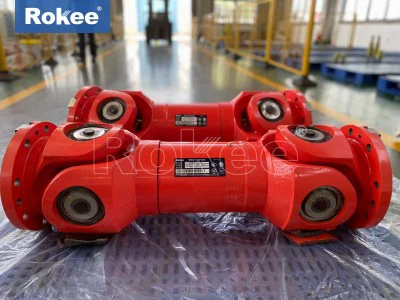
The core working principle of the universal joint coupling relies on the flexible spatial rotation and deflection adaptation capability of its internal cross shaft structure. The main structure of the universal joint coupling is composed of two fork-shaped joint bodies connected to the driving shaft and the driven shaft respectively and a middle cross shaft connecting the two fork bodies, and the four ends of the cross shaft are equipped with precision bearing structures to ensure flexible rotation and swinging between the cross shaft and the fork bodies. When the driving shaft of the production line transmission system rotates and outputs power, the rotational torque and motion are transmitted to the cross shaft through the driving side fork body, and the cross shaft further transmits the power to the driven side fork body and the connected driven shaft, realizing the synchronous rotation operation of the two shafts. Different from rigid couplings that require strict coaxiality of the two shafts, the cross shaft of the universal joint coupling can swing freely in multiple spatial directions within a certain angle range during operation, which can automatically compensate for installation misalignment, vibration displacement and thermal deformation deviation between the driving shaft and the driven shaft in the polyurethane sandwich panel production line. For the automatic transmission system of large-scale polyurethane sandwich panel production line, double-section universal joint couplings are mostly used in key transmission positions. By reasonably arranging the installation angle of the two groups of universal joints, the angular velocity fluctuation generated by the single-section universal joint during the transmission process is effectively offset, so that the input shaft and output shaft can maintain a constant and synchronous rotational speed operation state, avoiding the problem of unstable transmission speed caused by angle deviation. This stable constant-speed transmission effect is crucial for the automatic production of polyurethane sandwich panels, because only when the conveying speed of the panel base material and the operating speed of the pressing and cutting equipment remain highly synchronized, can the foam material be evenly filled and compounded, and the dimensional accuracy and surface flatness of each finished sandwich panel can be guaranteed to meet production standards.
In the actual operation scenario of the polyurethane sandwich panel production line, the application advantages of universal joint couplings are reflected in every key automatic production link, effectively supporting the seamless connection and coordinated operation of each process module. In the raw material automatic feeding and mixing link of the production line, various polyurethane raw materials and auxiliary materials need to be accurately conveyed to the mixing equipment according to the set proportion and flow rate, and the mixing and stirring equipment needs stable rotational power to ensure the uniform mixing of raw materials. The transmission shaft connecting the power motor and the mixing stirring mechanism is affected by the vibration generated by the high-speed operation of the mixer and the position deviation of the on-site equipment layout. The universal joint coupling used at this position can effectively absorb vibration and compensate for shaft body deviation, ensuring that the stirring mechanism runs at a constant speed without jitter, avoiding uneven raw material mixing caused by unstable transmission power, and laying a good raw material foundation for the subsequent foaming and composite forming of sandwich panels. In the continuous foam pouring and composite pressing link, which is the core processing link determining the structural performance of polyurethane sandwich panels, the upper and lower plate conveying rollers and the pressing forming mechanism of the production line need to maintain precise synchronous transmission. The thickness and density of the polyurethane foam interlayer inside the sandwich panel depend entirely on the stable pressing pressure and constant conveying speed of this link. The universal joint couplings installed between the transmission rollers and the power drive shaft can adapt to the slight up and down displacement and angular deflection of the conveying rollers during the pressing process, ensuring that each group of conveying rollers maintains synchronous rotation and consistent conveying speed. There will be no relative sliding or speed difference between the upper and lower base plates during the composite pressing process, so that the polyurethane foam can foam and solidify evenly in the closed composite space, forming a sandwich panel with uniform internal structure and stable overall performance.
In the constant-temperature curing and fixed-length cutting links in the later stage of polyurethane sandwich panel production, the role of universal joint couplings in maintaining automatic transmission stability is also particularly prominent. The curing section of the production line is in a relatively closed constant-temperature environment for a long time, and the transmission shafts and connecting parts inside the equipment are prone to thermal expansion and contraction deformation due to long-term influence of constant temperature. The rigid transmission connection is easy to cause transmission resistance increase and component wear due to thermal deformation, while the universal joint coupling can flexibly adapt to the tiny position changes of the transmission shaft caused by thermal deformation through its own flexible deflection function, maintaining the continuity and stability of power transmission without affecting the curing conveying speed of the sandwich panels. The fixed-length cutting link has extremely high requirements for transmission positioning accuracy and instantaneous transmission response speed. The cutting equipment needs to complete fixed-size cutting instantaneously according to the conveying position of the sandwich panels, and the transmission system must ensure no speed fluctuation and transmission delay. The universal joint coupling can effectively reduce the vibration and impact generated during the start-stop and cutting impact process of the cutting equipment, buffer the mechanical impact on the transmission shaft, ensure that the conveying and cutting actions are accurately coordinated, make the cutting size of each batch of sandwich panels accurate and consistent, and avoid product waste and quality problems caused by transmission errors. In the final finished product conveying and stacking automatic link, the universal joint couplings used in the finished product conveying transmission mechanism can adapt to the height difference and position deviation of different sections of the conveying line, ensure the stable and smooth conveying of finished sandwich panels, prevent panel collision and damage caused by unstable conveying, and realize the automatic and orderly stacking of finished products, improving the overall automation level of the production line.
In addition to realizing stable automatic transmission and ensuring product production quality, the application of universal joint couplings in polyurethane sandwich panel production lines also brings significant advantages in reducing equipment operation failure rate and simplifying daily equipment maintenance work. Industrial automated production lines have high requirements for continuous operation rate, and any small transmission component failure will cause production line shutdown and affect production efficiency. Compared with rigid transmission connectors and other types of flexible coupling parts, the overall structural design of universal joint couplings is simple and reasonable, with few internal vulnerable parts, and the main components are made of high-strength and wear-resistant metal materials processed by forging and precision heat treatment processes. The overall mechanical strength is high, with strong compression resistance, wear resistance and fatigue resistance, and can adapt to long-term high-load continuous operation in the harsh production environment of polyurethane sandwich panel production lines. In the actual production process, the universal joint coupling can effectively disperse the mechanical stress generated during transmission, avoid local stress concentration of the transmission shaft and bearing parts, reduce the wear and damage speed of key transmission components, and greatly extend the overall service life of the transmission system equipment. At the same time, the installation and disassembly structure of the universal joint coupling is simple and convenient. When daily equipment inspection and regular maintenance are carried out, the staff can complete the inspection, lubrication and replacement maintenance work of the coupling parts in a short time without disassembling a large number of production line equipment structures. This not only reduces the time and labor cost of equipment maintenance, but also improves the overall operation efficiency of the production line, ensuring that the polyurethane sandwich panel production line can maintain long-term stable and efficient automatic production operation.
With the continuous upgrading of building energy-saving standards and the continuous expansion of the application market of polyurethane sandwich panels, the polyurethane sandwich panel production industry will continue to move towards higher automation, larger-scale production and more precise intelligent manufacturing. The requirements for the stability, synchronization accuracy and continuous operation capacity of the automatic transmission system of the production line will be further improved, and the importance of universal joint couplings as the core flexible transmission components in the production line will become more prominent. In the future production line upgrading and transformation process, universal joint couplings with more optimized structural design and stronger deflection adaptation and vibration buffering performance will be more widely used in various key transmission positions of polyurethane sandwich panel production lines. By continuously optimizing the matching application of universal joint couplings and the transmission system of automated production lines, the automatic transmission efficiency of polyurethane sandwich panel production lines can be further improved, product quality stability can be guaranteed, production operation and maintenance costs can be reduced, and strong mechanical transmission support can be provided for the high-quality and high-efficiency automated production of polyurethane sandwich panels. Relying on the reliable transmission performance of universal joint couplings, the polyurethane sandwich panel production industry will better meet the market demand for high-performance building energy-saving materials, and promote the stable development and technological progress of the entire building thermal insulation material manufacturing industry.