Universal Joint Coupling For Conveyor

Universal joint couplings serve as core flexible transmission components specially optimized for conveyor system operation, playing an irreplaceable role in ensuring stable power transmission of various material conveying equipment. Unlike rigid coupling structures that require precise coaxial alignment, these specialized joints can effectively compensate for angular deviation, parallel offset and minor axial displacement between connected drive shafts, solving the common operational problems caused by installation errors, equipment frame deformation and dynamic position changes during conveyor operation. Widely adapted to belt conveyors, screw conveyors and roller conveying lines used in industrial material handling, they maintain continuous and efficient torque transmission even under non-ideal shaft alignment conditions. By buffering mechanical vibration and reducing transmission friction, universal joint couplings lower equipment operating load, minimize component wear and tear, and greatly improve the overall operational stability and service life of conveyor systems, becoming a key guarantee for long-term uninterrupted industrial conveying production.
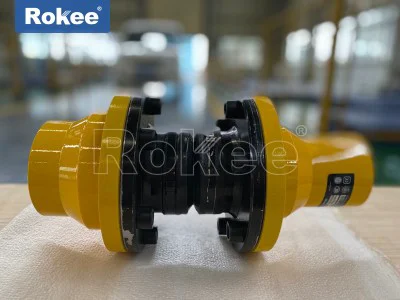
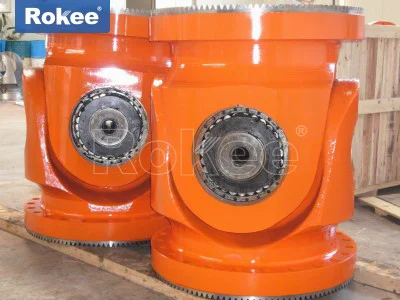
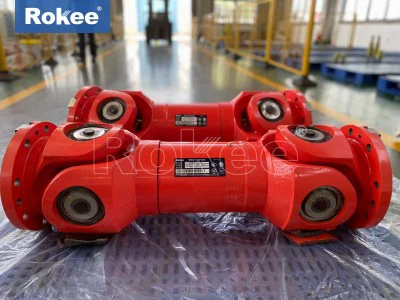
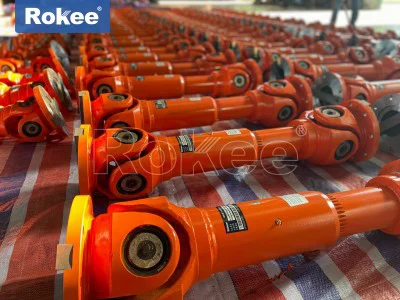
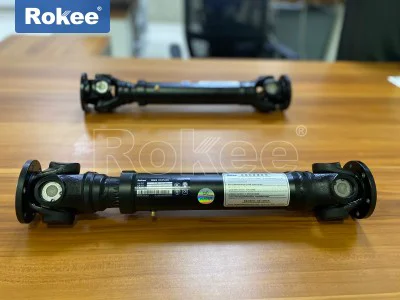
The basic structural design of conveyor universal joint couplings is refined and practical, tailored to the continuous operation characteristics of conveying equipment. The core structure mainly consists of two symmetric fork joints and a central cross shaft assembly, matched with high-precision bearing sets and sealed protective structures. The fork joints are connected to the drive shaft and driven shaft of the conveyor respectively, while the cross shaft acts as the flexible connecting core, enabling multi-angle rotational swing between the two joints. This classic articulated structure breaks through the limitation of fixed-axis transmission of traditional couplings, allowing the connected shafts to operate stably within a certain angular deflection range. For conveyor equipment with limited installation space or complex structural layout, the compact structural form of universal joint couplings avoids the bulky volume of other flexible transmission parts. Meanwhile, the overall integrated design enhances structural rigidity, ensuring that the coupling will not produce excessive deformation or torque loss when bearing the continuous load of material conveying. The internal bearing components adopt wear-resistant structural design, which can adapt to the frequent start-stop and continuous rotation working state of conveyors, laying a solid structural foundation for long-term stable operation.
The working principle of universal joint couplings in conveyor systems centers on flexible adaptive power transmission, realizing efficient torque output under misalignment conditions. When the conveyor driving motor operates and drives the active shaft to rotate, the cross shaft structure of the coupling converts the fixed-axis rotational motion of the active shaft into flexible rotational motion with adjustable angles. This mechanical conversion enables the driven shaft to synchronize rotation stably even when there is angular deviation or parallel offset between the two shafts. During the operation of industrial conveyors, factors such as uneven ground foundation, long-term load-bearing frame deformation and thermal expansion and contraction of metal components will inevitably cause shaft misalignment. Rigid transmission parts will generate huge additional stress under such conditions, leading to shaft vibration, noise and accelerated wear. In contrast, universal joint couplings rely on the flexible swing of the cross shaft and bearing assembly to offset these deviations, eliminate additional transmission stress, and keep the torque transmission rate stable. This adaptive working mode ensures that the conveyor can maintain uniform operating speed and stable material conveying state without jitter or material scattering caused by unstable power transmission.
Material selection and manufacturing craftsmanship determine the durability and operational performance of universal joint couplings for conveyors, adapting to harsh industrial working environments. Most high-quality conveyor universal joints adopt high-strength alloy steel as the main body material, which has excellent tensile strength, impact resistance and fatigue resistance, and can withstand long-term high-torque load operation of heavy-duty conveying equipment. The surface of the coupling is treated with anti-corrosion and wear-resistant processes to effectively resist the erosion of dust, moisture and industrial debris in the conveyor working environment, avoiding surface oxidation, rust and component abrasion. The key moving parts such as cross shafts and bearings undergo precision finishing and heat treatment to improve surface hardness and structural stability, reducing friction coefficient during relative movement. In addition, the internal sealing structure is optimized to prevent external dust and impurities from entering the movable gap, and avoid the loss of internal lubricating grease. This rigorous material matching and processing technology enables the coupling to maintain stable performance in high-frequency and long-term operating scenarios, reduce frequent failure rates, and adapt to the continuous production needs of industrial conveying lines.
Universal joint couplings bring significant performance advantages to the overall operation of conveyor systems, solving many pain points of traditional transmission structures. The most prominent advantage is their strong misalignment compensation capability, which can adapt to composite spatial displacement generated during conveyor installation and operation, greatly reducing the installation and debugging difficulty of conveying equipment. Compared with elastic couplings with limited compensation range, universal joint couplings support larger angular deflection while maintaining high transmission efficiency, without obvious power loss. In terms of vibration reduction and noise reduction, the flexible connection structure can effectively buffer the mechanical vibration generated by conveyor start-stop, load fluctuation and uneven material conveying, suppress resonance of the transmission system, and reduce operating noise. Moreover, the coupling has strong load adaptability, which can stably transmit torque under both light-load fine material conveying and heavy-load bulk material conveying conditions. Its impact resistance can cope with instantaneous load impact caused by uneven material feeding, protecting the conveyor motor, reducer and transmission shaft components from damage, and improving the overall safety and stability of the equipment.
The application scenarios of universal joint couplings cover almost all types of industrial conveyor systems, with strong industry adaptability. In belt conveyor systems widely used in mining, building materials and logistics industries, they connect the reducer output shaft and the roller drive shaft, adapting to the position deviation of the drive part caused by long-distance equipment layout and long-term operation. In screw conveyors for powder and granular material transportation, the flexible connection of universal joints solves the transmission obstacle caused by the inclined installation of the equipment, ensuring smooth power transmission in inclined and spatial turning conveying states. For roller conveying lines used in factory assembly lines and warehousing and sorting systems, the compact universal joint structure is suitable for dense and multi-group shaft connection layouts, realizing synchronous operation of multiple conveying rollers. In addition, they are also applied in special conveying equipment such as lifting conveyors and telescopic conveyors, adapting to the dynamic position changes of equipment during lifting and telescopic movement. Relying on their versatile performance, universal joint couplings have become standard matching parts for modern conveyor transmission systems.
Daily maintenance and reasonable use methods are crucial to extend the service life of conveyor universal joint couplings and maintain stable equipment operation. In routine equipment inspection, it is necessary to regularly check the operating state of the coupling, observe whether there is abnormal vibration, noise or jamming during rotation, and timely judge whether the internal moving parts are worn or the fixed structure is loose. Regular lubrication maintenance is essential, and professional high-temperature and wear-resistant lubricating grease should be filled into the bearing and cross shaft movable parts according to the operating frequency to reduce friction loss between components. It is necessary to regularly check the integrity of the sealing structure to prevent dust, material residues and moisture from entering the interior and causing component corrosion or clamping failure. During equipment operation, avoid long-term overload operation of the conveyor, because excessive torque will cause deformation and fatigue damage of the coupling structure. At the same time, regular calibration of shaft alignment can reduce the long-term maximum deflection operation of the coupling and slow down component wear. Standardized maintenance management can effectively reduce coupling failure rate, avoid equipment shutdown caused by transmission failure, and improve the continuous operation efficiency of conveyor systems.
With the continuous upgrading of industrial intelligent conveying equipment, the technological development of conveyor universal couplings is also advancing towards high efficiency, durability and intelligence. Modern conveying equipment is developing in the direction of high speed, heavy load and long-distance operation, which puts forward higher requirements on the transmission stability and fatigue resistance of couplings. New-type universal joint couplings adopt optimized structural topology design, further improving misalignment compensation ability and torque transmission efficiency while reducing self-weight and structural volume. Advanced wear-resistant and self-lubricating materials are gradually applied to core components, reducing the frequency of manual lubrication maintenance and improving equipment operation intelligence. In addition, the integrated protection design is continuously upgraded, with better dust-proof, waterproof and anti-collision performance, adapting to more complex and harsh industrial production environments. In the future, with the continuous innovation of mechanical manufacturing technology, universal joint couplings will achieve more precise transmission control and longer service life, providing more reliable core transmission support for the efficient and stable operation of modern intelligent conveyor systems.