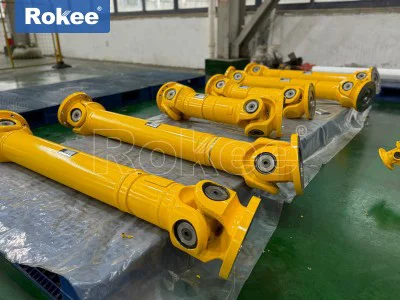
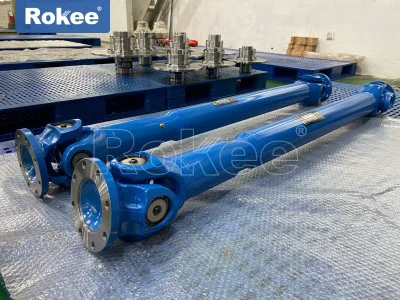
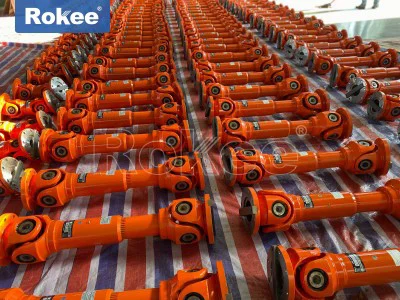
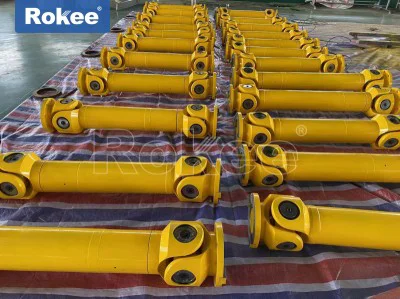
Cardan Universal Joint Coupling
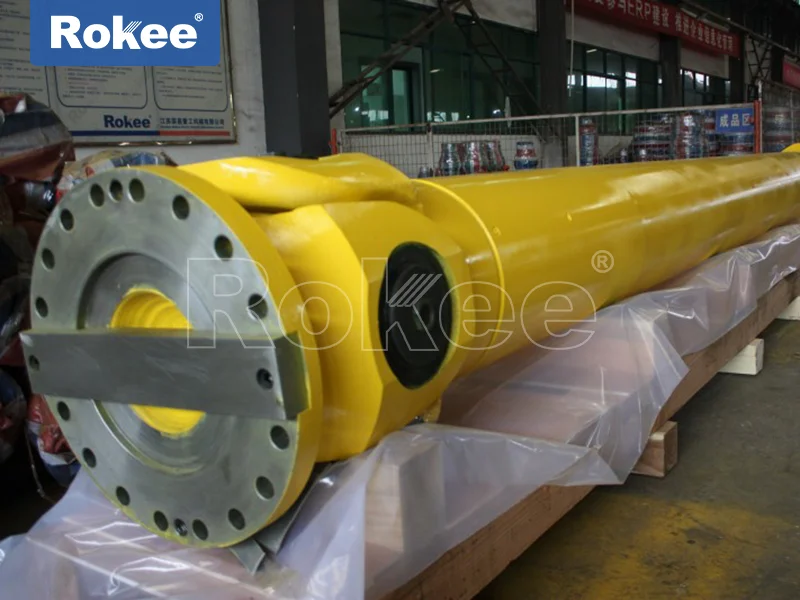
Cardan universal joint coupling, commonly referred to as U-joint, is a fundamental and versatile mechanical transmission component designed to transfer rotational torque and motion between two misaligned shafts. Distinguished by its unique hinged structural design, this coupling effectively accommodates angular deflection between driving and driven shafts, enabling stable power transmission even when the connected shafts are not collinear. Unlike rigid shaft couplings that only support coaxial transmission, the Cardan joint’s flexible pivoting mechanism adapts to dynamic angle changes during mechanical operation, making it indispensable in various power transmission systems. Its simple yet robust mechanical structure, reliable working performance, and strong environmental adaptability allow it to serve a wide range of mechanical equipment, from ordinary transmission devices to complex industrial machinery and mobile mechanical systems.
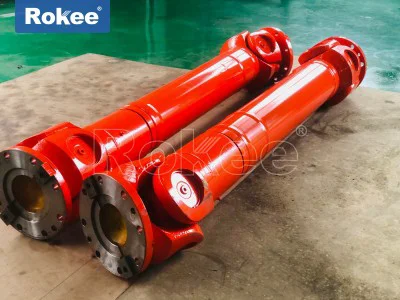
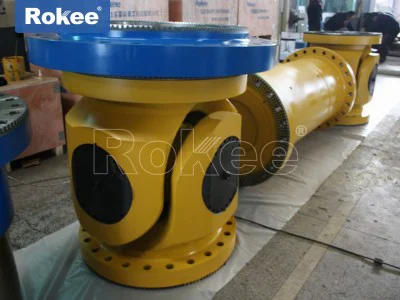
The structural composition of cardan universal joint coupling follows a precise and compact mechanical design, with every core component cooperating closely to complete torque transmission and deflection compensation. The core functional unit consists of a cross-shaped spider, two symmetrical fork-shaped yokes, and matched rolling bearing assemblies. The cross-shaped spider acts as the central hinge core, featuring four mutually perpendicular connecting arms that connect the two yokes separately, forming a flexible pivot structure with multi-directional rotation capability. One yoke is fixedly installed on the driving shaft while the other is mounted on the driven shaft, realizing the mechanical connection between the two shafts. The rolling bearings installed at the joints of the cross spider and yokes greatly reduce friction resistance during rotational operation, avoiding rigid friction and wear between metal components. In addition, complete auxiliary structures including sealing parts, positioning fasteners and anti-loosening components are equipped in practical applications. These auxiliary parts can isolate internal moving structures from external dust, moisture and impurities, prevent bearing lubricant leakage, and ensure the long-term stable operation of the coupling. The overall structural design abandons redundant configurations, focusing on mechanical strength and motion flexibility, which lays a solid foundation for its efficient power transmission and angle adaptation performance.
The working principle of Cardan universal joint coupling is based on the spatial hinge motion characteristics of its cross-yoke structure, realizing continuous torque transmission under angular misalignment conditions. When the driving shaft starts to rotate, it drives the connected active yoke to perform circular rotational motion, and the motion is transmitted to the cross-shaped spider through the bearing assembly. Driven by the cross spider, the passive yoke and the driven shaft synchronously rotate, completing the transmission of rotational power and torque. The most distinctive feature of this working mechanism is that it allows a certain angle of intersection between the two connected shafts. During operation, the cross spider can freely pivot at multiple angles relative to the two yokes, automatically compensating the angular deviation generated by shaft displacement or mechanical vibration. It is worth noting that a single Cardan joint has the characteristic of periodic instantaneous angular velocity fluctuation. When the driving shaft rotates at a constant speed, the instantaneous rotational speed of the driven shaft will produce regular slight changes within one rotation cycle. This speed fluctuation is a natural mechanical characteristic of the single-joint structure and will not affect the overall stable operation of low-speed and medium-load mechanical systems. For high-precision and high-speed transmission scenarios, double Cardan joint combinations are usually adopted to offset speed fluctuations and achieve more uniform power transmission.
Cardan universal joint coupling possesses unique mechanical motion characteristics that distinguish it from other types of shaft couplings, forming its core application value in mechanical transmission. First of all, it has excellent angular misalignment compensation capability, which can adapt to stable power transmission under persistent angular deflection and dynamic variable angle working conditions. This enables the coupling to cope with shaft position offset caused by mechanical operation vibration, equipment assembly errors and structural deformation, avoiding transmission jitter or component damage caused by rigid connection. Secondly, it has outstanding torque transmission stability under medium and heavy load conditions. The integrated forging structure of the cross spider and yoke has high mechanical strength and rigidity, which can bear large instantaneous torque and impact load without structural deformation or power transmission interruption. In addition, the coupling has flexible motion response, with small rotation resistance and sensitive power transmission, which can quickly synchronize the rotational speed of the driving and driven shafts. Its motion adaptability also includes good axial and radial auxiliary compensation performance, which can buffer slight axial displacement and radial deviation of the shafts during operation. These comprehensive mechanical characteristics make it adaptable to complex and variable working conditions that cannot be met by rigid couplings and elastic couplings.
The core performance advantages of Cardan universal joint coupling are fully reflected in structural practicability, operational reliability and cost-effectiveness, making it widely recognized in the mechanical industry. In terms of structural performance, its modular assembly design facilitates convenient installation, disassembly and daily maintenance. Each core component is independent and replaceable, without the need for overall equipment disassembly during maintenance, which effectively reduces equipment maintenance time and operating costs. In terms of operational reliability, the all-metal mechanical structure has strong wear resistance, high temperature resistance and impact resistance, and can maintain stable working performance in harsh working environments such as high dust, variable temperature and frequent start-stop operation. Compared with elastic couplings that rely on flexible rubber parts, it avoids aging, deformation and failure of elastic materials, with longer service life and more stable long-term performance. Moreover, the coupling has strong load adaptability, which can normally operate in both low-speed heavy-load and high-speed light-load working modes. Its power transmission efficiency remains at a high level within the allowable deflection angle range, with low mechanical energy loss. In addition, the simple and mature structural design effectively reduces manufacturing difficulty, ensuring stable product quality and good versatility for different types of mechanical equipment.
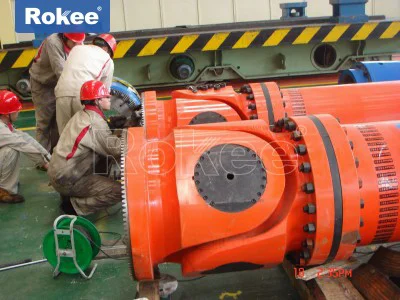
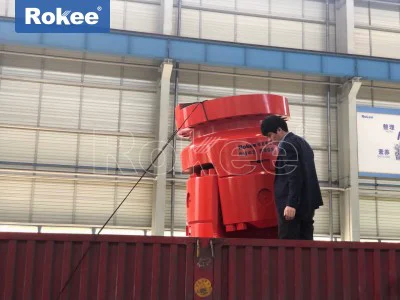
Cardan universal joint coupling is applied in a wide range of mechanical scenarios, covering industrial equipment, mobile machinery, transportation machinery and other multiple fields, relying on its excellent comprehensive performance. In industrial transmission systems, it is commonly used in various mechanical transmission devices that require variable angle power transmission, such as conveyor equipment, mechanical transmission platforms and processing machinery, solving the power transmission problem between offset shafts in complex mechanical layouts. In mobile engineering machinery, it serves as a key transmission component for walking and power output structures, adapting to the angle changes of mechanical arms and walking structures during operation. In the field of transportation machinery, it undertakes the power transmission work of power output systems, realizing stable power transmission between dynamically offset shafts during driving and operation. At the same time, it is also widely used in agricultural machinery, mining machinery and general mechanical equipment. In these scenarios, the mechanical structures often produce continuous vibration and position deviation during operation, and the Cardan joint’s misalignment compensation capability can effectively avoid transmission failure and component wear caused by shaft deviation. Its strong scene adaptability makes it a standard configuration component in most mechanical power transmission systems with variable angle transmission requirements.
Despite its extensive application advantages, Cardan universal joint coupling also has inherent performance limitations that restrict its application in high-precision and extreme working conditions. The most prominent limitation is the periodic instantaneous speed fluctuation of the single joint structure. This inherent mechanical characteristic will produce slight rotational vibration and torque pulsation during operation, which cannot meet the ultra-high precision transmission requirements of precision instruments and high-speed precision equipment. In addition, its allowable deflection angle has a certain limit. Excessively large shaft deflection will increase internal friction and torque loss, cause serious component wear, and even reduce transmission efficiency and service life sharply. Under long-term high-load and high-frequency operation conditions, the rolling bearings and friction pairs inside the coupling are prone to wear and fatigue aging, resulting in increased transmission clearance, jitter during operation and reduced transmission accuracy. Moreover, compared with some precision constant-velocity couplings, the single Cardan joint has weaker stability in high-speed continuous operation, and is more likely to produce mechanical noise and vibration. These limitations determine that it is more suitable for conventional industrial transmission scenarios, while high-precision, ultra-high-speed and super-large deflection working conditions need to be matched with optimized combined structures or other types of precision couplings.
With the continuous upgrading of modern mechanical manufacturing technology, the optimization and development of Cardan universal joint coupling are constantly advancing, focusing on solving its inherent performance defects and expanding its application scope. At present, the double Cardan joint combined structure has been widely popularized. By pairing two single joints symmetrically, the instantaneous speed fluctuation of a single joint is completely offset, realizing constant-velocity power transmission, which greatly improves the operation stability and transmission accuracy. In terms of material optimization, high-strength alloy materials and wear-resistant surface treatment processes are adopted for core components, which effectively improve the wear resistance, fatigue resistance and impact resistance of the coupling, and extend its service life under harsh working conditions. Structural optimization designs such as integrated sealing structures and self-lubricating bearing assemblies have also been applied, reducing later maintenance frequency and improving environmental adaptability. In addition, lightweight structural design is gradually applied to mobile mechanical equipment, reducing the overall weight of the coupling while ensuring mechanical strength, optimizing mechanical energy consumption. In the future, with the development of intelligent and high-precision mechanical equipment, Cardan universal joint coupling will further realize precision, lightweight and low-noise optimization, and expand its application in high-end mechanical transmission fields.