Cardan Coupling for Telehandlers

As a core power transmission component in modern material handling machinery, cardan couplings play an irreplaceable role in the stable operation of telehandlers. Telehandlers are widely applied in construction, agricultural production, warehouse logistics and municipal engineering, undertaking complex tasks such as high-altitude material handling, heavy load stacking and cross-distance cargo transportation. The entire working process of the equipment relies on continuous and efficient torque transmission between the power unit and the execution mechanism, and cardan couplings precisely solve the power connection problems caused by frequent posture adjustments, structural displacement and multi-angle movement of telehandler booms. Different from fixed mechanical transmission structures, telehandlers operate in highly variable working environments, with their telescopic booms, steering systems and walking mechanisms constantly producing angular deflection, axial displacement and radial deviation during operation. Ordinary rigid transmission parts cannot adapt to such dynamic structural changes, while the unique articulated structure of cardan couplings enables stable power transmission under non-collinear shaft connection conditions, becoming a key guarantee for the flexible and efficient operation of telehandlers.
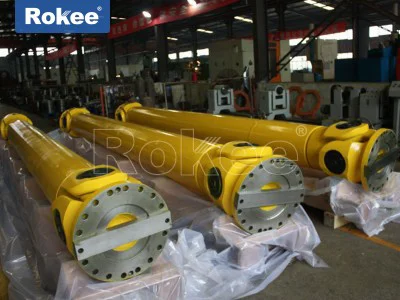
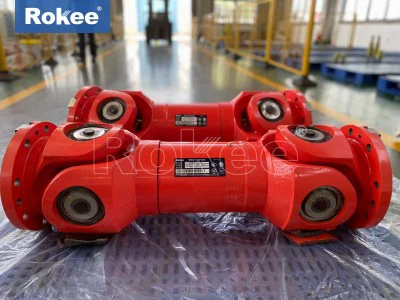
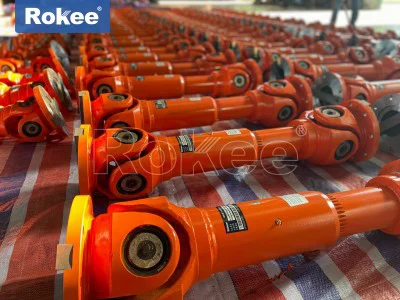
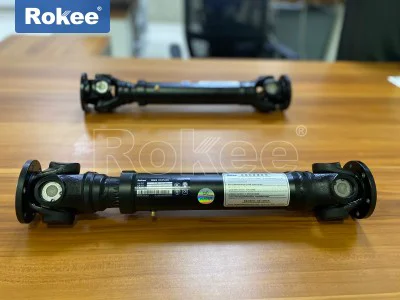
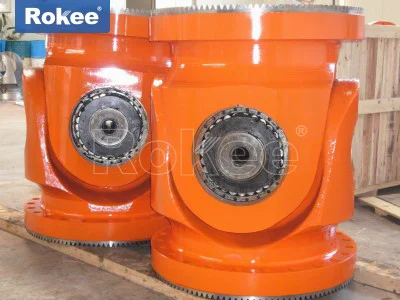
The basic structural composition of cardan couplings lays a solid foundation for their adaptive performance in telehandler systems. The core structure consists of two fork-shaped yokes and an intermediate cross-shaped spider, with precision bearings installed at each contact pivot of the cross shaft and yokes. This compact mechanical structure forms a flexible hinge connection, allowing mutual rotation and angle adjustment between the connected driving shaft and driven shaft. In the assembly structure of telehandlers, one end of the cardan coupling is connected to the power output shaft of the engine or hydraulic motor, and the other end is linked to the transmission shaft of the boom power system or walking drive system. The ingenious structural design enables the coupling to compensate for angular, axial and radial misalignments generated during equipment operation. When the telehandler’s boom stretches, retracts, lifts or deflects, the relative position of the power transmission shafts changes in real time, and the cross shaft of the coupling can freely rotate within a certain angle range to adapt to the shaft displacement, avoiding transmission stagnation or mechanical jamming caused by shaft misalignment. The internal needle bearings of the coupling effectively reduce friction resistance during pivot movement, ensuring the fluency of rotational power transmission while reducing mechanical wear.
The working principle of cardan couplings determines their excellent applicability to the complex working logic of telehandlers. As a non-rigid positive transmission component, it realizes synchronous rotation and torque transmission between two intersecting or non-parallel rotating shafts. When the driving shaft outputs rotational power, the cross shaft transmits the torque to the driven yoke and shaft through hinge rotation, maintaining continuous power output even with a real-time included angle between the two shafts. A single cardan coupling can adapt to a deflection angle ranging from 5 degrees to 45 degrees, fully covering the angle change range of telehandler transmission shafts during boom movement, steering adjustment and load lifting. In actual operation, telehandlers often bear uneven loads, and the fuselage will produce slight deformation and displacement under heavy load conditions. Rigid transmission structures are prone to stress concentration, resulting in shaft deformation, part fatigue or power transmission loss, while cardan couplings can buffer and release partial mechanical stress through their flexible hinge structure. This stress buffering effect effectively protects the entire transmission system from impact damage caused by sudden load changes or structural displacement, improving the overall operational stability of the equipment.
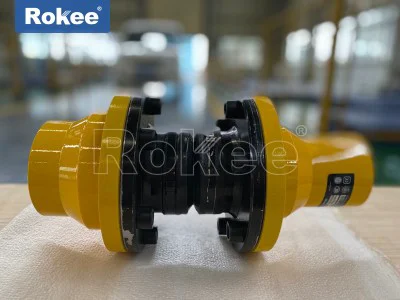
Compared with traditional transmission parts, cardan couplings show unique performance advantages matching the working characteristics of telehandlers. Telehandlers belong to multi-functional engineering machinery, with frequent start-stop operations, variable load conditions and complex working postures, which put forward extremely high requirements on the stability and durability of transmission components. Cardan couplings adopt an all-metal mechanical structure with high structural rigidity and torsional resistance, which can bear large torque impact generated by heavy load lifting and rapid boom movement. Unlike elastic couplings that rely on flexible materials for buffering, cardan couplings realize pure mechanical hinge transmission, avoiding aging, deformation and failure of elastic materials under long-term high-load operation, thus adapting to the long-duration and high-intensity working mode of engineering machinery. In addition, the double cardan coupling structure, optimized based on the single-section structure, further solves the problem of uneven instantaneous velocity in single-section transmission. By arranging two groups of universal hinge structures symmetrically and matching with a centering structure, it maintains equal angle operation of the two ends of the coupling, realizes constant velocity torque transmission, and eliminates the vibration and power fluctuation of telehandlers caused by velocity difference during power transmission, making the equipment’s operation more stable and precise.
The installation and matching characteristics of cardan couplings are highly compatible with the mechanical design of telehandlers. In the overall layout of telehandlers, the power system and execution mechanism are arranged in a scattered manner, and the transmission shafts cannot maintain absolute collinearity due to the limitations of fuselage structure, boom movement space and steering stroke. Cardan couplings do not require precise coaxial installation conditions, and can normally exert transmission performance within the allowable misalignment range, reducing the assembly difficulty of equipment and adapting to the structural design characteristics of telehandlers with multi-degree-of-freedom movement. Meanwhile, the compact structural size of the coupling avoids excessive occupation of the limited internal space of the telehandler fuselage, and the telescopic matching structure of individual models can adapt to the axial distance change of the transmission shaft during boom stretching and retracting, further expanding the application range. In the walking transmission system of telehandlers, cardan couplings can adapt to the chassis jitter and shaft displacement generated during off-road driving, ensuring stable power output of the walking mechanism; in the boom hydraulic transmission system, they can cope with the angle change of the oil pump and motor shaft during boom posture adjustment, ensuring continuous and stable hydraulic power supply.
Long-term stable operation of telehandlers depends on the durability and wear resistance of cardan couplings under harsh working conditions. Telehandlers often work in dusty construction sites, muddy farmlands and humid outdoor environments, and the transmission system is easily affected by dust, sediment and moisture, leading to part wear and corrosion. The structural design of cardan couplings takes full account of industrial working condition adaptability. The matching gaps of internal hinge parts are reasonably controlled, and the surface of metal parts is treated with anti-corrosion and wear-resistant processes, which can effectively resist the erosion of external impurities and reduce abrasive wear during operation. The bearing parts inside the coupling are filled with high-performance lubricating grease, which forms a stable lubricating film during operation, reducing the friction coefficient of the pivot parts and avoiding dry wear and mechanical noise caused by long-term operation. Under continuous heavy load and frequent angle adjustment, the coupling can maintain stable transmission accuracy, without loose failure or torque attenuation, ensuring that the telehandler can maintain consistent operating efficiency in long-hour and high-strength working scenarios.
Reasonable maintenance and daily inspection of cardan couplings are crucial to extend the service life of telehandler transmission systems. In the daily operation of telehandlers, the frequent movement of booms and chassis will cause continuous friction and fatigue load on the hinge parts of the couplings. Regular lubrication maintenance is required to supplement lubricating grease for the bearing parts and reduce the loss of mechanical friction. At the same time, it is necessary to regularly check the tightness of the coupling connection parts to avoid power transmission failure caused by loose assembly under long-term vibration. During seasonal operation and after long-time high-load work, the wear degree of the cross shaft and yoke pivot should be inspected. If slight wear or gap increase is found, timely adjustment and maintenance can prevent further expansion of mechanical defects. Different from vulnerable parts such as seals and gaskets, cardan couplings have a long service cycle, and standardized maintenance can effectively avoid sudden failure of the transmission system, reduce equipment downtime and maintenance costs, and improve the continuous operation capacity of telehandlers in engineering operations.
With the continuous upgrading of telehandler mechanical design towards high efficiency, energy saving and intelligence, the structural optimization and performance improvement of cardan couplings are also advancing synchronously. Modern telehandlers have higher requirements for transmission smoothness, energy utilization rate and low vibration operation. The optimized cardan coupling structure adopts more precise bearing matching and streamlined yoke design, which further reduces friction resistance and power transmission loss, improving the energy utilization efficiency of the whole machine. The lightweight structural optimization design reduces the self-weight of the coupling on the premise of ensuring torsional rigidity, effectively reducing the overall load of the telehandler transmission system and reducing energy consumption during equipment operation. In addition, the improved anti-vibration structural design can absorb and weaken the vibration generated during torque transmission, reduce the vibration resonance of the telehandler fuselage, improve the operating comfort and structural stability of the equipment, and also reduce the fatigue loss of other connecting parts of the fuselage.
In the entire mechanical system of telehandlers, cardan couplings are small in volume but undertake the core power transmission task, serving as the mechanical link that connects power output and execution action. All movement functions of telehandlers, from walking steering, boom lifting and stretching to load rotation and positioning, are inseparable from the stable torque transmission of cardan couplings. Its unique flexible transmission performance makes up for the structural defects of rigid transmission parts in adapting to dynamic displacement, solves the power transmission difficulties under complex working postures and variable load conditions, and becomes an indispensable core component of telehandler hydraulic transmission and mechanical transmission systems. With the continuous expansion of telehandler application scenarios and the improvement of equipment performance standards, cardan couplings will continue to be optimized in structural design, material performance and transmission efficiency, providing more reliable and efficient power transmission guarantees for modern multi-functional telehandlers, and promoting the continuous improvement of the overall working performance and service life of material handling machinery.