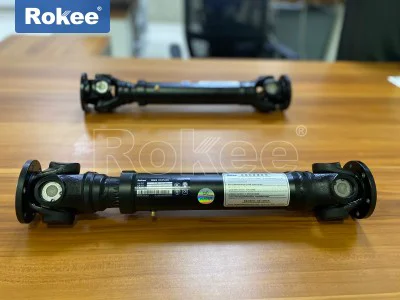
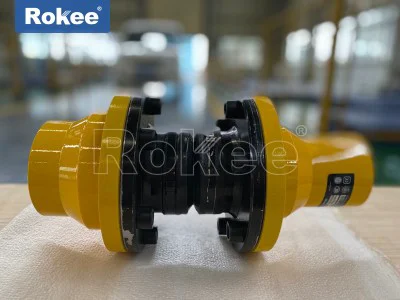
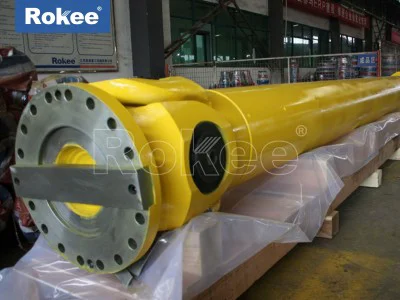
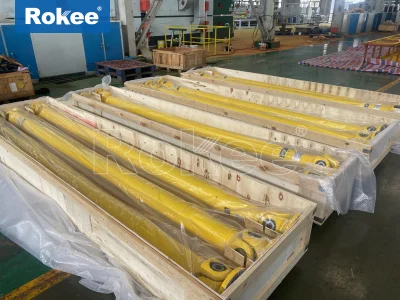
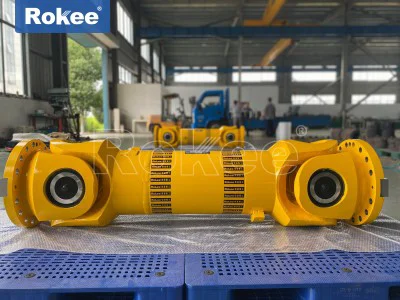
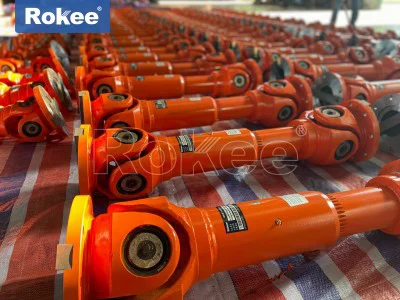
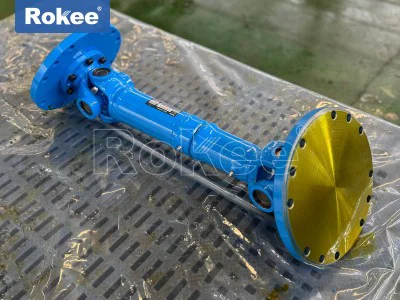
Large Angle Cardan Drive Shaft

Large angle cardan drive shaft is a specialized mechanical transmission component designed to deliver stable torque and rotational power between spatially misaligned shafts, standing out from conventional drive shafts with its exceptional large-angle deflection capacity. As a core derivative of standard cardan transmission structures, it retains the basic universal joint transmission mechanism while undergoing targeted structural optimization to adapt to extreme angular offset working conditions that ordinary drive shafts cannot withstand. This component effectively solves the power transmission bottleneck in mechanical systems where driving and driven shafts feature large inclination angles, frequent angle changes, and complex spatial layouts. It balances transmission efficiency, structural stability and load-bearing performance, making it widely applicable in various heavy-duty and special mechanical equipment. With the continuous upgrading of mechanical automation and industrial equipment, large angle cardan drive shafts have become an indispensable key part of modern transmission systems, providing reliable power connection solutions for complex and variable mechanical operating environments.
The structural composition of large angle cardan shafts is scientifically optimized around large-angle deflection and high-load transmission, inheriting the classic cardan joint core while enhancing each component’s adaptability to extreme working angles. The entire assembly mainly consists of reinforced universal joint heads, high-rigidity tubular shaft bodies, precision yoke assemblies, wear-resistant bearing units and flexible spline connection structures. Different from ordinary cardan shafts with limited deflection range, its cross-shaped central spider adopts an enlarged structural design with thicker wall thickness and optimized trunnion layout, which greatly expands the movable range of the joint. The yoke components are forged with high-strength alloy materials and undergo precision machining and stress relief treatment, effectively avoiding structural deformation and fatigue damage under large-angle bending conditions. The built-in needle roller bearings feature improved dimensional matching and surface hardness, reducing friction loss during high-angle rotational deflection. Meanwhile, the splined connection part reserves sufficient axial compensation space, which can adapt to the slight axial displacement of the shaft body while realizing large-angle transmission, ensuring the overall structural coordination and operational stability of the drive shaft in complex motion states.
The working principle of large angle cardan drive shafts is based on the spatial multi-linkage motion law of universal joint mechanisms, realizing continuous and stable power transmission under large angular misalignment between driving and driven shafts. When the power source drives the input shaft to rotate at a constant speed, the driving yoke synchronously drives the central cross spider to perform composite rotational motion. The cross spider transmits torque to the driven yoke through the vertically distributed trunnion structures, thereby driving the output shaft to rotate. In the working process with large deflection angles, the relative positional relationship between the cross spider and the two sets of yokes changes dynamically with rotation, and the optimized structural gap and movable range enable the joint to maintain flexible rotation without jamming or collision. To overcome the inherent speed fluctuation defect of single universal joints under large-angle conditions, most large angle cardan drive shafts adopt a double-joint combined layout. The two universal joints cooperate with each other to offset the uneven speed change generated by a single joint, ensuring that the output shaft maintains stable rotational speed and consistent torque output even at a large inclination angle, thus realizing efficient and continuous power transmission.
Large angle cardan drive shafts possess prominent technical advantages in structural adaptability and transmission performance compared with traditional transmission shafts, making them uniquely valuable in complex mechanical scenarios. First of all, their core advantage lies in the ultra-wide angular deflection capacity, which can stably complete power transmission under far larger shaft inclination angles than conventional products, breaking the spatial layout limitations of traditional transmission systems. Secondly, the optimized high-strength structural design endows the product with excellent load-bearing capacity and anti-fatigue performance. It can operate stably for a long time under heavy load, high torque and frequent angle switching working conditions, with low structural failure rate. In addition, the built-in flexible compensation structure can simultaneously adapt to angular deviation, axial displacement and slight radial misalignment, with strong comprehensive fault tolerance for installation errors and equipment operation deformation. Moreover, the improved bearing and friction matching structure effectively reduces rotational friction resistance and power loss, maintaining high transmission efficiency even in large-angle working states. The overall structure is compact and easy to install and debug, with strong compatibility with various mechanical power systems, which greatly improves the flexibility of mechanical equipment layout design.
The application scenarios of large angle cardan shafts cover multiple industrial and mechanical fields that require complex angular power transmission, with strong practicality and universal applicability. In heavy engineering machinery, they are widely used in the power transmission systems of excavators, cranes and loaders, adapting to the large-angle swing and displacement of mechanical arms and walking mechanisms during operation to ensure stable power output of movable components. In special transportation equipment, this drive shaft is applied to the transmission structures of special vehicles with variable wheelbase and adjustable chassis angle, solving the power connection problem of chassis components under dynamic angle changes. In industrial automation production lines, it serves the transmission parts of large-scale rotating and swinging equipment, providing reliable power support for reciprocating and angle-adjusting mechanical actions. In agricultural machinery and mining equipment, which feature harsh working environments and complex equipment movements, large angle cardan drive shafts adapt to the violent vibration and frequent angular deflection of equipment, maintaining continuous and stable power transmission. Its excellent large-angle adaptability also makes it an important transmission component in marine mechanical equipment and aerospace auxiliary power systems.
Despite its superior comprehensive performance, large angle cardan drive shafts still have certain working limitations and application constraints in actual operation, which need to be fully considered in equipment design and use. Excessively large deflection angles will still cause subtle torque fluctuation and transmission efficiency attenuation, even with double-joint compensation structure. When the shaft deflection angle approaches the extreme design value, the friction and wear of joint components will increase significantly, accelerating the fatigue loss of bearings and cross spider. In addition, under ultra-high speed and ultra-heavy load superimposed working conditions, the large-angle bending state of the shaft body will produce certain structural vibration, which may affect the operational stability of precision mechanical equipment. The structural complexity of large-angle optimized components also leads to higher requirements for processing precision and assembly technology, making the product more sensitive to installation accuracy errors. Meanwhile, long-term operation in high-temperature, dusty and corrosive environments will accelerate the aging and wear of sealing and friction parts, reducing the service life and working stability of the drive shaft. These limitations determine that targeted parameter matching and environmental adaptation design are required in practical application.
Scientific and standardized daily maintenance and fault prevention are crucial to prolonging the service life and maintaining the stable performance of large angle cardan drive shafts. Regular lubrication maintenance is the core of daily upkeep; professional high-temperature and wear-resistant lubricating grease should be regularly injected into the universal joint bearings and spline connection parts to reduce dry friction and component wear during large-angle rotation. It is necessary to regularly check the tightness of each fastening component to prevent bolt loosening and structural displacement caused by long-term vibration, which may lead to transmission deviation and component damage. Daily inspection should focus on the wear state of the cross spider, bearing rollers and yoke mating surfaces, and replace severely worn parts in a timely manner to avoid sudden failure during operation. In addition, the sealing performance of the drive shaft assembly should be checked regularly to prevent dust, impurities and corrosive media from entering the internal structure and damaging precision matching parts. During equipment operation, avoid long-term overload operation and extreme-angle limit operation, and reasonably control the working deflection angle within the optimal range, so as to effectively reduce structural fatigue loss and ensure the long-term stable operation of the large angle cardan drive shaft.
With the continuous progress of mechanical manufacturing technology and the upgrading of industrial equipment demand, large angle cardan drive shafts are evolving towards high precision, high durability, lightweight and intelligent optimization. In terms of material technology, new high-strength, wear-resistant and corrosion-resistant alloy materials are gradually applied to product processing, which further improves the load-bearing capacity and environmental adaptability of components while reducing the overall weight of the shaft body. In structural design, more bionic mechanical structures and finite element simulation optimization technologies are adopted to further balance the large-angle deflection flexibility and structural rigidity, reduce transmission vibration and torque fluctuation, and improve transmission stability and efficiency. In terms of processing technology, precision forging, CNC finishing and surface strengthening treatment technologies are popularized and applied, effectively improving the dimensional accuracy and surface performance of components. In the future, with the integration of intelligent monitoring technology, large angle cardan drive shafts will realize real-time monitoring of operating status, wear degree and angle deviation, providing data support for predictive maintenance, and further expanding their application scope in high-end intelligent mechanical equipment and special engineering fields.