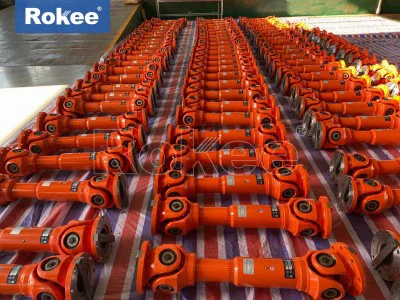
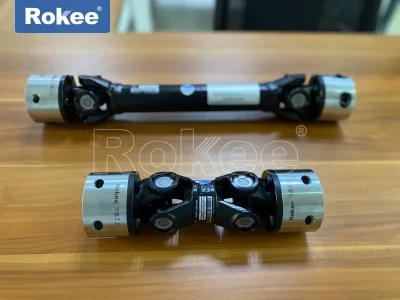
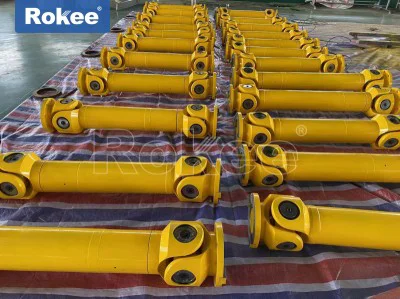
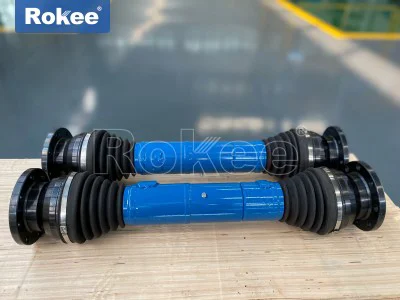
Telescopic Cardan Universal Joint Coupling

Telescopic cardan universal joint coupling is a versatile and high-performance mechanical transmission component evolved from traditional cross-shaft universal joints, specially designed to solve the dynamic misalignment and variable shaft spacing problems in mechanical transmission systems. Different from fixed-length universal joints, this coupling integrates the angular deflection compensation capability of classic cardan joints with flexible axial telescopic adjustment function, enabling it to adapt to three-dimensional displacement changes during equipment operation. Its core structural innovation lies in the built-in spline sliding pair, which allows the coupling to freely extend and contract within a certain stroke while stably transmitting torque. Widely applied in mechanical equipment requiring frequent position adjustment, vibration displacement and dynamic shaft distance change, it effectively reduces transmission vibration, avoids shaft jamming and mechanical wear caused by misalignment, and improves the overall stability and service life of the transmission system. As a key connecting part of power transmission, it has become an indispensable component in industrial transmission, mobile machinery and automated equipment fields due to its dual advantages of angle adaptability and length adjustability.
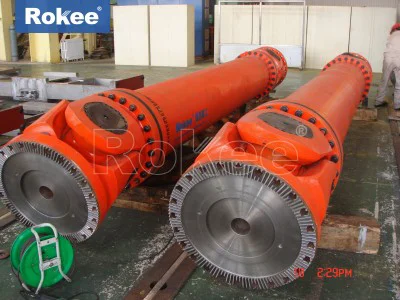
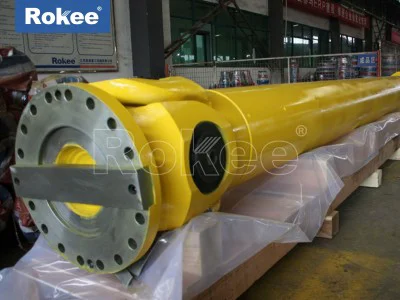
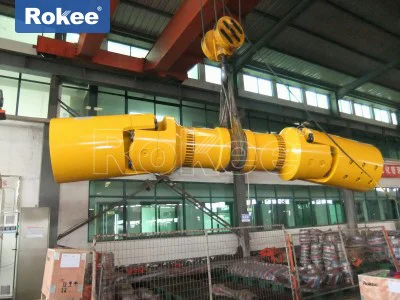
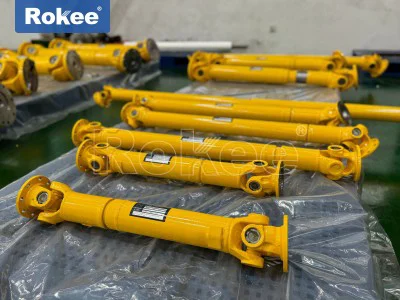
The structural composition of telescopic cardan universal joint coupling is precise and hierarchical, with each component undertaking independent and coordinated transmission functions to ensure stable and efficient power output. The core functional modules mainly include cross shaft universal joint assembly, telescopic spline pair, fork connection components and integrated sealing protection structure. The cross shaft assembly, composed of cross journal, needle roller bearings and bearing fixing parts, is the key part to realize angular compensation, which can flexibly adapt to the deflection angle between driving shaft and driven shaft and ensure continuous torque transmission under non-coaxial operating conditions. The telescopic spline pair consists of precisely machined internal and external splines, which form a sliding fit structure. This structure allows the coupling to achieve free axial stretching and retracting, so as to cope with the dynamic change of shaft spacing during equipment operation. The fork components at both ends adopt an integrated forging structure, with high structural rigidity and connection stability, which can firmly connect the coupling with the transmission shaft. In addition, the external dust-proof and sealing devices can effectively isolate dust, moisture and abrasive impurities in the working environment, prevent bearing wear and spline jamming, and maintain the long-term stable operation of the internal transmission structure.
The working principle of telescopic cardan universal joint coupling is based on the complementary cooperation of angular deflection transmission and axial sliding adjustment, realizing adaptive power transmission under complex displacement conditions. In the power transmission process, the driving shaft drives the fork and cross shaft assembly to rotate, and the cross shaft transmits torque to the driven fork and the connected driven shaft. When the two shafts produce angular misalignment due to equipment vibration, operation displacement or installation deviation, the cross shaft and needle roller bearing structure can flexibly rotate and deflect, offsetting the angle error and ensuring uniform and continuous torque transmission without power loss. When the working state changes and the axial distance between the two shafts changes dynamically, the internal and external spline pairs slide relatively along the axial direction. This telescopic movement does not interfere with the circumferential torque transmission, realizing the synchronous coordination of length adjustment and power output. Compared with ordinary fixed-length universal joints, this working mode completely solves the transmission failure problems caused by fixed shaft distance, such as shaft bending, component extrusion and increased friction loss, and greatly improves the adaptability of the transmission system to complex working conditions.
Telescopic cardan universal joint coupling possesses prominent performance advantages that make it superior to traditional coupling products in complex industrial working scenarios. First of all, it has dual compensation capabilities of angle and axial displacement, which can adapt to simultaneous angular deflection and axial distance change of the transmission shaft, a performance that ordinary rigid couplings and single-function universal joints cannot achieve. Secondly, the spline telescopic structure has smooth sliding performance and small friction resistance, which can realize real-time dynamic length adjustment without generating additional transmission resistance or mechanical impact, ensuring the stability of high-speed operation. In terms of load capacity, the cross shaft and high-strength fork structure can bear large torque and impact load, adapting to heavy-duty and intermittent working conditions. Moreover, the overall structure is compact and easy to install and disassemble, without complex debugging procedures in the installation process. The optimized sealing and wear-resistant design effectively reduces daily wear and fatigue loss, extending the service cycle of the equipment. In addition, its vibration damping performance is excellent, which can absorb part of the mechanical vibration generated during operation, reduce the vibration and noise of the transmission system, and improve the operating comfort and stability of the whole machine.
This type of coupling has extremely wide application coverage, mainly serving various mechanical equipment with dynamic displacement and variable transmission spacing requirements. In industrial production equipment, it is widely used in automated production lines, conveyor machinery and processing equipment, adapting to the position offset and spacing change of transmission shafts caused by equipment operation and mechanical movement, ensuring the continuous and stable operation of production transmission. In mobile engineering machinery, it is applied to the transmission systems of various mobile devices. The vibration and displacement of mechanical parts during walking and operation will cause real-time changes in shaft distance and angle, and the telescopic cardan coupling can perfectly adapt to such dynamic changes to maintain efficient power transmission. In addition, it is also commonly used in metallurgical machinery, mining equipment and packaging machinery. These devices often face harsh working environments and complex operating conditions, with frequent mechanical vibration and displacement. The strong environmental adaptability and displacement compensation ability of the coupling can effectively avoid transmission faults caused by mechanical displacement, reduce equipment failure rate, and improve the continuous operation efficiency of industrial equipment.
Material selection and manufacturing process determine the comprehensive mechanical properties and service life of telescopic cardan universal joint coupling. High-strength alloy steel is the mainstream raw material for core components such as cross shaft, fork and spline shaft. This material has high tensile strength, wear resistance and fatigue resistance, which can resist long-term torque impact, friction wear and mechanical fatigue in heavy-load operation. The key structural parts adopt precision forging and integral forming process, which eliminates the structural defects caused by welding and assembly, improves the overall structural rigidity and load uniformity, and avoids local stress concentration and component deformation. The spline pair is processed by precision broaching and grinding technology to ensure high matching accuracy of internal and external splines, reduce sliding friction and avoid jamming and abnormal wear during telescopic movement. The needle roller bearings inside the universal joint adopt high-precision assembly technology, with small rotation resistance and high rotation accuracy, ensuring flexible angular deflection movement. Meanwhile, surface treatment processes such as quenching and anti-corrosion coating are adopted for the outer surface of components, which enhances the hardness and anti-corrosion ability of the product, enabling it to adapt to high-temperature, dusty and humid harsh working environments.
Daily maintenance and fault prevention are crucial to maintaining the stable performance and long-term service life of telescopic cardan universal joint coupling. In routine use, regular lubrication maintenance is the core link. It is necessary to inject special high-temperature and wear-resistant lubricating grease into the bearing parts and spline sliding pairs regularly to reduce friction and wear between moving parts and avoid dry friction damage caused by lack of lubrication. At the same time, the sealing and dust-proof device should be inspected regularly to check for aging, damage or falling off of the sealing parts, so as to prevent external impurities from entering the interior and causing spline jamming and bearing abrasion. In the daily operation process, abnormal vibration, noise and transmission jitter of the coupling should be monitored in real time. Once abnormal conditions are found, the equipment should be shut down in time for inspection to eliminate hidden dangers such as component looseness, excessive wear and displacement deviation. In addition, long-term overload operation should be avoided, because long-term overload torque will cause fatigue deformation of cross shaft and fork structure, affecting the compensation accuracy and transmission efficiency of the coupling. Scientific and standardized maintenance can effectively reduce equipment failure rate, maintain the stable transmission performance of the coupling, and extend its overall service life.
With the continuous upgrading of modern mechanical transmission technology, the technical optimization and development trend of telescopic cardan universal joint coupling is becoming increasingly clear. At present, the industry is constantly optimizing its structural design, pursuing more compact volume and larger compensation stroke, so as to adapt to the miniaturization and high-precision development trend of modern mechanical equipment. The lightweight design of core components has become an important research direction. By optimizing the material ratio and structural layout, the overall weight of the coupling is reduced on the premise of ensuring load capacity, which helps reduce the overall energy consumption of the transmission system. In terms of performance optimization, new wear-resistant and anti-fatigue materials are gradually applied to production, which further improves the adaptability of the coupling to extreme working conditions such as high speed, heavy load and strong vibration. In addition, with the development of intelligent equipment, the integrated design of wear monitoring and fault early warning functions is gradually integrated into the coupling structure, realizing real-time monitoring of operating status. In the future, telescopic cardan universal joint coupling will develop towards higher precision, stronger adaptability, longer service life and intelligent maintenance, and will be more widely used in high-end intelligent manufacturing and advanced mechanical transmission fields.