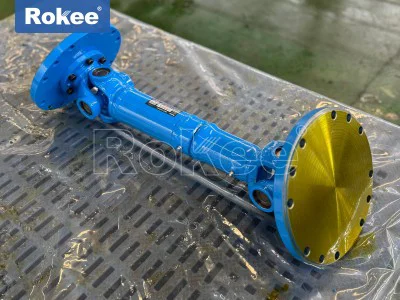
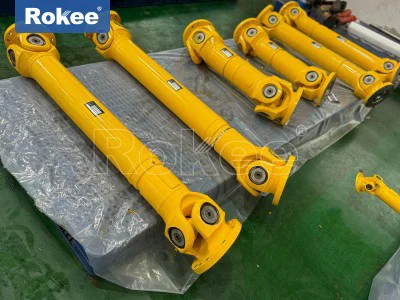
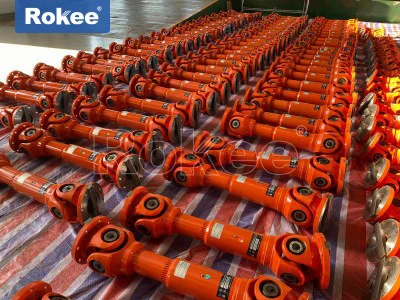
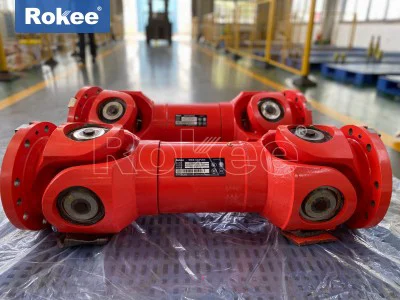
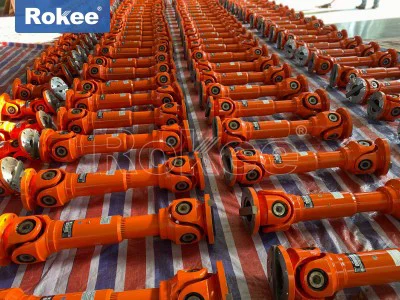
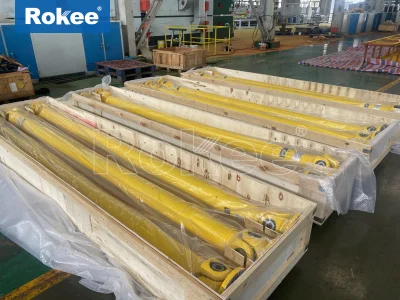
Universal Joint Coupling Low Speed Heavy Load

Universal joint couplings tailored for low-speed and heavy-load working conditions are essential flexible transmission components in modern heavy industrial mechanical systems, uniquely designed to address the torque transmission and shaft alignment challenges of large-scale equipment operation. Unlike conventional couplings optimized for high-speed and light-load scenarios, these specialized universal joints prioritize load-bearing stability, structural durability and displacement compensation capability rather than high rotational speed efficiency. They excel in connecting misaligned, spatially offset or dynamically changing transmission shafts, delivering continuous and stable high torque output at low rotational speeds while adapting to complex mechanical deformations and installation deviations during equipment operation. Widely deployed in heavy industrial fields that rely on steady low-speed power transmission, these couplings effectively buffer mechanical impact, reduce transmission failure risks, and extend the overall service life of heavy equipment, making them an irreplaceable core component of heavy-load mechanical transmission systems.
The core design logic of low-speed heavy-load universal joint couplings is fundamentally different from that of ordinary universal joints, with all structural optimizations centered on adapting to high torque pressure and low-frequency operation characteristics. Ordinary universal joints usually pursue lightweight structure and high-speed rotation stability, making them prone to structural deformation, bearing wear and torque loss under heavy load conditions. In contrast, low-speed heavy-duty models adopt thickened and reinforced core structures, including enlarged cross shaft bodies, thickened fork-shaped joint heads and high-rigidity bearing assemblies, which greatly enhance the overall structural strength and anti-deformation ability. The internal matching structure is precisely optimized to reduce assembly gaps, ensuring that each force-bearing component can evenly bear huge torque pressure during low-speed operation. Since low-speed operation avoids high-frequency centrifugal force and vibration interference, designers can focus on improving load-bearing limit and structural stability without sacrificing load capacity for speed performance, forming a professional transmission structure that perfectly matches the operating characteristics of heavy industrial equipment.
Working principle of low-speed heavy-load universal joint couplings follows the classic Cardan transmission mechanism, with adaptive improvements for heavy-load operating environments. The basic transmission process relies on the mutual cooperation of cross shaft and double fork joints to realize torque and rotational motion transmission between two shafts with angular deviation and axial offset. When the driving shaft rotates at a low speed, the cross shaft flexibly adjusts the angle and position of the driven shaft through the bearing assembly, maintaining continuous power output even when the two shafts produce dynamic displacement due to equipment load changes or mechanical vibration. Different from high-speed universal joints that need to suppress velocity fluctuation, low-speed heavy-load products allow mild instantaneous angular velocity changes, which is negligible for low-frequency operation but greatly improves the structural firmness under extreme load. This working principle enables the coupling to maintain stable transmission state under long-term heavy pressure, effectively solving the power interruption problem caused by shaft misalignment in traditional rigid transmission structures.
Material selection is the key factor determining the service performance and durability of low-speed heavy-load universal joint couplings, directly affecting their heavy-load resistance and fatigue resistance under long-term low-speed operation. Core load-bearing components such as cross shafts, joint forks and bearing seats are mostly made of high-strength alloy materials with excellent toughness and compressive resistance, which undergo special forging and heat treatment processes to eliminate internal structural defects and improve overall mechanical properties. These materials feature high yield strength and strong anti-fatigue performance, capable of withstanding long-term repeated high torque impact without plastic deformation or structural cracking. Auxiliary components including sealing parts and buffer gaskets adopt wear-resistant and pressure-resistant composite materials, which can adapt to harsh industrial working environments such as dust, humidity and mechanical friction. Reasonable material matching enables the coupling to maintain stable working performance in long-term continuous heavy-load operation, reducing frequent replacement and maintenance caused by component wear and damage.
Low-speed heavy-load universal joint couplings possess multiple unique performance advantages that make them suitable for harsh heavy industrial working conditions. First of all, they have excellent multi-directional displacement compensation capability, which can simultaneously adapt to angular deviation, axial displacement and radial offset between transmission shafts, tolerating larger installation errors and mechanical deformation than ordinary couplings. Secondly, their ultra-high torque bearing capacity can meet the power transmission demands of large-scale heavy equipment, realizing stable low-speed and high-power output without torque attenuation. In addition, the optimized structural design effectively reduces mechanical friction and impact wear, with low failure rate and strong operational stability during long-term continuous operation. Meanwhile, the simple and compact overall structure facilitates daily inspection and maintenance, avoiding complex disassembly operations. These comprehensive performance advantages enable the coupling to adapt to various complex and harsh working scenarios that are difficult for ordinary transmission components to cope with.
The application scenarios of low-speed heavy-load universal joint couplings cover almost all heavy industrial fields requiring stable low-speed high-torque transmission. In metallurgical industry, they are applied to rolling mill transmission systems to undertake stable power transmission during metal rolling, adapting to the huge load pressure generated by metal extrusion and rolling. In construction machinery, they serve large-scale crushing equipment, rotary drilling rigs and heavy hoisting equipment, ensuring reliable power output during low-speed heavy-load construction operations. In agricultural heavy machinery, the couplings support low-speed and high-torque transmission of large tillage and harvesting equipment, adapting to complex field working conditions and variable load changes. In addition, they are also widely used in mining equipment, port handling machinery and large industrial conveyor systems, providing stable transmission guarantee for various heavy-load and low-frequency operating mechanical equipment.
In actual industrial operation, standardized maintenance and use specifications are crucial to maintain the long-term stable performance of low-speed heavy-load universal joint couplings. Daily maintenance mainly focuses on regular lubrication of bearing and cross shaft friction parts, using high-viscosity and wear-resistant lubricating grease suitable for heavy-load conditions to reduce component friction and wear, and avoid dry grinding damage under high torque. It is necessary to regularly check the tightness of assembly parts to prevent connection looseness caused by long-term vibration, which may lead to transmission deviation and load concentration. Meanwhile, timely clean the dust, debris and corrosive substances attached to the coupling surface to avoid structural corrosion and component abrasion. During equipment operation, avoid sudden overload impact in a short time, and control the load change rate stably, so that the coupling can bear torque evenly. Scientific maintenance can effectively delay component fatigue aging, maximize the service life of the coupling, and ensure the long-term stable operation of the entire mechanical transmission system.
With the continuous upgrading of heavy industrial equipment towards large-scale and high-load operation, the technical optimization of low-speed heavy-load universal joint couplings is also advancing continuously. Current research and development directions mainly focus on structural lightweight optimization on the premise of maintaining high load-bearing performance, improving transmission flexibility while ensuring structural strength, and reducing equipment operation energy consumption. At the same time, new wear-resistant and high-strength composite materials are gradually applied to coupling manufacturing, further enhancing the anti-fatigue and anti-corrosion performance of products to adapt to more extreme working environments. In addition, integrated structural design and precise processing technology are continuously improved to reduce assembly gaps and transmission errors, and improve the overall transmission stability and efficiency. As the core component of heavy-load mechanical transmission, low-speed heavy-load universal joint couplings will continue to iterate and upgrade, providing more reliable and efficient transmission solutions for modern heavy industrial production.