Perfect Adaptation Scheme Of Universal Shaft Coupling And Sandwich Panel Line
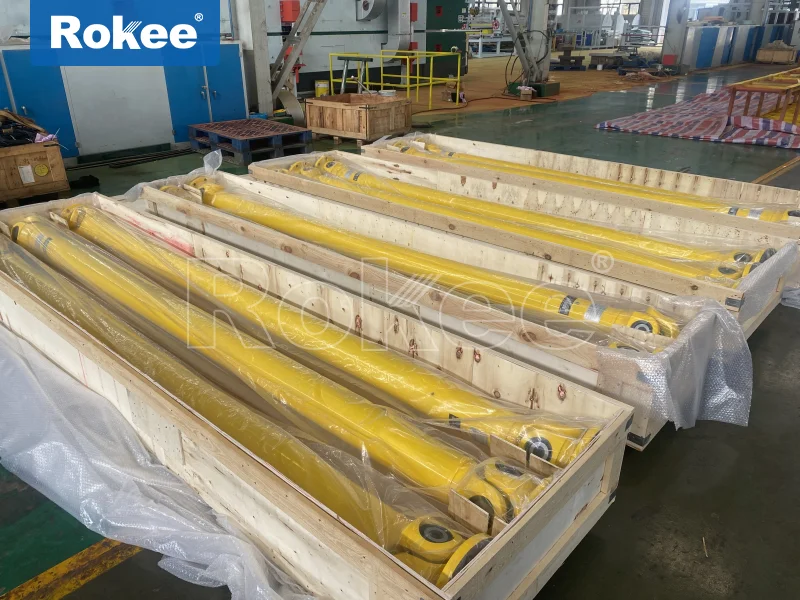
In the modern industrial production system, the sandwich panel line is an important equipment for the mass production of sandwich panels, which are widely used in construction, cold storage, transportation and other fields due to their excellent thermal insulation, sound insulation and load-bearing performance. The stable operation of the sandwich panel line directly determines the production efficiency, product quality and production safety. As a key connecting component in the power transmission system of the sandwich panel line, the universal shaft coupling undertakes the important task of transmitting torque between the motor, reducer and various working components (such as uncoiler, forming machine, cutting machine, conveyor, etc.). The perfect adaptation between the universal shaft coupling and the sandwich panel line is not only the premise to ensure the efficient and stable operation of the whole production line, but also an important means to reduce equipment failure rate, extend service life and reduce production costs. However, in actual production, due to the differences in the working conditions, load characteristics and structural design of the sandwich panel line, the improper adaptation of the universal shaft coupling often leads to a series of problems, such as uneven torque transmission, excessive vibration, abnormal noise, rapid wear of components, and even sudden shutdown of the production line, which seriously affects the normal production order. Therefore, it is of great practical significance to study and formulate a scientific and reasonable adaptation scheme of universal shaft coupling and sandwich panel line.
To realize the perfect adaptation between the universal shaft coupling and the sandwich panel line, it is necessary to first have a comprehensive understanding of the working characteristics of the two, clarify the core requirements of the adaptation, and then carry out targeted selection, installation, debugging and maintenance work. The sandwich panel line is a continuous production equipment with complex structure, which is composed of multiple functional units, and each unit has different working loads, speeds and motion forms. For example, the uncoiler needs to provide stable torque to realize the smooth uncoiling of the steel coil, and the speed needs to be adjusted according to the production rhythm; the forming machine needs to bear large impact load during the forming process of the sandwich panel, and the torque transmission needs to be accurate and stable; the cutting machine needs to have instantaneous large torque when cutting the finished sandwich panel, and the operation needs to be flexible and reliable. These different working requirements put forward diversified requirements for the performance of the universal shaft coupling. At the same time, the working environment of the sandwich panel line is usually accompanied by dust, vibration, temperature changes and other factors, which also puts forward higher requirements for the wear resistance, corrosion resistance and stability of the universal shaft coupling.
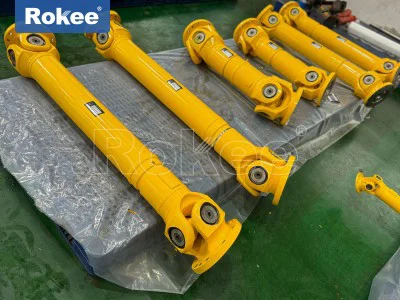
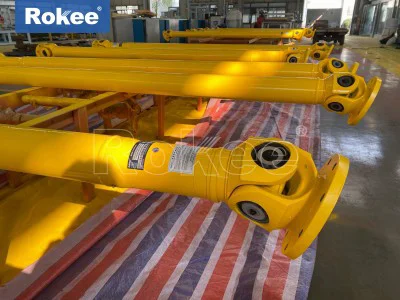
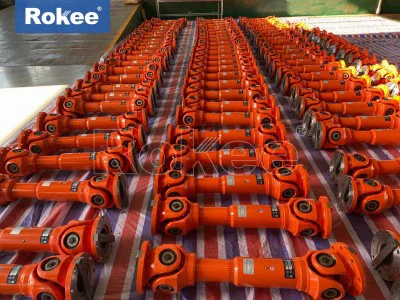
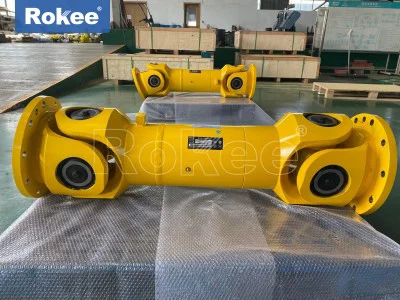
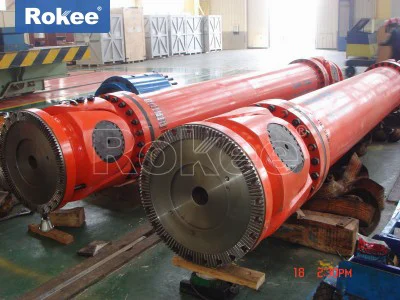
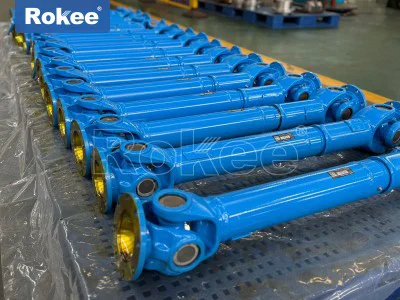
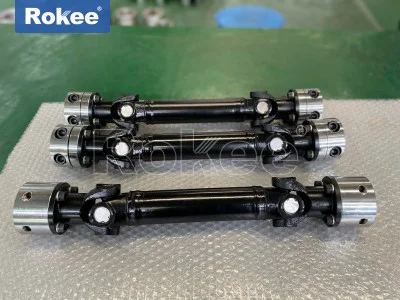
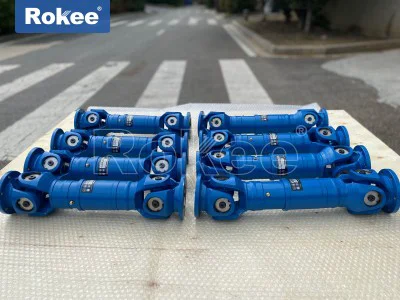
The universal shaft coupling is a kind of flexible coupling that can transmit torque between two shafts with relative displacement (angular displacement, radial displacement and axial displacement). Its main characteristics are strong adaptability, high transmission efficiency, and can compensate for the installation deviation and working displacement between the shafts. According to the structural form, it can be divided into cross shaft type, ball cage type, ball fork type and other types. Different types of universal shaft couplings have different performance characteristics and application scopes. For example, the cross shaft universal coupling has the advantages of simple structure, high bearing capacity and strong angular compensation capacity, which is suitable for heavy load and low speed working conditions; the ball cage universal coupling has the advantages of stable transmission, small vibration and high speed adaptability, which is suitable for high speed and precision transmission occasions. Therefore, the first step of the adaptation scheme is to select the appropriate type of universal shaft coupling according to the specific working conditions of each functional unit of the sandwich panel line.
In the selection process of the universal shaft coupling, it is necessary to comprehensively consider the following key factors to ensure that the selected coupling can perfectly match the working requirements of the sandwich panel line. First of all, it is necessary to determine the torque parameters of the coupling. The torque transmitted by the universal shaft coupling must be greater than the maximum working torque of the corresponding functional unit of the sandwich panel line, and a certain safety factor should be reserved to avoid torque overload leading to coupling damage. The maximum working torque of each functional unit can be calculated according to the motor power, speed and transmission ratio, and combined with the actual working load characteristics (such as whether there is impact load, pulsating load, etc.). For example, the forming machine and cutting machine in the sandwich panel line have obvious impact load during operation, so the safety factor should be appropriately increased when selecting the coupling, usually 1.5-2.5 times the maximum working torque. Secondly, it is necessary to consider the speed range of the coupling. The maximum allowable speed of the universal shaft coupling must be greater than the maximum working speed of the connected shaft to avoid resonance or excessive centrifugal force leading to coupling failure. The speed of each functional unit of the sandwich panel line varies, for example, the speed of the conveyor is relatively low, while the speed of the motor and reducer output shaft is relatively high, so it is necessary to select the coupling with corresponding speed level according to the actual speed.
In addition, the installation deviation and displacement compensation capacity of the universal shaft coupling should be considered. Due to the errors in the manufacturing and installation of the sandwich panel line, there will inevitably be angular deviation, radial deviation and axial deviation between the connected shafts. The universal shaft coupling selected must have sufficient compensation capacity to absorb these deviations, so as to avoid additional stress on the coupling and the connected shafts, and ensure the stable transmission of torque. For example, the cross shaft universal coupling can compensate for angular deviation up to 5°-45° (different models have different ranges), while the ball cage universal coupling can compensate for angular deviation up to 30°-40°, and has better radial and axial displacement compensation capacity. In the actual selection, it is necessary to determine the required compensation capacity according to the installation accuracy of the sandwich panel line and the working displacement of the components, and select the coupling with matching compensation performance. At the same time, the working environment of the sandwich panel line should be considered. If the production line is in a dusty, humid or corrosive environment, the universal shaft coupling with good sealing performance and corrosion resistance should be selected, such as adding protective covers, selecting corrosion-resistant materials or surface treatment methods, to prevent dust, moisture and corrosive media from entering the coupling, resulting in wear and corrosion of internal components.
After selecting the appropriate type of universal shaft coupling, the next step is to carry out scientific installation and debugging, which is an important link to ensure the perfect adaptation between the coupling and the sandwich panel line. The installation quality directly affects the transmission performance and service life of the coupling, as well as the stable operation of the whole production line. Before installation, it is necessary to carry out a comprehensive inspection of the universal shaft coupling and the connected shafts. First, check whether the coupling has cracks, deformations, rust or excessive wear, especially the key components such as the cross shaft, bearing, spline pair and flange. If any abnormal situation is found, it should be replaced or repaired in time. At the same time, check the surface of the connected shafts, remove oil stains, dust and burrs, ensure that the shaft surface is smooth and clean, so as to avoid affecting the fit accuracy between the coupling and the shaft. In addition, it is necessary to prepare appropriate installation tools, such as torque wrenches, laser alignment instruments, dial indicators, etc., to ensure the accuracy of the installation process.
During the installation process, the key is to ensure the alignment accuracy of the connected shafts. The alignment of the shafts is divided into angular alignment and radial alignment. If the alignment deviation is too large, it will lead to excessive vibration, noise and wear of the coupling, and even damage the motor and reducer in serious cases. For the ordinary working conditions of the sandwich panel line, the angular deviation should be controlled within 1°, and the radial deviation should be controlled within 0.1mm/m; for the high-speed or heavy-load working conditions (such as the connection between the motor and the reducer), the alignment accuracy requirement is higher, and the laser alignment instrument should be used for calibration to ensure that the angular deviation is not more than 0.05° and the radial deviation is not more than 0.1mm/m. When aligning, if there is a deviation, it can be adjusted by adding adjusting gaskets or adjusting the position of the equipment to ensure that the two shafts are in the correct alignment state. After the alignment is completed, the coupling is connected to the shaft. The connection method usually includes key connection, interference fit or bolt connection. When using key connection, it is necessary to ensure that the key and keyway fit closely, without looseness; when using bolt connection, it is necessary to adopt the diagonal step tightening method, and tighten according to the specified torque value to avoid uneven stress caused by uneven tightening, which leads to the deformation of the coupling flange. After the connection is completed, manually rotate the coupling to check whether it rotates flexibly, without jamming, abnormal noise or obvious resistance. If there is any abnormal situation, it should be checked and adjusted in time.
After the installation of the universal shaft coupling is completed, it is necessary to carry out systematic debugging work together with the sandwich panel line to verify the adaptation effect. The debugging work is mainly divided into no-load debugging and load debugging. In the no-load debugging stage, the sandwich panel line is started without any load, and the operation state of the universal shaft coupling is observed, including vibration, noise, temperature rise and other indicators. The normal operation of the coupling should be stable and quiet, without obvious vibration and abnormal noise. The temperature of the bearing part should not exceed 70℃. If there is abnormal vibration or noise, it may be caused by poor alignment, loose connection or excessive wear of components, and it is necessary to stop the machine in time for inspection and adjustment. After the no-load debugging is normal, the load debugging can be carried out. Gradually increase the load of the production line, from the minimum load to the rated load, and continuously monitor the operation parameters of the universal shaft coupling, such as torque transmission, vibration, temperature, etc., to ensure that the coupling can stably transmit torque under various load conditions, without overload, slippage or other phenomena. During the load debugging process, it is necessary to pay attention to the coordination between the coupling and each functional unit of the production line, ensure that the speed and torque of each unit are matched, and avoid the impact of the sudden change of load on the coupling. After the load debugging is completed and the operation is stable for a period of time (usually 24-48 hours), the adaptation effect of the coupling is considered to meet the requirements, and the production line can be put into formal operation.
The perfect adaptation between the universal shaft coupling and the sandwich panel line is not a one-time work, but requires long-term maintenance and management. Only through scientific and standardized maintenance can the good adaptation state be maintained, the service life of the coupling be extended, and the stable operation of the sandwich panel line be ensured. The daily maintenance work mainly includes the following aspects: first, regular lubrication. The universal shaft coupling has many moving parts (such as cross shaft, bearing, spline pair, etc.), which need to be lubricated regularly to reduce friction and wear, and prevent rust and corrosion. The type of lubricant should be selected according to the working conditions of the coupling. For ordinary working conditions, lithium-based grease can be used; for high-temperature, heavy-load or corrosive environments, high-temperature grease or anti-corrosion grease should be selected. The lubrication cycle should be adjusted according to the working intensity and environment. For ordinary working conditions, lubrication should be carried out every 300-500 hours or every 3 months; for harsh working conditions, the lubrication cycle should be shortened to 100-200 hours or every month. When lubricating, the old grease should be squeezed out by injecting new grease through the oil injection nozzle to ensure that the new grease fully fills the friction parts. For the coupling without oil injection nozzle, it should be disassembled for manual smearing.
Second, regular inspection. Regularly check the working state of the universal shaft coupling, including whether the connection bolts are loose, whether the components are worn, whether there is oil leakage, and whether the vibration and noise are abnormal. The inspection cycle can be set according to the production intensity. Generally, a daily inspection is required during the production process, focusing on observing the appearance and operation state of the coupling; a comprehensive inspection is required every 3-6 months, including disassembling the coupling to check the wear of internal components such as cross shaft, bearing and spline pair. If the wear of the cross shaft exceeds 2%-3% of the diameter, or the side clearance of the spline exceeds 1.5 times the initial value, the components should be replaced in time to avoid further damage. At the same time, the alignment state of the connected shafts should be rechecked every 6 months or during the major maintenance of the equipment to ensure that the alignment accuracy meets the requirements. In addition, for the high-speed coupling (rotating speed > 1000rpm), dynamic balance detection should be carried out regularly to ensure that the unbalance is ≤ 0.1g·mm/kg, so as to avoid excessive vibration caused by unbalance.
Third, cleaning and protection. Regularly clean the surface of the universal shaft coupling to remove oil stains, dust and impurities, so as to avoid impurities entering the internal parts of the coupling and accelerating wear. In a humid or corrosive environment, rust-proof oil should be applied regularly, or a coupling made of stainless steel should be selected to enhance corrosion resistance. At the same time, the protective cover of the coupling should be checked regularly to ensure that it is intact and firm, so as to prevent personnel injury or impurities from entering the coupling during operation. Fourth, fault handling. When the universal shaft coupling fails during operation (such as abnormal vibration, noise, bearing overheating, cross shaft wear and fracture, etc.), it is necessary to stop the machine in time for inspection and handling, and not continue to operate with faults, so as to avoid expanding the fault range and causing greater losses. For example, if the vibration and noise are abnormal, it can be solved by re-aligning, replacing worn components or optimizing lubrication; if the bearing is overheated, it may be caused by insufficient lubrication, grease pollution or seal failure, and it is necessary to unblock the oil injection nozzle, replace the lubricant or repair the seal structure; if the cross shaft is fractured, it is mostly related to overload, material fatigue or improper installation, and it is necessary to replace the components that meet the material requirements and strengthen the load monitoring.
In addition, in order to further improve the adaptation effect between the universal shaft coupling and the sandwich panel line, it is also necessary to pay attention to the coordination between the coupling and other components of the production line. For example, the selection of the reducer should match the motor and the universal shaft coupling to ensure that the torque and speed transmitted by the reducer can be stably transmitted to the working components through the coupling; the installation and adjustment of the working components (such as uncoiler, forming machine, etc.) should also consider the adaptation with the coupling to avoid the impact of the installation deviation of the working components on the coupling. At the same time, the operation and maintenance personnel of the production line should be trained regularly to improve their understanding of the performance and adaptation requirements of the universal shaft coupling, master the correct installation, debugging and maintenance methods, and timely find and handle the potential problems in the operation process, so as to ensure the long-term stable operation of the coupling and the whole production line.
It should be emphasized that the adaptation scheme of the universal shaft coupling and the sandwich panel line is not fixed, but needs to be adjusted and optimized according to the actual working conditions and production needs. With the continuous upgrading of the sandwich panel line and the continuous improvement of production efficiency requirements, the performance requirements of the universal shaft coupling are also constantly improving. Therefore, it is necessary to regularly summarize the operation experience, analyze the problems existing in the adaptation process, and continuously optimize the selection, installation, debugging and maintenance schemes of the coupling, so as to achieve the perfect adaptation between the universal shaft coupling and the sandwich panel line, and provide a strong guarantee for the efficient, stable and safe operation of the sandwich panel production.
In conclusion, the perfect adaptation between the universal shaft coupling and the sandwich panel line is a systematic project involving selection, installation, debugging, maintenance and other links. Only by comprehensively considering the working characteristics of the two, selecting the appropriate type of coupling, carrying out scientific installation and debugging, and strengthening daily maintenance and management, can we effectively avoid the problems caused by improper adaptation, ensure the efficient and stable transmission of torque, reduce the equipment failure rate, extend the service life of the equipment, and ultimately improve the production efficiency and product quality of the sandwich panel line, creating greater economic benefits for the enterprise. In the future, with the continuous development of mechanical manufacturing technology, the performance of the universal shaft coupling will be further improved, and the adaptation scheme with the sandwich panel line will be more scientific and reasonable, which will provide more reliable support for the development of the sandwich panel industry.