Cardan Shaft Coupling For PU Sandwich Panel Machine With Easy Maintenance And Reduced Loss

The continuous and stable operation of PU sandwich panel production lines is the fundamental guarantee for consistent product forming quality, uniform foam density, and precise dimensional accuracy of finished building insulation panels. As a core transmission component connecting driving power units and driven processing mechanisms in the entire production system, the cardan shaft coupling undertakes the critical task of transmitting stable torque and rotational power throughout every production link, from raw material feeding and continuous foaming to panel pressing, cutting, and finished product conveying. PU sandwich panel manufacturing belongs to continuous industrial production mode with long-term uninterrupted operation, complex on-site working conditions, and frequent dynamic load changes during equipment startup, shutdown, and production speed adjustment. Traditional rigid transmission connecting parts often struggle to adapt to the actual operating environment of such production lines, prone to severe transmission vibration, obvious power transfer attenuation, rapid wear of matching parts, and frequent failure shutdowns caused by installation alignment deviations and operational mechanical displacement. These common problems not only directly increase unnecessary power consumption and production operating costs but also lead to frequent equipment maintenance, prolonged downtime, unstable production rhythm, and even fluctuations in the quality of PU sandwich panels, resulting in unqualified products and additional production waste. In contrast, the professionally customized cardan shaft coupling for PU sandwich panel machines stands out among various transmission connection accessories by virtue of its unique structural design, excellent displacement compensation performance, ultra-low transmission loss characteristics, and user-friendly simple maintenance design, becoming an indispensable key configuration to optimize the transmission efficiency of PU sandwich panel production lines, extend the overall service life of mechanical equipment, and reduce daily operation and maintenance burdens for production enterprises.
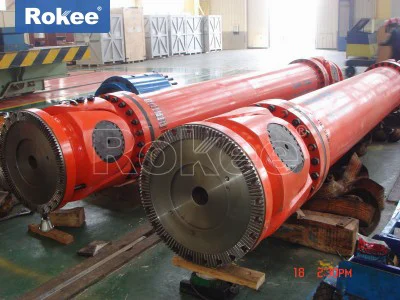
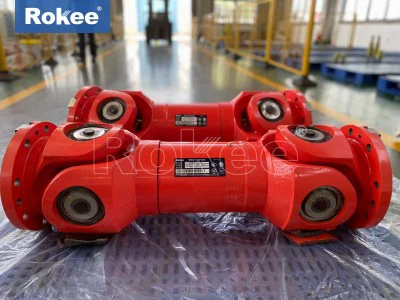
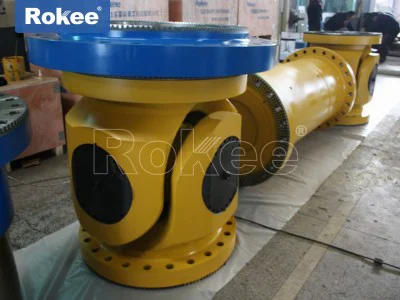
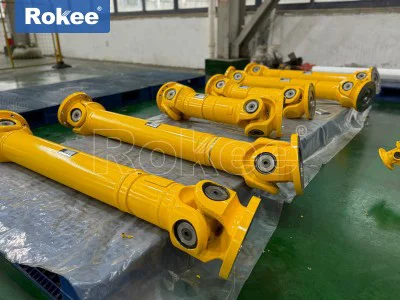
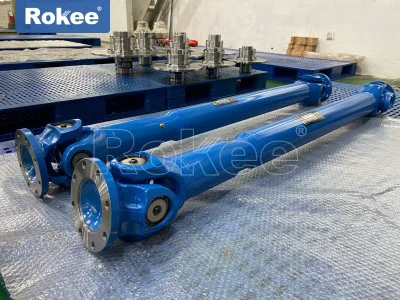
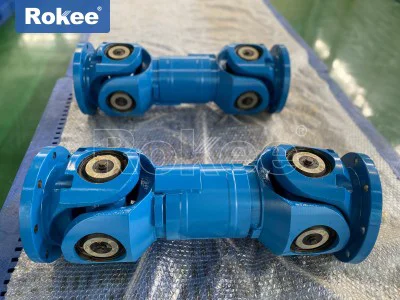
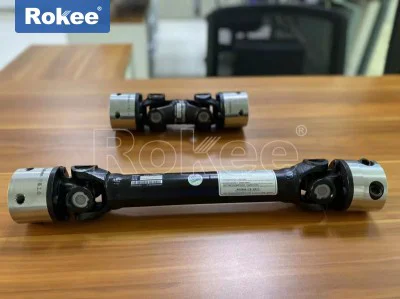
The inherent structural advantages of the cardan shaft coupling lay a solid foundation for its stable and efficient operation in the complex working scenarios of PU sandwich panel production equipment. The core structure of this coupling is composed of symmetrically arranged articulated yokes and a precision forged cross shaft spider, with two sets of hinge structures arranged perpendicular to each other and closely connected as the main force transmission carrier. This classic and mature mechanical structure design fundamentally breaks through the inherent limitations of rigid couplings that require extremely high coaxial alignment of driving and driven shafts during installation and operation. In the actual assembly and use process of PU sandwich panel production lines, affected by large-scale equipment installation foundation settlement, long-term mechanical operation vibration, thermal expansion and contraction of metal components caused by continuous production temperature changes, and slight position deviation of mechanical parts under long-term cyclic load, it is almost impossible to maintain absolute precise coaxiality between the power input shaft and the equipment working shaft for a long time. Small angular deflection, axial displacement, and radial offset between the two shafts are inevitable objective phenomena in daily production and operation. The cardan shaft coupling can effectively compensate for all kinds of misalignment deviations generated during equipment installation and long-term operation relying on the flexible rotation coordination between the cross shaft and the articulated yokes, ensuring that the torque and rotational power output by the power unit can be continuously and smoothly transmitted to each processing mechanism of the PU sandwich panel machine without interruption and without extra mechanical stress. Unlike elastic couplings that rely on flexible rubber or plastic buffer parts for deviation compensation and vibration reduction, the main load-bearing and transmission components of the cardan shaft coupling are all made of high-strength alloy metal materials processed by precision forging and heat treatment, which have excellent mechanical strength, strong impact resistance, and outstanding fatigue resistance, perfectly adapting to the heavy-load and continuous operation characteristics of PU sandwich panel production lines that run for hundreds of hours continuously without frequent shutdown.
Reduced transmission loss is one of the most prominent core advantages of the cardan shaft coupling applied to PU sandwich panel machines, and it also brings tangible energy-saving and consumption reduction benefits for long-term continuous production processing. In the entire mechanical transmission system of PU sandwich panel production equipment, any tiny resistance, friction loss, and power attenuation in the link of power transmission from the motor and reducer to the foaming pressing mechanism and conveying and cutting mechanism will be amplified in the long-term continuous production process, eventually forming huge unnecessary energy waste and increasing the overall production energy consumption of the enterprise. Many traditional ordinary couplings have unreasonable force transmission paths and large contact friction between matching parts during operation. When encountering shaft body misalignment and load fluctuation, additional friction resistance and mechanical vibration will be generated, which not only consumes a large amount of effective power but also converts the lost power into heat energy, causing temperature rise of transmission parts, accelerated aging and wear of components, and further worsening transmission efficiency. The cardan shaft coupling adopts a direct and efficient force transmission design with a compact and reasonable internal structure. The contact fit between the cross shaft and the articulated yokes is precise and compact, with smooth rotation coordination and no redundant mechanical friction and idle rotation during operation. Even under the conditions of angular deflection and dynamic load changes during the operation of the PU sandwich panel machine, the coupling can still maintain a stable and efficient power transmission state, minimizing the power loss in the torque transmission process. This low-loss transmission characteristic ensures that almost all the power output by the power equipment acts on the actual production and processing links of PU sandwich panel foaming, pressing and forming, avoiding energy waste caused by transmission failure. At the same time, stable and low-vibration transmission operation effectively reduces the vibration and impact on the main mechanical components of the equipment such as bearings, reducers and machine bases, reduces the mechanical fatigue loss of key equipment parts, and indirectly extends the service life of the entire PU sandwich panel production line equipment, helping production enterprises reduce the frequency of equipment replacement and renovation and lower long-term production input costs.
Easy maintenance and simple daily upkeep design make the cardan shaft coupling highly adaptable to the actual production and operation management needs of PU sandwich panel processing enterprises, effectively solving the pain points of traditional transmission parts that are difficult to maintain, time-consuming to repair and costly to replace. Most of the production workshops engaged in PU sandwich panel manufacturing adopt continuous shift production mode, and the production line needs to maintain long-term uninterrupted operation to meet market order demand. Any long-term equipment shutdown maintenance will directly lead to production schedule delays, order delivery delays and economic losses. Therefore, production enterprises have extremely high requirements for the convenience of daily maintenance and the simplicity of fault handling of key equipment components. Many traditional couplings have complex integrated structures, sealed and non-detachable designs, or require professional precision tools and professional technical personnel for disassembly, inspection and maintenance. Once wear, aging or minor failure occurs, the maintenance process is cumbersome, the replacement cycle is long, and the production line has to be shut down for a long time, seriously affecting the normal production rhythm. The cardan shaft coupling for PU sandwich panel machines adopts a modular and split assembly design for all key components, with a simple overall structure and clear disassembly and assembly steps. All wearing parts and key matching parts are designed with standardized specifications, without complex installation procedures and tedious debugging work in daily maintenance and replacement. The regular daily maintenance work of the coupling only needs simple regular lubrication treatment and routine visual inspection of the connection fastening state, which can be completed by ordinary on-site equipment operators without the need for professional maintenance technicians with professional skills and complex detection equipment. When individual wearing parts reach the service life and need to be replaced, the whole replacement process can be completed in a short time without disassembling a large number of adjacent mechanical parts, realizing rapid maintenance and quick restart of the production line, minimizing the shutdown time caused by coupling maintenance and replacement, and ensuring the continuity and stability of PU sandwich panel production work.
In the actual production and application process of PU sandwich panel machines, the excellent matching performance of the cardan shaft coupling is also reflected in its strong adaptability to complex on-site working conditions and stable operation reliability under variable load production states. The production and processing of PU sandwich panels involves multiple complex links such as raw material mixing, high-pressure foaming, continuous rolling pressing, fixed-length cutting and finished product transportation. The load of the equipment transmission system is not constant during the production process, and frequent load changes will be generated with the adjustment of production speed, the switching of production specifications of different thicknesses of sandwich panels, and the startup and shutdown of the front and rear processing equipment. Some ordinary couplings are prone to loosening of connecting parts, abnormal transmission noise, obvious vibration and even part damage under frequent variable load conditions, which not only affects the transmission stability but also easily causes jitter of the sandwich panel during pressing and forming, resulting in uneven panel thickness, inconsistent foaming core density and poor surface flatness, affecting the overall quality and market applicability of finished products. The cardan shaft coupling has high structural rigidity and strong impact load resistance, and can cope with frequent load fluctuations and instantaneous impact torque generated during the operation of PU sandwich panel production lines without structural deformation and connection loosening. Its good vibration damping and buffering effect can effectively weaken the mechanical vibration generated during equipment operation, avoid the vibration conduction to the panel forming and processing links, ensure that the PU sandwich panel is always in a stable forming state in the foaming and pressing stage, effectively guarantee the consistent dimensional accuracy and stable internal quality of each batch of finished panels, and reduce the defective rate and rework rate of products caused by transmission system instability.
Moreover, the long-term service life and low wear characteristics of the cardan shaft coupling further reduce the comprehensive operating cost of PU sandwich panel production enterprises and bring long-term stable economic benefits to production and processing. The key components of the coupling are processed through multiple precision processes and special heat treatment technology, with high surface hardness, good wear resistance and strong corrosion resistance. The internal friction pairs are designed with optimized contact structures, which reduce the wear degree of parts during long-term high-frequency operation. Under the normal operating conditions of the PU sandwich panel production line, the coupling can maintain stable transmission performance for a long time without frequent replacement due to excessive wear of parts. Compared with other types of couplings that need to be replaced frequently and have high later maintenance and replacement costs, the cardan shaft coupling has lower long-term use cost and less maintenance workload. For PU sandwich panel production enterprises, this not only saves a lot of spare parts procurement costs and manual maintenance labor costs every year but also avoids production efficiency reduction and economic losses caused by frequent equipment shutdown and maintenance. While ensuring the efficient and stable operation of the production line, it realizes the dual goals of reduced loss operation and simple and efficient maintenance, and creates a more stable and cost-effective production operation condition for the standardized and large-scale production of PU sandwich panels.
In conclusion, as a professional transmission connection component tailored for PU sandwich panel production machines, the cardan shaft coupling perfectly integrates efficient low-loss transmission performance, easy daily maintenance advantages, strong working condition adaptability and long-term stable operation reliability. Aiming at the pain points of easy transmission loss, frequent failure, difficult maintenance and high operating cost of traditional couplings in the application of PU sandwich panel production lines, this coupling relies on its unique structural design and excellent mechanical performance to effectively optimize the equipment transmission effect, reduce power consumption and mechanical wear, simplify daily maintenance work, shorten equipment shutdown time, and stabilize product production quality. With the continuous development of the building insulation material industry, the market has higher and higher requirements for the production efficiency, product quality stability and production cost control of PU sandwich panels. Choosing a high-performance cardan shaft coupling with easy maintenance and reduced loss is not only an important measure to optimize the transmission system of PU sandwich panel production equipment, but also an inevitable choice for production enterprises to realize efficient production, cost reduction and efficiency improvement, and long-term stable development. In the future continuous production and operation, this kind of coupling will continue to play an irreplaceable core role in the mechanical transmission link of PU sandwich panel machines, escorting the stable operation of production lines and the high-quality output of building insulation sandwich panel products.