Mining Cardan Shaft
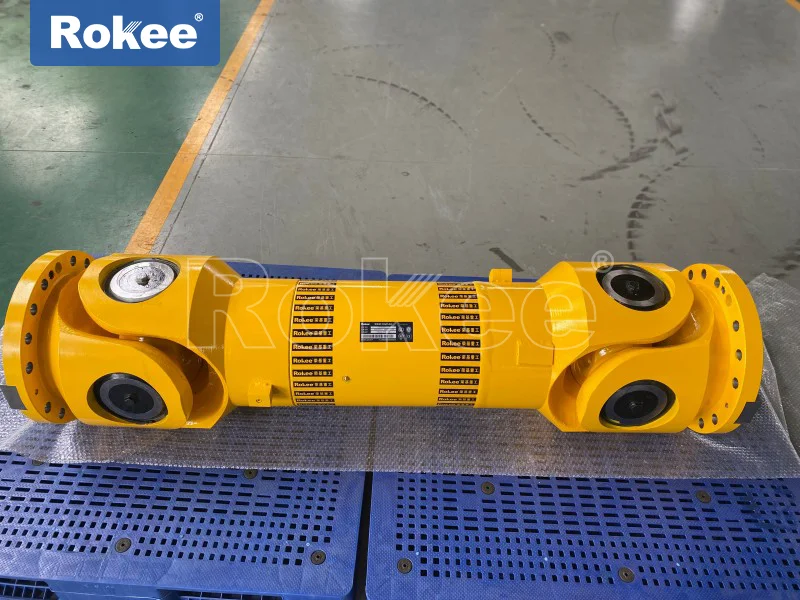
In the complex and harsh operating environment of mining operations, the efficient and reliable transmission of power is crucial to ensuring the smooth operation of various mining equipment, and the mining cardan shaft, as a key mechanical component in power transmission systems, plays an irreplaceable role. Unlike cardan shafts used in general industrial fields, mining cardan shafts are specially designed and manufactured to adapt to the extreme working conditions of mines, including heavy loads, frequent misalignments, strong vibrations, large temperature fluctuations, and exposure to dust, gravel, and corrosive substances. To fully understand the importance of mining cardan shafts in mining production, it is necessary to conduct an in-depth analysis of their structure, performance, types, and specific applications, which can not only help in the rational selection and proper use of these components but also provide a basis for their maintenance, service life extension, and operational efficiency improvement.
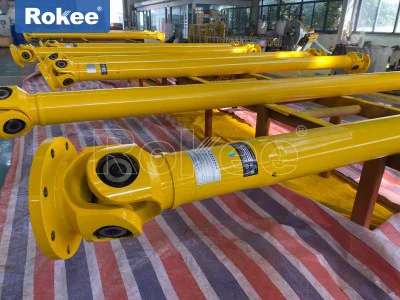
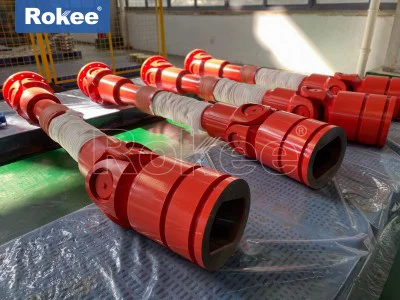
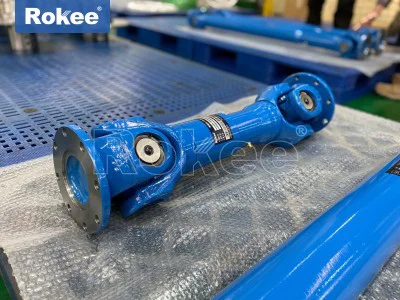
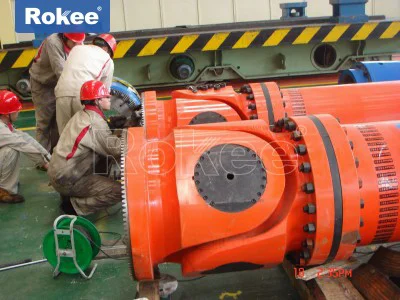
The structure of a mining cardan shaft is a sophisticated assembly of multiple components, each of which undertakes specific functions to ensure the overall stability and reliability of power transmission under harsh mining conditions. At the core of its structure is the universal joint, also known as the U-joint, which is the key component that enables the cardan shaft to transmit torque between two shafts with angular misalignment. The universal joint typically consists of a cross shaft, four needle roller bearings, and two fork-shaped yokes. The cross shaft, made of high-strength alloy steel through precision forging and heat treatment, has four cylindrical journals that match the needle roller bearings, ensuring smooth rotation and strong load-bearing capacity. The needle roller bearings, which are installed in the bearing seats of the fork yokes, reduce friction between the cross shaft and the yokes, allowing the universal joint to flex freely within a certain angular range while transmitting torque efficiently. The fork yokes, connected to the input and output shafts respectively, are usually integrated with the shaft body or connected by high-strength bolts, ensuring a firm connection that can withstand the impact of heavy loads and vibrations.
Connected to the universal joints is the central shaft body, which is the main part responsible for transmitting torque and bearing the overall load. The shaft body of mining cardan shafts is usually designed as a hollow tubular structure, which not only reduces the overall weight of the component to reduce energy consumption during operation but also maintains high torsional strength and rigidity to resist the torsional stress generated by heavy torque transmission. The material of the shaft body is usually high-quality alloy steel, such as 40Cr or 45MnB, which undergoes processes such as quenching and tempering to improve its hardness, toughness, and wear resistance, enabling it to withstand the long-term impact of heavy loads and the erosion of harsh environments. In some cases, the inner wall of the hollow shaft body is also subjected to surface treatment, such as carburizing or nitriding, to further enhance its wear resistance and service life.
To compensate for the axial displacement between the input and output shafts caused by installation errors, equipment vibration, or thermal expansion, most mining cardan shafts are equipped with a spline connection structure. The spline connection consists of a spline shaft and a spline sleeve, which are matched with each other through precision machining. The spline shaft is usually connected to one end of the universal joint, while the spline sleeve is connected to the central shaft body or the other universal joint. The sliding fit between the spline shaft and the sleeve allows the cardan shaft to adjust its length axially within a certain range, ensuring that the power transmission is not affected by axial displacement. At the same time, the spline connection is designed with a lubrication system, usually equipped with an oil injection port and a sealing device, to ensure that the spline surface is adequately lubricated, reducing friction and wear, and preventing dust and debris from entering the spline pair, which could cause jamming or damage.
Sealing devices are another important part of the mining cardan shaft structure, as they play a crucial role in protecting the internal components from the harsh mining environment. The universal joints and spline connections are all equipped with sealing rings or dust covers, which are made of wear-resistant and corrosion-resistant materials such as nitrile rubber or fluororubber. These sealing devices effectively prevent dust, gravel, water, and corrosive substances from entering the bearing and spline pairs, avoiding premature wear, rust, and failure of the components. In addition, some high-performance mining cardan shafts are also equipped with protective covers made of steel plates, which can prevent the cardan shaft from being hit by falling rocks or other debris during operation, further improving the safety and reliability of the component.
The performance of mining cardan shafts is directly related to the stability and efficiency of mining equipment operation, and their performance indicators are designed and optimized according to the specific requirements of mining working conditions. The most important performance indicator is the torque-carrying capacity, which refers to the maximum torque that the cardan shaft can transmit without damage. Mining equipment, such as excavators, loaders, conveyors, and crushers, often needs to transmit large torques during operation, so the mining cardan shaft must have a high torque-carrying capacity to meet the power transmission needs. The torque-carrying capacity of a cardan shaft is determined by the material strength of its components, the structural design, and the precision of machining and assembly. Generally, the torque-carrying capacity of mining cardan shafts ranges from several thousand N·m to hundreds of thousands of N·m, and different types of cardan shafts are designed with different torque ratings to adapt to different types of mining equipment.
Angular compensation capacity is another key performance indicator of mining cardan shafts. In mining operations, due to the uneven ground, equipment vibration, and installation errors, the input and output shafts of the power transmission system often have a certain angular misalignment. The cardan shaft must be able to compensate for this angular misalignment while transmitting torque smoothly. The angular compensation range of mining cardan shafts is usually between 5° and 45°, depending on the structure of the universal joint and the design of the shaft body. For example, cross-axis universal joints have a larger angular compensation range, which is suitable for equipment with large misalignment angles, such as excavators and loaders, while ball cage universal joints have a smaller angular compensation range but can achieve more stable and uniform torque transmission, which is suitable for high-speed and high-precision mining equipment.
Torsional stiffness and fatigue resistance are also important performance indicators of mining cardan shafts. Torsional stiffness refers to the ability of the cardan shaft to resist torsional deformation under torque. A higher torsional stiffness ensures that the cardan shaft does not produce excessive torsional deformation during operation, which helps to maintain the accuracy of power transmission and reduce vibration. Fatigue resistance refers to the ability of the cardan shaft to withstand repeated torsional loads and vibrations without fatigue failure. Mining equipment operates continuously for a long time, and the cardan shaft is subjected to repeated torsional stress and impact loads, so it must have strong fatigue resistance to ensure a long service life. To improve the torsional stiffness and fatigue resistance, the components of the mining cardan shaft are made of high-strength materials, and advanced manufacturing processes such as precision forging, heat treatment, and precision machining are adopted to eliminate internal defects and improve the structural strength and toughness.
In addition, the mining cardan shaft also needs to have good wear resistance and corrosion resistance. The working environment of mines is full of dust, gravel, and corrosive substances, which will cause serious wear and corrosion to the surface of the cardan shaft components, especially the universal joint bearings and spline pairs. Therefore, the surface of these components is usually subjected to special treatment, such as chrome plating, zinc plating, or spray welding, to form a hard and wear-resistant surface layer, which can effectively reduce wear and corrosion. At the same time, the lubrication system of the cardan shaft is also optimized to ensure that the moving components are adequately lubricated, forming a lubricating film between the friction surfaces to reduce friction and wear.
Vibration and noise control is another important performance requirement for mining cardan shafts. Excessive vibration and noise not only affect the comfort of the operator but also accelerate the wear and failure of the cardan shaft and other related components. To reduce vibration and noise, the mining cardan shaft is subjected to dynamic balance testing during the manufacturing process to eliminate the unbalance caused by uneven mass distribution. The dynamic balance grade of mining cardan shafts is usually above G6.3, which can effectively reduce vibration during high-speed operation. In addition, the structural design of the universal joint and the shaft body is also optimized to reduce the impact and friction between components, thereby reducing noise.
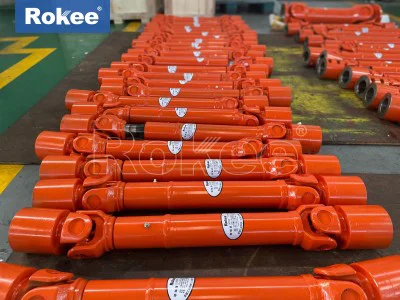
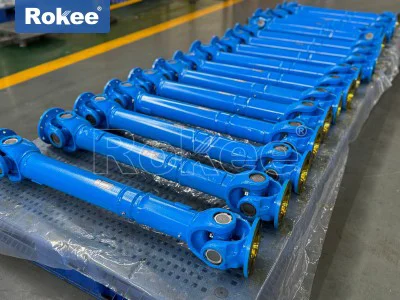
Mining cardan shafts can be divided into different types according to their structural characteristics, torque-carrying capacity, angular compensation range, and application scenarios, each of which has its own unique characteristics and applicable scope. According to the structure of the universal joint, mining cardan shafts can be divided into cross-axis cardan shafts and ball cage cardan shafts. Cross-axis cardan shafts, also known as Hooke's joint cardan shafts, are the most commonly used type in mining equipment. They consist of two cross-axis universal joints and a central shaft body, with a simple structure, high torque-carrying capacity, and a large angular compensation range (usually 15° to 45°). This type of cardan shaft is suitable for heavy-duty mining equipment with large misalignment angles, such as excavators, loaders, and crushers, which can adapt to the complex and variable working conditions of mines.
Ball cage cardan shafts, also known as constant velocity cardan shafts, are mainly used in mining equipment that requires high-speed and stable power transmission, such as mining electric locomotives and high-speed conveyors. The universal joint of this type of cardan shaft is composed of a ball cage, steel balls, and a raceway, which can ensure that the input and output shafts rotate at the same speed, avoiding the speed fluctuation caused by the cross-axis universal joint, thereby reducing vibration and noise. Ball cage cardan shafts have a smaller angular compensation range (usually 5° to 20°) but higher transmission efficiency and stability, which is suitable for equipment with high speed and low misalignment angle.
According to the presence or absence of a telescopic structure, mining cardan shafts can be divided into telescopic cardan shafts and non-telescopic cardan shafts. Telescopic cardan shafts are equipped with a spline connection structure, which can adjust the length axially to compensate for the axial displacement between the input and output shafts. This type of cardan shaft is widely used in mining equipment where the distance between the input and output shafts may change, such as conveyors and excavators, which can effectively avoid the damage caused by axial tension or compression to the cardan shaft. Non-telescopic cardan shafts do not have a telescopic structure, and their length is fixed, which is suitable for mining equipment where the distance between the input and output shafts is fixed, such as some small crushers and pumps.
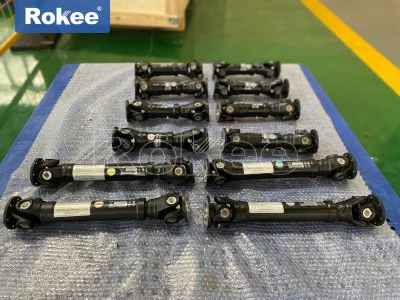
According to the torque-carrying capacity, mining cardan shafts can be divided into light-duty, medium-duty, heavy-duty, and extra-heavy-duty cardan shafts. Light-duty cardan shafts have a torque-carrying capacity of less than 10,000 N·m, which is suitable for small mining equipment, such as small conveyors and portable crushers. Medium-duty cardan shafts have a torque-carrying capacity of 10,000 to 50,000 N·m, which is suitable for medium-sized mining equipment, such as medium-sized excavators and loaders. Heavy-duty cardan shafts have a torque-carrying capacity of 50,000 to 200,000 N·m, which is suitable for large mining equipment, such as large crushers, belt conveyors, and mining trucks. Extra-heavy-duty cardan shafts have a torque-carrying capacity of more than 200,000 N·m, which is suitable for super-large mining equipment, such as open-pit mining excavators and large-scale conveyor systems.
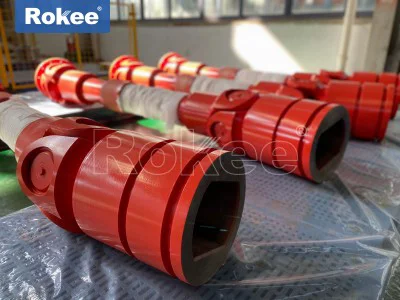
In addition, according to the installation method, mining cardan shafts can be divided into flange-connected cardan shafts and key-connected cardan shafts. Flange-connected cardan shafts are connected to the input and output shafts through flanges and high-strength bolts, which have a firm connection and high load-bearing capacity, and are suitable for heavy-duty mining equipment. Key-connected cardan shafts are connected to the input and output shafts through keys, which have a simple structure and easy installation and disassembly, and are suitable for light-duty and medium-duty mining equipment.
The application of mining cardan shafts covers almost all fields of mining operations, and they are an important part of various mining equipment, ensuring the efficient and stable operation of the equipment. In open-pit mining, mining cardan shafts are widely used in large excavators, loaders, mining trucks, and belt conveyors. Large excavators, which are used to excavate ore and rock, rely on cardan shafts to transmit power from the engine to the hydraulic system and the walking mechanism, enabling the excavator to complete excavation, rotation, and walking actions. The cardan shafts used in excavators need to have a high torque-carrying capacity and a large angular compensation range to adapt to the complex movement of the excavator arm and the uneven ground. Loaders, which are used to load ore and rock into mining trucks, also use cardan shafts to transmit power from the engine to the working mechanism and the walking mechanism, ensuring the flexibility and efficiency of the loader's operation.
Mining trucks, which are used to transport ore and rock from the mining site to the processing plant, use cardan shafts in their transmission systems to transmit power from the engine to the drive axle, enabling the truck to carry heavy loads and travel on rough mining roads. The cardan shafts used in mining trucks need to have a high torque-carrying capacity, strong fatigue resistance, and good wear resistance to withstand the long-term impact of heavy loads and the harsh road conditions. Belt conveyors, which are used to transport ore and rock continuously, use cardan shafts to connect the motor and the reducer, transmitting power to the conveyor belt, ensuring the stable operation of the conveyor. The cardan shafts used in belt conveyors need to have good stability and low vibration to avoid affecting the continuous transportation of ore.
In underground mining, mining cardan shafts are widely used in underground excavators, scrapers, and mine hoists. Underground excavators, which are used to excavate underground ore, rely on cardan shafts to transmit power to the working mechanism and the walking mechanism, enabling the excavator to operate in narrow underground spaces. The cardan shafts used in underground excavators need to be compact in structure, high in reliability, and easy to maintain, as the underground working environment is narrow and maintenance is difficult. Scrapers, which are used to transport underground ore, use cardan shafts to transmit power from the engine to the drive system, ensuring the scraper's ability to climb and carry loads in underground roadways. Mine hoists, which are used to lift ore, rock, and personnel from underground to the ground, use cardan shafts in their transmission systems to transmit power from the motor to the hoisting mechanism, ensuring the safe and stable operation of the hoist. The cardan shafts used in mine hoists need to have extremely high reliability and safety, as any failure could lead to serious accidents.
In addition to the above-mentioned main mining equipment, mining cardan shafts are also used in mining auxiliary equipment, such as crushers, grinders, and pumps. Crushers, which are used to crush ore and rock into small particles, use cardan shafts to transmit power from the motor to the crushing mechanism, ensuring the crushing efficiency and effect. Grinders, which are used to grind ore into powder, use cardan shafts to connect the motor and the grinding mechanism, transmitting power stably. Pumps, which are used to pump underground water and slurry, use cardan shafts to transmit power from the motor to the pump shaft, ensuring the normal operation of the pump.
The rational selection and proper use of mining cardan shafts are crucial to ensuring the efficient and stable operation of mining equipment. When selecting a mining cardan shaft, it is necessary to consider the torque-carrying capacity, angular compensation range, axial displacement compensation, working speed, and working environment of the equipment, and select the appropriate type and specification of the cardan shaft according to these factors. For example, for heavy-duty equipment with large misalignment angles, a cross-axis telescopic heavy-duty cardan shaft should be selected; for high-speed equipment with small misalignment angles, a ball cage cardan shaft should be selected. At the same time, it is also necessary to pay attention to the material and manufacturing process of the cardan shaft to ensure that it has sufficient strength, toughness, wear resistance, and corrosion resistance.
In the process of use, it is necessary to regularly inspect and maintain the mining cardan shaft to ensure its normal operation. Regular inspection includes checking the tightness of the connection bolts, the wear of the universal joint bearings and spline pairs, the integrity of the sealing device, and the lubrication of the lubrication system. If any wear, damage, or leakage is found, it should be repaired or replaced in time. Regular maintenance includes adding lubricating oil to the universal joint bearings and spline pairs, cleaning the sealing device, and conducting dynamic balance testing to eliminate unbalance. Through regular inspection and maintenance, the service life of the mining cardan shaft can be effectively extended, and the failure rate of mining equipment can be reduced, ensuring the smooth progress of mining production.
With the continuous development of mining technology, the requirements for mining equipment are becoming higher and higher, which also puts forward higher requirements for mining cardan shafts. In the future, mining cardan shafts will develop in the direction of higher torque-carrying capacity, larger angular compensation range, lighter weight, longer service life, and better reliability. New materials, such as carbon fiber composites, may be used to reduce the weight of the cardan shaft while improving its strength and corrosion resistance. Advanced manufacturing technologies, such as 3D printing and precision casting, may be adopted to improve the precision and performance of the cardan shaft components. At the same time, intelligent monitoring technologies may be integrated into the cardan shaft, enabling real-time monitoring of its operating status, early warning of potential failures, and further improving the reliability and safety of the cardan shaft.
In conclusion, the mining cardan shaft is a key mechanical component in mining power transmission systems, whose structure, performance, types, and applications are closely related to the efficiency, stability, and safety of mining operations. By understanding the detailed structure of the mining cardan shaft, mastering its key performance indicators, distinguishing different types of cardan shafts, and clarifying its specific applications in various mining equipment, we can better select, use, and maintain mining cardan shafts, thereby improving the operational efficiency of mining equipment, reducing production costs, and ensuring the smooth progress of mining production. As mining technology continues to advance, the mining cardan shaft will continue to play an important role in the mining industry, contributing to the sustainable development of the mining industry.