Cardan Coupling Specifications
Cardan couplings, also universally recognized as universal joints, are essential mechanical transmission components engineered to transfer rotational torque and motion between two non-collinear shafts with intersecting or dynamically variable axis angles. Serving as a core connecting unit in mechanical power transmission systems, these couplings resolve the technical challenge of stable power delivery under misaligned shaft installation and operational displacement, making them prevalent in industrial transmission equipment, mobile mechanical devices, and various power drive systems. The inherent structural flexibility and adaptive transmission performance define their core application value, while standardized structural specifications, dimensional parameters, and performance indicators determine their operational stability, service life, and applicability in diverse working scenarios.
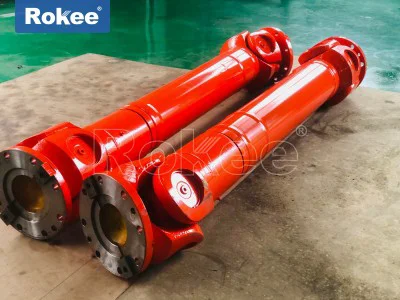
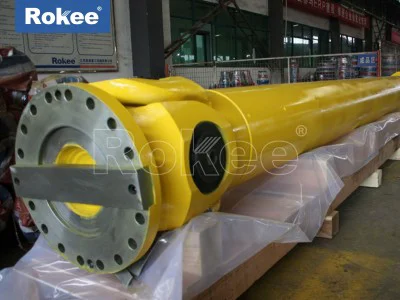
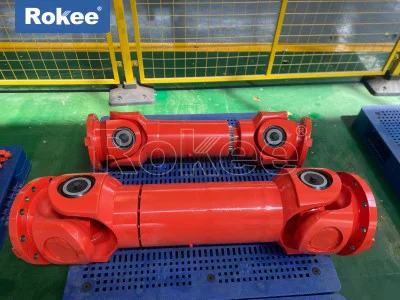
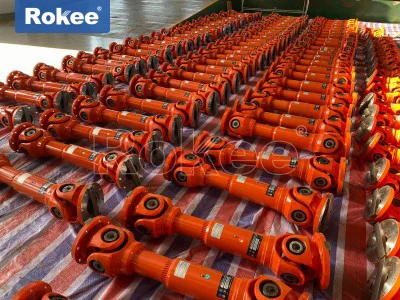
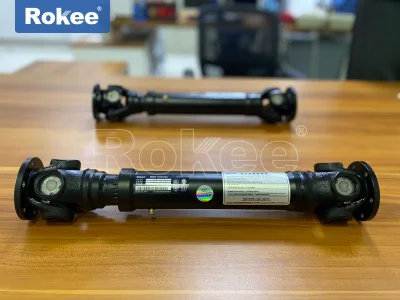
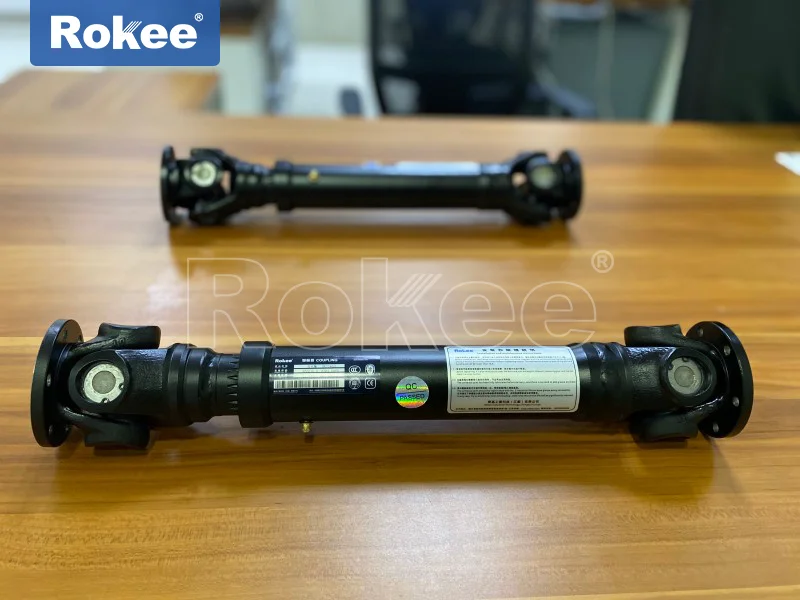
The basic structural composition of a cardan coupling follows a mature and optimized mechanical design, with every component dimension and matching relationship constituting fundamental specification standards for product application. The core assembly consists of two symmetrical yoke structures and an intermediate cross-shaped spider component, forming a mutually hinged four-point pivot connection system. The two end yokes are respectively fixed to the driving shaft and driven shaft, while the cross spider connects the two yokes through movable pivot pairs, enabling free rotational deflection between the connected shafts within a specific angle range. Most structural configurations integrate precision rolling bearing components at each pivot joint of the cross spider and yokes, typically needle roller bearings, which effectively reduce sliding friction during relative motion and improve transmission flexibility and mechanical efficiency. Auxiliary structural parts include shaft connecting sleeves, positioning fasteners, and sealing components, all of which follow unified dimensional design norms to ensure assembly accuracy and structural stability during long-term operation. The overall structural specifications adhere to mechanical design principles of compact layout, uniform stress distribution, and convenient disassembly and maintenance, avoiding redundant structural settings while fully meeting torque transmission and displacement compensation requirements.
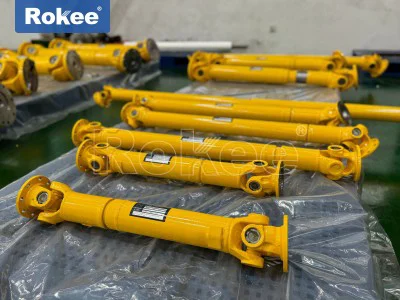
Angular compensation capacity stands as one of the most critical performance specifications of cardan couplings, representing the maximum shaft deflection angle that the coupling can adapt to while maintaining normal power transmission. Different structural designs and component configurations correspond to distinct angular adaptation ranges. In conventional single-section cardan coupling structures, the allowable operating angle between two connected shafts generally spans from 5 degrees to 35 degrees, with the optimal working angle for stable and efficient operation controlled within 15 degrees. Excessively large operating angles will amplify periodic speed fluctuation during transmission, increase mechanical vibration and component wear, and reduce overall transmission stability. For working scenarios requiring larger angle compensation, double-section cardan coupling structures are adopted, which combine two single joint units with an intermediate connecting shaft. This structural optimization balances the periodic motion deviation generated by a single joint, effectively eliminating speed unevenness and expanding the adaptive angular range to meet the transmission demands of large-deflection shaft systems. The angular compensation specification directly guides equipment installation and commissioning, requiring matching the actual shaft misalignment of mechanical systems with the coupling’s allowable angle range to avoid abnormal mechanical loss caused by parameter mismatch.
Torque transmission specifications are the core technical indicators that measure the load-bearing capacity of cardan couplings, covering rated transmission torque and ultimate bearing torque under continuous operating conditions. The rated torque parameter refers to the stable torque value that the coupling can bear for long-term continuous operation under standard working conditions, serving as the primary basis for model selection in conventional steady-state transmission systems. The ultimate torque represents the maximum instantaneous load that the coupling can withstand under short-term impact and overload conditions, reflecting the structural strength and anti-impact performance of the product. The torque bearing capacity is closely related to core structural specifications such as the cross spider diameter, bearing assembly size, yoke wall thickness, and shaft connection interface size. Larger structural dimensions correspond to higher structural rigidity and load-bearing limit, enabling the coupling to adapt to heavy-duty transmission scenarios. In practical application, the selection of torque specifications needs to reserve a reasonable safety margin according to actual working conditions, fully considering load fluctuation, frequent start-stop operation, and instantaneous impact load in mechanical systems, so as to prevent component fatigue damage or structural deformation caused by long-term overload operation.
Axial and radial displacement compensation specifications are important auxiliary performance indicators of cardan couplings, complementing angular compensation to achieve all-dimensional displacement adaptation of shaft transmission systems. In mechanical equipment operation, shaft displacement deviations often occur due to installation errors, equipment vibration, thermal expansion and contraction of components, and structural deformation during load bearing. Cardan couplings with spline connection structures possess excellent axial displacement compensation capability, allowing relative sliding between internal and external splines within a certain stroke range to adapt to axial distance changes between driving and driven shafts. Radial displacement compensation is realized through the cooperative deflection of the cross spider and yoke pivot structures, which can offset small-amplitude radial offset deviations of the two shafts. The displacement compensation specifications determine the coupling’s fault tolerance for equipment installation errors and operational structural changes, effectively avoiding additional mechanical stress and transmission resistance caused by rigid shaft connection, protecting shaft bodies, bearings, and other core components of the transmission system, and reducing equipment failure rates.
Transmission efficiency and rotational speed adaptation specifications define the operational economy and applicability of cardan couplings under different operating conditions. Under rated load and optimal angle conditions, the transmission efficiency of standard cardan couplings remains at a high level, with minimal power loss during torque and motion transmission. Transmission efficiency will slightly decrease with the increase of operating angle and load rate, but the overall stability is far superior to many flexible connecting structures. Each coupling model has a matching rated working speed and limit speed specification, which is restricted by structural balance, bearing operating performance, and component dynamic stability. Low-speed and heavy-load working conditions require couplings with enhanced structural rigidity and high torque bearing specifications, while high-speed transmission scenarios demand strict control of structural dynamic balance, optimized bearing matching, and reduced running friction to avoid vibration, noise, and accelerated wear caused by high-speed operation. Reasonable matching of rotational speed specifications can ensure the coupling maintains stable transmission performance and long service life in continuous cyclic operation.
Material and structural rigidity specifications form the fundamental guarantee for the mechanical performance and durability of cardan couplings. Conventional coupling core components are made of high-strength alloy materials with good toughness, wear resistance, and fatigue resistance, which can withstand repeated mechanical impact and cyclic load during long-term transmission operation. The overall structural rigidity is optimized through integrated forging and precision machining processes, with uniform component wall thickness and reasonable stress transition design, avoiding local stress concentration that easily causes fatigue fracture. The surface of key moving components is treated with precision finishing and anti-wear processing to reduce friction coefficient and improve wear resistance. Different material configurations and processing technologies correspond to different rigidity, wear resistance, and temperature resistance specifications, enabling couplings to adapt to conventional normal-temperature environments and harsh working conditions such as high temperature, low temperature, and dust pollution. Structural rigidity specifications also determine the coupling’s anti-deformation ability under heavy loads, ensuring no permanent structural deformation occurs during long-term high-load operation.
Operational stability and wear resistance specifications cover the dynamic performance and service life indicators of cardan couplings in long-term operation. Due to the structural characteristics of single cardan joints, periodic angular velocity fluctuation exists during rotation, which is the main source of transmission vibration and mechanical noise. High-specification cardan couplings optimize component matching precision and structural symmetry to minimize motion deviation and reduce vibration amplitude during operation. The matching precision of pivot bearings and cross spider directly affects wear resistance; high-precision matching reduces clearance between moving parts, avoids impact wear caused by excessive clearance, and maintains long-term transmission accuracy. Meanwhile, standardized lubrication structure specifications are designed for most couplings, with independent lubrication channels to ensure full grease coverage of friction pairs, reduce dry friction loss, and extend the service cycle of moving components. Wear resistance specifications determine the maintenance cycle and operational reliability of the equipment, making high wear resistance a core requirement for industrial-grade cardan couplings applied in continuous working scenarios.
Installation and matching specification standards regulate the interface size and assembly tolerance of cardan couplings, ensuring universal matching and convenient assembly with various mechanical shaft systems. The shaft connection interface adopts standardized shaft hole size and keyway positioning structure, with unified tolerance range for shaft hole fit, which can be compatible with conventional mechanical driving and driven shafts. The overall assembly size, including external outline dimensions and installation spacing, follows standardized design norms, facilitating integrated installation in limited mechanical space. The assembly tolerance specifications of pivot components strictly control the clearance range of movable joints, balancing the flexibility of rotational deflection and the stability of structural operation. Too small assembly clearance will lead to increased transmission resistance and poor flexibility, while excessive clearance will cause operational vibration and accelerated component wear. Unified installation and matching specifications realize the standardized application and replacement of cardan couplings, reducing equipment assembly difficulty and later maintenance costs.
In practical engineering applications, the comprehensive selection of cardan coupling specifications needs to be combined with the actual working conditions of the mechanical system, including transmission load characteristics, operating speed range, shaft misalignment degree, displacement variation amplitude, and working environment conditions. For steady-load, medium-speed, and small-angle deviation transmission scenarios, conventional standard-specification couplings can meet operational demands. For heavy-load, impact-load, and large-angle deviation working conditions, it is necessary to select enhanced-specification products with higher torque bearing capacity and better angular compensation performance. For high-speed precision transmission systems, priority should be given to couplings with high dynamic balance precision and low vibration specifications. Reasonable specification matching can not only ensure the efficient and stable operation of the mechanical transmission system but also maximize the service life of the coupling and reduce equipment operation and maintenance costs.
As a classic and mature mechanical transmission component, cardan couplings rely on their complete and standardized specification system to maintain irreplaceable application advantages in the mechanical industry. All dimensional parameters, performance indicators, and structural specifications are continuously optimized and improved with the development of mechanical engineering technology, adapting to the increasingly diversified and high-precision operational demands of modern mechanical equipment. The standardized specification design ensures the consistency, stability, and versatility of product performance, making cardan couplings widely applicable in various fields such as mechanical manufacturing, transportation equipment, agricultural machinery, and industrial transmission systems, providing reliable basic guarantee for the stable operation of mechanical power transmission systems.