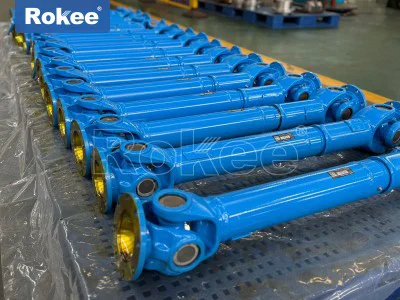
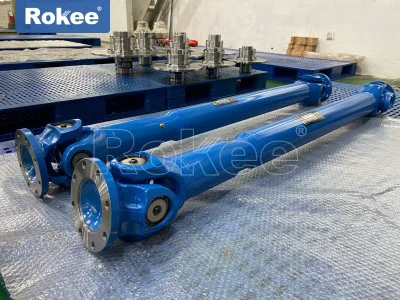
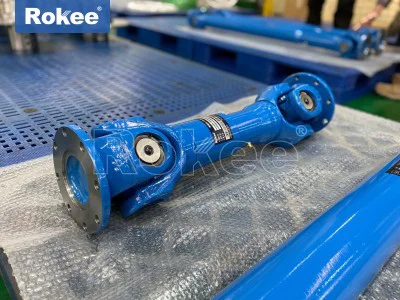
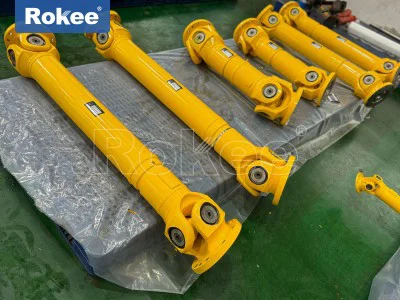
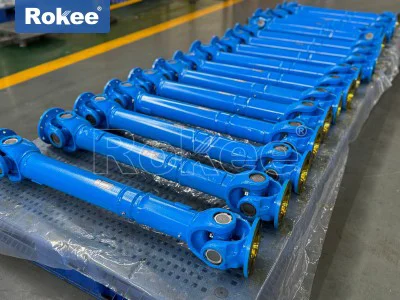
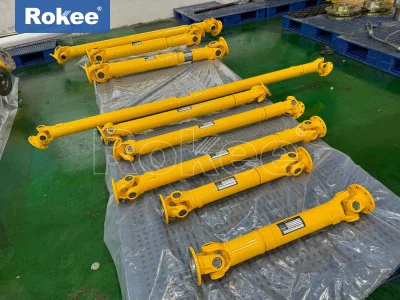
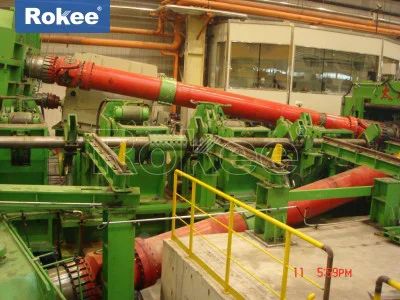
Custom Universal Shaft For PU Sandwich Panel Machine To Meet Production Needs

In the modern manufacturing industry, the production of PU sandwich panels has become an indispensable part of many fields such as construction, cold storage, and industrial workshops, thanks to their excellent thermal insulation, sound insulation, and structural strength. The PU sandwich panel machine, as the core equipment for realizing mass and high-quality production of such panels, relies on the coordinated operation of various components to ensure stable and efficient production processes. Among these components, the universal shaft plays a crucial role as a key transmission part, responsible for connecting different parts of the machine, transmitting torque, and adapting to the angular deviation between shafts, which directly affects the overall operation efficiency, stability, and product quality of the PU sandwich panel machine. However, due to the differences in production scale, product specifications, and working conditions of different manufacturers, the standard universal shafts on the market often cannot fully match the specific needs of each PU sandwich panel machine. Therefore, the custom universal shaft has gradually become the first choice for manufacturers to optimize production efficiency and ensure product consistency, as it can be tailored to the unique structural characteristics and production requirements of each machine, realizing precise matching and efficient transmission.
A universal shaft, also known as a cardan shaft, is a mechanical component designed to connect two non-coaxial shafts, transmitting rotational motion from a driving shaft to a driven shaft even when there is significant misalignment between the two axes. Its core structure usually includes universal joints, cross assemblies, and yokes, which work together to provide the flexibility to accommodate angular, radial, and axial displacements. The basic working principle of a universal shaft is based on the articulated design of its components: the cross shaft, as the intermediate connecting part, is connected to the yokes of the driving and driven shafts through hinges at its four ends, allowing one shaft to deflect freely within a certain range when the other is fixed, thereby ensuring continuous and stable torque transmission even when the two shafts are not collinear. This unique structural design makes universal shafts widely used in various industrial machinery, especially in equipment that requires dynamic adjustment of shaft positions during operation, such as PU sandwich panel machines. In the operation process of a PU sandwich panel machine, the universal shaft is mainly used to connect the main drive system, the roll forming system, the foaming system, and other key components, transmitting the power generated by the motor to each working unit, ensuring that each part operates in a coordinated manner at the specified speed and torque, thus realizing the continuous production of PU sandwich panels from raw material uncoiling, forming, foaming to cutting and stacking.
The reason why custom universal shafts are essential for PU sandwich panel machine lies in the diverse and personalized production needs of manufacturers, which cannot be met by standard universal shafts. Different PU sandwich panel machines have significant differences in structural design, production capacity, and product specifications. For example, some machines are designed for large-scale production, requiring the universal shaft to transmit large torque and adapt to high-speed operation; some machines are used to produce special-specification PU sandwich panels, which requires the universal shaft to have a more precise angular compensation capability to ensure the accuracy of the forming and foaming processes; and some machines operate in harsh working environments, such as high temperature, high humidity, or dusty conditions, which requires the universal shaft to have stronger corrosion resistance, wear resistance, and high-temperature resistance. Standard universal shafts are designed according to general specifications, with fixed torque capacity, angular compensation range, and material selection, which often cannot fully match the specific working conditions of each PU sandwich panel machine. Using such standard products may lead to problems such as insufficient torque transmission, poor operation stability, frequent wear and tear, and even equipment failure, which not only affects production efficiency but also increases maintenance costs and product defect rates. In contrast, custom universal shafts can be designed and manufactured according to the actual parameters and working requirements of the PU sandwich panel machine, achieving perfect matching between the shaft and the machine, thus effectively solving these problems and providing a reliable guarantee for the stable operation of the production line.
The customization process of a universal shaft for PU sandwich panel machines is a systematic project that requires close cooperation between manufacturers and customization service providers, covering multiple links such as demand communication, parameter confirmation, structural design, material selection, processing and manufacturing, and performance testing. The first step in the customization process is demand communication, where the manufacturer needs to clearly inform the customization service provider of the specific requirements of the PU sandwich panel machine, including the rated power of the machine, the operating speed, the torque required for transmission, the angular deviation between the connected shafts, the installation space, the working environment (such as temperature, humidity, and dust content), and the expected service life of the universal shaft. At the same time, the manufacturer should also provide the structural drawings of the machine's connecting parts to ensure that the custom universal shaft can be perfectly installed and matched with the existing components. Based on this information, the customization service provider will conduct a comprehensive analysis and evaluation, combined with the working characteristics of the PU sandwich panel machine, to determine the core parameters of the universal shaft, such as torque capacity, allowable angular deviation, axial compensation range, and overall dimensions.
Parameter confirmation is a key link in the customization process, as it directly determines the performance and applicability of the custom universal shaft. The torque capacity of the universal shaft is one of the most important parameters, which needs to be determined according to the maximum torque required by the PU sandwich panel machine during operation. If the torque capacity of the universal shaft is insufficient, it will lead to shaft deformation, fracture, or transmission failure during operation; if it is too large, it will cause unnecessary material waste and increase the cost of customization. The allowable angular deviation is another key parameter, which is determined according to the installation accuracy of the PU sandwich panel machine and the angular change of the shafts during operation. PU sandwich panel machines often have a certain angular deviation between the driving shaft and the driven shaft due to manufacturing and installation errors, as well as structural deformation during operation. The custom universal shaft needs to have a sufficient angular compensation capacity to adapt to this deviation, ensuring stable torque transmission without affecting the operation of the machine. In addition, the axial compensation range, overall length, and connection method of the universal shaft also need to be accurately confirmed according to the actual installation space and structural characteristics of the PU sandwich panel machine to avoid installation interference and ensure convenient disassembly and maintenance.
Structural design is another core link in the customization of universal shafts for PU sandwich panel machines, which needs to comprehensively consider the working conditions and performance requirements of the machine to optimize the structure and improve the stability and service life of the shaft. The structural design of the universal shaft mainly includes the design of the universal joint, the cross shaft, the yoke, and the spline connection. For PU sandwich panel machines that need to transmit large torque, the cross shaft and yoke should be designed with a reinforced structure to enhance their bearing capacity and avoid deformation or fracture under heavy load. For machines that operate at high speed, the universal shaft should be designed with a balanced structure to reduce vibration and noise during operation, ensuring stable transmission and extending the service life of the shaft and other components. In addition, the structural design should also consider the convenience of maintenance. For example, the universal joint and cross shaft should be designed to be detachable, making it easy to replace wearing parts and reduce maintenance time and costs. Some custom universal shafts also adopt a telescopic structure, which can compensate for the axial displacement caused by temperature changes or structural deformation during the operation of the PU sandwich panel machine, further improving the adaptability and stability of the transmission system.
Material selection is crucial to the performance and service life of the custom universal shaft, as it directly affects the shaft's torque capacity, wear resistance, corrosion resistance, and high-temperature resistance. The selection of materials should be based on the working conditions of the PU sandwich panel machine. For general working conditions, common carbon steel such as 45# steel is often used, which has good mechanical properties and processing performance, and can meet the basic transmission requirements. For machines that operate under heavy load, high speed, or harsh environments, alloy steel such as 42CrMo is more suitable, as it has higher strength, hardness, and wear resistance, and can withstand greater torque and longer service life. In addition, for PU sandwich panel machines that operate in corrosive environments (such as coastal areas or workshops with chemical substances), the surface of the universal shaft should be treated with anti-corrosion processes such as galvanizing or painting to prevent corrosion and extend the service life. The selection of materials should also consider the processing cost and production cycle, achieving a balance between performance and cost to meet the manufacturer's needs.
After the completion of design and material selection, the custom universal shaft enters the processing and manufacturing stage. This stage requires strict control of processing accuracy to ensure that the dimensions, shape, and surface quality of each component meet the design requirements. The processing of the universal shaft involves multiple processes such as turning, milling, drilling, heat treatment, and assembly. Heat treatment is a key process, which can improve the mechanical properties of the material, such as hardness, strength, and toughness, ensuring that the universal shaft can withstand the required torque and wear during operation. For example, the cross shaft and yoke need to be quenched and tempered to improve their hardness and toughness, while the spline connection part needs to be carburized to enhance its wear resistance. During the assembly process, the components should be accurately aligned and assembled to ensure the flexibility of the universal joint and the stability of the transmission. After assembly, the universal shaft should be subjected to static and dynamic balance tests to reduce vibration during high-speed operation and avoid affecting the operation of the PU sandwich panel machine.
Performance testing is the final link in the customization process, which is used to verify whether the custom universal shaft meets the design requirements and the actual needs of the PU sandwich panel machine. The performance test mainly includes torque test, angular compensation test, vibration test, and service life test. The torque test is used to verify whether the torque capacity of the universal shaft meets the required standard, ensuring that it can transmit the required torque without deformation or failure. The angular compensation test is used to check the flexibility and stability of the universal shaft when there is an angular deviation between the shafts, ensuring that the torque transmission is not affected. The vibration test is used to detect the vibration amplitude and noise of the universal shaft during operation, ensuring that it meets the requirements of the PU sandwich panel machine and does not cause adverse effects on the machine and the production environment. The service life test is used to simulate the actual working conditions of the universal shaft, testing its service life under long-term operation, ensuring that it can meet the manufacturer's expected service life requirements. Only after passing all performance tests can the custom universal shaft be delivered to the manufacturer for use.
The application of custom universal shafts in PU sandwich panel machines brings significant advantages to manufacturers, effectively improving production efficiency, product quality, and equipment stability. Firstly, the custom universal shaft achieves perfect matching with the PU sandwich panel machine, ensuring efficient and stable torque transmission, reducing energy loss, and improving the overall operation efficiency of the machine. Compared with standard universal shafts, custom products can avoid problems such as insufficient torque, unstable transmission, and frequent failure, reducing the number of equipment shutdowns and improving production continuity. Secondly, the custom universal shaft has better adaptability, which can be tailored to the specific working conditions and production needs of the machine, ensuring that the machine can operate stably in different environments and produce different specifications of PU sandwich panels. For example, in the production of thick PU sandwich panels, the custom universal shaft can provide larger torque to ensure the smooth operation of the forming and foaming processes; in the production of thin PU sandwich panels, it can adjust the transmission speed and torque to ensure the accuracy of the product thickness and surface quality. Thirdly, the custom universal shaft has a longer service life and lower maintenance costs. Due to the reasonable structural design and appropriate material selection, the custom universal shaft is more wear-resistant, corrosion-resistant, and durable, reducing the frequency of component replacement and maintenance time, thus reducing the overall operating costs of the manufacturer.
In addition to the customization process and application advantages, the daily maintenance of custom universal shafts is also crucial to ensure their long-term stable operation and extend their service life. The maintenance of universal shafts mainly includes regular lubrication, wear inspection, alignment calibration, and cleaning. Regular lubrication is essential to reduce friction between components, prevent wear and tear, and ensure the flexibility of the universal joint. The type of lubricant should be selected according to the working conditions of the PU sandwich panel machine; for example, high-temperature lubricants should be used in high-temperature environments. The lubrication cycle should be determined according to the operation time and working environment: under normal working conditions, lubrication should be carried out every 300 to 500 hours or every 3 months; under harsh working conditions, the cycle should be shortened to 100 to 200 hours or every month. During lubrication, the old lubricant should be cleaned first to avoid clogging, and then new lubricant should be injected until it overflows from the lubrication hole.
Regular wear inspection is also an important part of maintenance. The cross shaft, universal joint, yoke, and spline connection part should be inspected regularly for signs of wear, corrosion, cracks, or looseness. If any abnormal wear or damage is found, the wearing parts should be replaced in a timely manner to avoid further damage to the universal shaft and the PU sandwich panel machine. Alignment calibration is necessary to ensure that the connected shafts are in the correct position, avoiding excessive angular deviation or radial deviation, which may lead to increased vibration, noise, and wear of the universal shaft. Alignment calibration should be carried out every 6 months or during equipment overhauls, using tools such as laser alignment instruments to improve accuracy. Regular cleaning is also required to remove dust, oil, and other impurities from the surface of the universal shaft, preventing impurities from entering the internal components and affecting the transmission effect and service life.
With the continuous development of the PU sandwich panel industry, the requirements for production efficiency, product quality, and equipment stability are getting higher and higher, which puts forward more stringent requirements for the performance of universal shafts. Custom universal shafts, with their perfect matching, high adaptability, and stable performance, have become an important guarantee for the modernization and upgrading of PU sandwich panel production lines. In the future, with the continuous progress of mechanical processing technology, material science, and design concepts, the customization technology of universal shafts will also continue to develop. More advanced structural designs, more high-performance materials, and more precise processing techniques will be applied to the customization of universal shafts for PU sandwich panel machines, making them more efficient, durable, and intelligent. For example, the application of intelligent monitoring technology can realize real-time monitoring of the operating status of the universal shaft, such as torque, temperature, and vibration, timely warning of potential failures, and reducing the risk of equipment shutdown. At the same time, the optimization of the customization process will further shorten the production cycle, reduce the customization cost, and make custom universal shafts more widely used in the PU sandwich panel industry.
In conclusion, the custom universal shaft is an indispensable key component for PU sandwich panel machines to meet personalized production needs. Its customization process covers multiple links such as demand communication, parameter confirmation, structural design, material selection, processing and manufacturing, and performance testing, which requires close cooperation between manufacturers and customization service providers to ensure perfect matching with the machine. The application of custom universal shafts can effectively improve the operation efficiency, stability, and product quality of PU sandwich panel machines, reduce maintenance costs, and bring significant economic benefits to manufacturers. With the continuous development of the industry, the role of custom universal shafts in the PU sandwich panel production process will become more and more important, promoting the healthy and sustainable development of the PU sandwich panel industry.