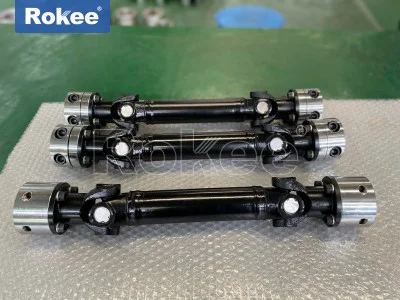
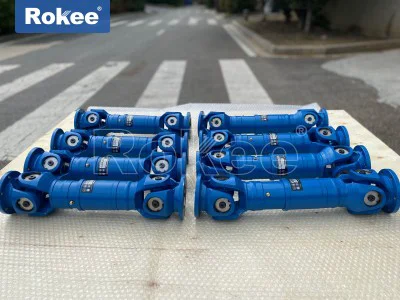
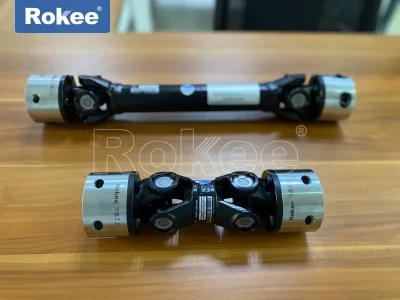
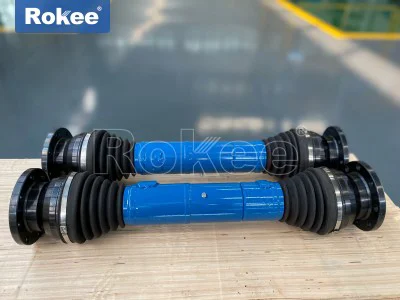
Scheme Of Cardan Shaft Coupling Adapting To Different Types Of PU Sandwich Panel Line
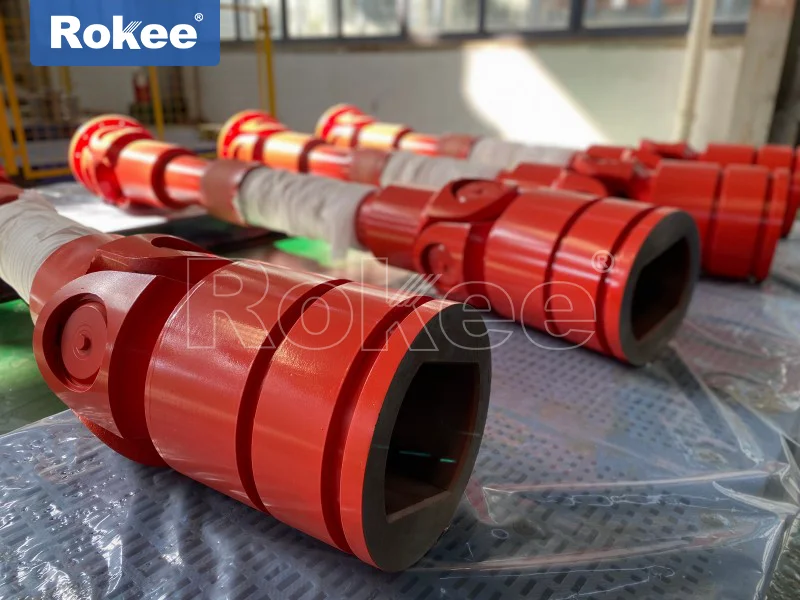
PU sandwich panels have become indispensable composite building materials in modern construction, cold chain logistics, and industrial enclosure industries due to their excellent thermal insulation, structural stability, and lightweight characteristics. The diversified market demands have driven the iterative upgrading of PU sandwich panel production lines, forming multiple types of production equipment differentiated by production speed, panel thickness range, processing precision, and functional configuration. These differentiated production lines put forward highly variable requirements for the power transmission system, among which the stability, adaptability, and fault tolerance of shaft coupling components directly determine the overall operating efficiency and product forming quality of the production line. As a flexible and efficient power transmission component, the cardan shaft coupling features unique spatial kinematic transmission characteristics and excellent misalignment compensation capability, which can well adapt to the complex and variable transmission working conditions of different PU sandwich panel production lines, realizing stable torque transmission and synchronous operation of equipment under various installation deviation and dynamic load conditions.
The operational logic of various PU sandwich panel line follows a continuous composite forming process, but there are significant differences in structural layout, transmission load characteristics, and operating parameters between different types of lines. Conventional high-speed continuous production lines focus on large-batch and high-efficiency production of standard-thickness wall and roof panels, with the entire line maintaining long-term continuous high-speed operation and the transmission system bearing stable and cyclic dynamic loads. Medium and low-speed customized production lines are mainly used for processing special-thickness panels, shaped composite panels, and functional enhanced panels, with frequent adjustments in production speed and intermittent start-stop working conditions, and the transmission system needs to cope with instantaneous load changes and variable torque output. In addition, compact integrated production lines for small-scale production adopt a highly centralized equipment layout, resulting in narrow installation space for transmission components and prone to axial, radial, and angular misalignment between driving and driven shafts; while large-scale split-type production lines have long transmission distances and multi-node power transmission structures, putting forward higher requirements for the torsion resistance and synchronous transmission accuracy of couplings. These diverse working condition differences make traditional rigid couplings and ordinary flexible couplings difficult to achieve universal adaptation, while the structural characteristics of cardan shaft couplings can effectively cover the transmission needs of all types of PU sandwich panel production lines.
The core working principle of the cardan shaft coupling is based on the spatial hinge motion composed of cross shafts and fork-shaped joints, which can realize continuous and stable torque and rotational motion transmission between two intersecting or spatially offset shafts. Different from rigid couplings that strictly require coaxial installation of shafts, the cardan shaft coupling relies on the flexible hinge structure of the cross shaft to form a multi-dimensional compensation mechanism. It can not only adapt to a certain range of angular deflection between the driving shaft and the driven shaft, but also effectively compensate for tiny axial stretching and radial offset generated during equipment operation. In the continuous operation process of PU sandwich panel production lines, equipment vibration, thermal expansion and contraction caused by long-term operation, and minor deformation of the frame structure will lead to real-time changes in shaft alignment accuracy. The cardan shaft coupling can automatically adapt to these dynamic deviations without generating additional mechanical stress or transmission resistance, avoiding the transmission jitter, torque loss, and component wear problems that are common in traditional coupling applications. This inherent adaptive mechanical property lays a solid foundation for its wide application in different types of PU sandwich panel production lines.
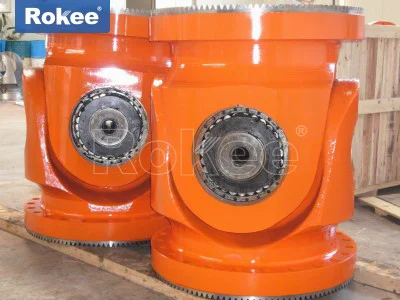
To realize the precise adaptation of cardan shaft couplings to differentiated PU sandwich panel line, targeted structural optimization and parameter matching schemes are required for different production line characteristics. For high-speed continuous production lines that operate stably for a long time, the core design goal of the coupling is to maintain high transmission efficiency and low fatigue wear under long-term high-speed rotation. The optimized cardan shaft coupling adopts a reinforced cross shaft structure and high-precision rolling bearing assembly, which reduces the friction coefficient during hinge movement and avoids rotational speed fluctuation and torque attenuation in the high-speed operating state. The integral forging process is adopted for the fork-shaped joints to improve overall structural rigidity, effectively resisting cyclic torsion load and preventing structural deformation and fatigue damage during long-term continuous operation. This optimized structure ensures that the transmission system can maintain synchronous and stable operation of uncoiling, leveling, foaming, lamination, and cutting units in high-speed production, avoiding panel forming defects such as uneven surface density and inconsistent thickness caused by transmission jitter.
For medium and low-speed customized production lines with frequent load changes and start-stop cycles, the adaptive scheme of cardan shaft couplings focuses on improving impact resistance and variable load adaptability. During the frequent speed regulation and start-stop process of customized production lines, the transmission system will generate instantaneous impact torque, which is easy to cause fatigue damage to coupling components and affect the transmission accuracy. The improved cardan shaft coupling optimizes the gap matching of the hinge pair and adds a buffer structure at the shaft connection end, which can effectively absorb instantaneous impact load and reduce the mechanical vibration and torque mutation generated during equipment switching. At the same time, the structural flexibility of the coupling is appropriately adjusted to adapt to frequent speed changes and intermittent operating conditions, ensuring that the power output of the driving motor can be accurately transmitted to each functional component, and maintaining the processing accuracy of special-shaped and special-thickness PU sandwich panels. This adaptive design solves the problem of poor matching between traditional couplings and variable working conditions of customized production lines, and improves the stability of flexible production.
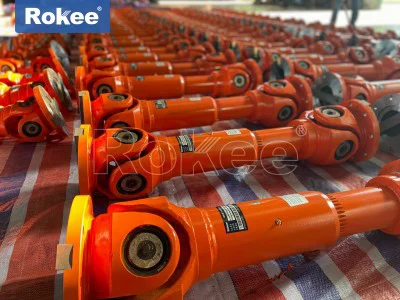
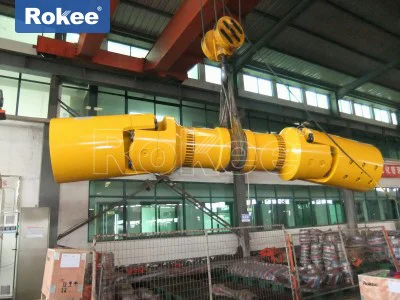
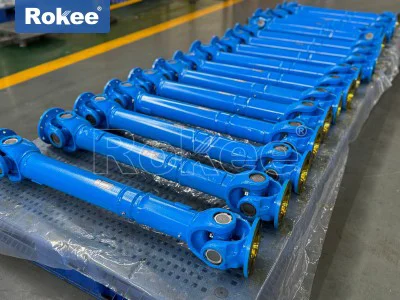
Aiming at the spatial layout characteristics of compact integrated production lines and large-scale split production lines, the cardan shaft coupling realizes spatial adaptation through structural dimensional optimization and modular combination design. For compact production lines with limited installation space, the miniaturized and integrated cardan shaft coupling structure is adopted, which reduces the overall installation size while ensuring torque transmission capacity, and can be flexibly arranged in the narrow transmission gap between compactly distributed equipment components. The compact structure also reduces the overall weight of the transmission system, reduces the inertial resistance of equipment operation, and is conducive to improving the sensitivity of production line speed regulation. For large-scale split production lines with long transmission distances and multi-node transmission, the modular combined cardan shaft coupling scheme is adopted. By matching different lengths of intermediate shaft sections and multi-group universal hinge structures, long-distance synchronous power transmission is realized, and the multi-dimensional misalignment generated by the split layout of large-scale equipment is compensated in real time. The modular design also facilitates the segmented installation, maintenance and replacement of components, reducing the difficulty of daily operation and maintenance of large production lines.
In addition to structural adaptive optimization, the material selection and surface treatment process of cardan shaft couplings are also key links to adapt to different production line working environments. The internal production environment of PU sandwich panel production lines is accompanied by trace chemical volatiles generated by PU foaming and curing, as well as dust and humid air generated by long-term mechanical operation, which will cause certain corrosion and wear to transmission components. For standard indoor production lines, high-strength alloy steel with good comprehensive mechanical properties is selected as the main material of the coupling, which ensures sufficient torsion resistance and structural stability. For special production lines with high humidity and strong dust pollution, anti-corrosion and wear-resistant surface treatment processes are adopted to form a protective layer on the surface of coupling components, isolating the erosion of environmental media, reducing component wear and corrosion failure, and extending the service life of the coupling. This differentiated material and process matching enables the cardan shaft coupling to maintain stable working performance in various production line environments and improve the overall operational reliability of the equipment.
The adaptive application of cardan shaft couplings brings significant comprehensive performance improvements to different types of PU sandwich panel production lines. In terms of transmission performance, the multi-dimensional misalignment compensation capability of the coupling eliminates the transmission dead zone and torque loss caused by shaft misalignment, improves the overall transmission efficiency of the production line, and ensures the consistency of equipment operating speed. For high-speed mass production lines, stable transmission performance effectively reduces the defective rate of panels caused by transmission fluctuation and improves production yield. For customized flexible production lines, accurate torque transmission and impact resistance ensure the processing dimensional accuracy and structural uniformity of special panels, meeting the personalized production quality requirements. In terms of equipment operation and maintenance, the cardan shaft coupling has a simple and reliable structural form, strong fault tolerance, and low failure rate in long-term operation. Compared with other types of couplings, it does not need frequent calibration and maintenance, effectively reducing the downtime loss and maintenance cost of the production line.
In the actual system matching process, the adaptive scheme of cardan shaft couplings also needs to be dynamically optimized according to the functional differences of different production line units. The transmission units of PU sandwich panel production lines include material uncoiling and leveling unit, PU foaming and composite lamination unit, traction conveying unit, fixed-length cutting unit, and finished product stacking unit. Each unit has different transmission load and stability requirements. The uncoiling and leveling unit needs stable low-jitter transmission to ensure flat material feeding; the lamination and traction unit needs high-torque synchronous transmission to ensure the composite bonding effect of panels; the cutting and stacking unit needs sensitive speed regulation and instant stop transmission performance. By adjusting the structural rigidity, hinge flexibility and installation angle parameters of the cardan shaft coupling, precise matching with the transmission characteristics of each functional unit can be realized, forming a highly coordinated overall transmission system, and ensuring that all links of PU sandwich panel production maintain efficient and stable operating states.
With the continuous development of PU sandwich panel production technology towards high automation, high precision and multi-functional integration, the types of production lines are further enriched, and the working condition differences and functional requirements of production equipment are becoming more refined. The cardan shaft coupling, with its unique spatial transmission advantage, flexible misalignment compensation capability and scalable structural design, can continuously adapt to the updated and diversified production line working conditions. Its excellent universality and adaptability make it a core matching component for the transmission system of different PU sandwich panel production lines, effectively solving the common transmission stability problems faced by mass production, customized production, compact layout and large-scale split production lines. In the future, with the further optimization of coupling structure design, material performance and modular matching technology, the adaptive performance of cardan shaft couplings in PU sandwich panel production equipment will be further improved, providing more reliable power transmission guarantee for the high-efficiency and high-quality production of PU sandwich panels, and promoting the stable development of the whole composite panel manufacturing industry.