Internal Spline Universal Shaft

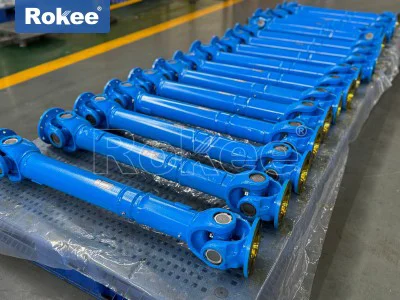
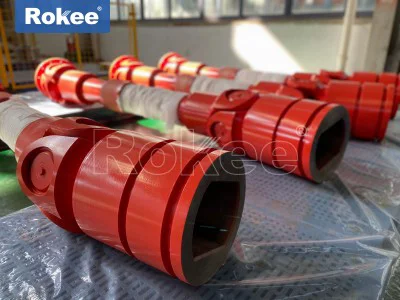
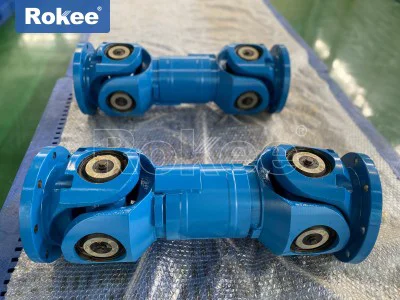
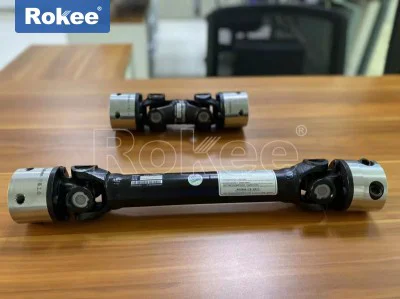
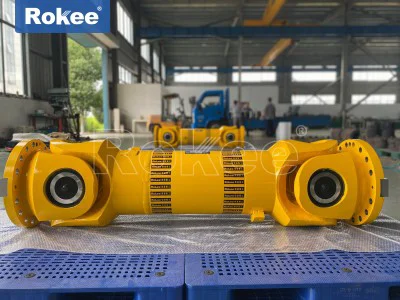
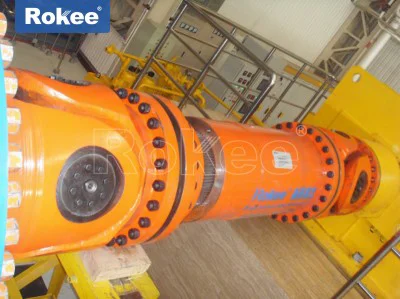
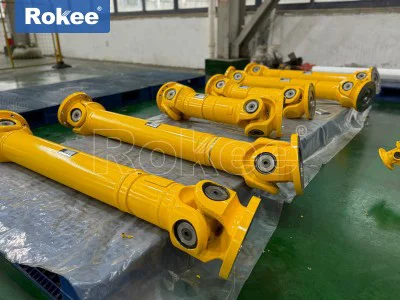
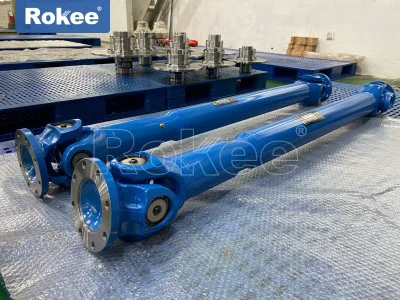
Internal spline universal shaft is a precision transmission component that combines spline connection with universal joint function, playing a crucial role in mechanical transmission systems. This specially designed transmission shaft mainly consists of three parts: internal spline shaft sleeve, universal joint mechanism, and external spline shaft.
As the core feature of this component, the internal spline shaft sleeve has a precise involute spline tooth profile machined on its inner surface, which can achieve tight meshing with the spline shaft of the supporting equipment. Compared with traditional external spline designs, internal spline structures have higher torque transmission capabilities and better centering. The spline teeth usually adopt an involute tooth profile with a pressure angle of 30 °, which not only ensures the smoothness of transmission, but also facilitates automatic centering during assembly.
The universal joint part usually adopts a cross axis or ball cage design. The former has a simple structure and strong load-bearing capacity, while the latter can achieve smaller vibrations and more uniform speed transmission. In high-end applications, a dual universal joint arrangement will also be used to eliminate speed fluctuations.
The reason why internal spline universal shafts are widely used in the industrial field is mainly due to their unique technological advantages:
Torque transmission capability: The internal spline design provides a larger contact area, which can transmit up to 30% -50% of torque compared to traditional keyway connections, making it particularly suitable for high-power transmission scenarios.
Accurate axial positioning: The spline engagement achieves precise positioning between the shaft and the sleeve, with axial clearance controlled within the range of 0.05-0.1mm, ensuring the stability of the transmission system.
Excellent angle compensation capability: The universal joint allows for a deflection angle of 15 ° -45 °, effectively compensating for installation errors and relative displacement during operation.
Durability and easy maintenance: High quality alloy steel materials combined with surface hardening treatment can achieve a product life of over 10000 hours, and the lubrication point design is easy to maintain regularly.
Modular design: Standardized internal spline specifications make components highly interchangeable, greatly simplifying inventory management and replacement processes.
Maintenance suggestions:
Regularly check the lubrication condition and use the specified type of extreme pressure grease
Monitor the wear of the universal joint cross shaft or ball cage
Check the wear and corrosion of the spline engagement area
Pay attention to the occurrence of abnormal vibrations or noise
Perform preventive replacement according to the manufacturer's specified cycle