Cardan Drive Shaft With Intermediate Bearing
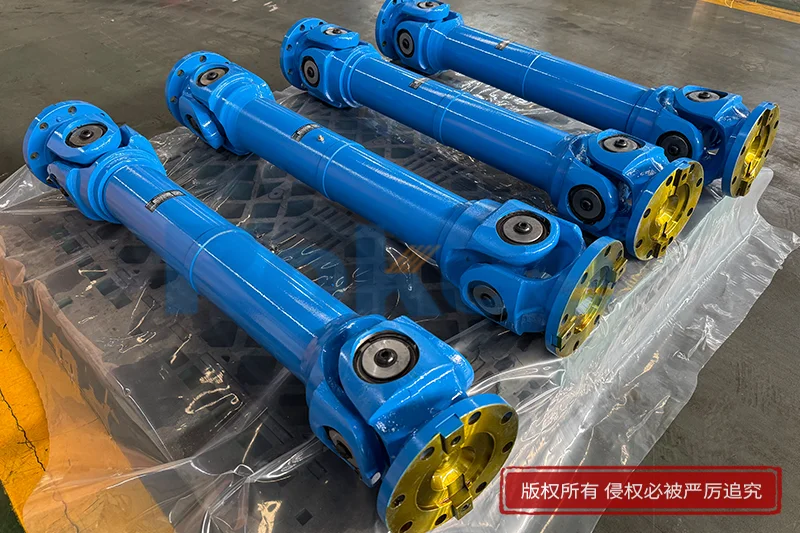
A cardan drive shaft with an intermediate bearing represents one of the most robust and widely adopted solutions for transmitting rotational power between non-collinear, offset, or dynamically shifting mechanical interfaces. Named after Gerolamo Cardano, the Italian Renaissance mathematician who first described the gimbal principle, the Cardan shaft—more commonly known as a universal joint drive shaft—relies on paired universal joints working in opposition to deliver near-constant velocity despite operating angles. When the distance between the gearbox output and the final drive differential exceeds a practical single-shaft length, a single tube would flex resonantly, bend under its own weight, and vibrate destructively at critical speeds. Inserting an intermediate bearing at a division point resolves these problems by splitting the shaft into shorter, dynamically stiffer sections while preserving the angular articulation that universal joints provide. This arrangement has become foundational in rear-wheel-drive and all-wheel-drive passenger vehicles, light and heavy commercial trucks, buses, agricultural tractors, construction equipment, marine auxiliary drives, and industrial machinery ranging from printing presses to rolling mills.
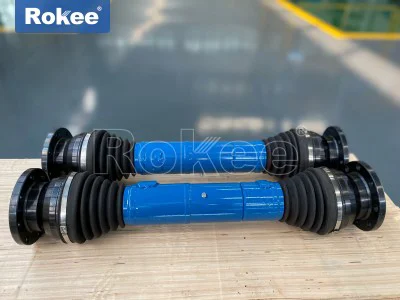
The intermediate bearing itself is a precision-mounted support that bridges two separately spinning shaft sections while accommodating the relative motion that inevitably occurs between the chassis, engine, and drive axle. Typically housed in a cast or pressed-steel bracket bolted to the vehicle frame or chassis crossmember, the bearing carries a deep-groove ball bearing or, in heavier-duty variants, a roller bearing pressed into a rubber-isolated outer ring. The rubber bushing is far more than a passive mount: it is tuned in stiffness and damping to isolate road and driveline noise from the cabin, to permit slight axial float as the shaft thermally expands, and to tolerate small lateral displacements caused by engine torque roll or axle articulation. Without this elastomeric isolation, the bearing would transmit high-frequency vibration directly into the body structure, producing audible driveline drone and shortening component life under fatigue loading. The bearing is usually pre-lubricated and sealed for life in light-duty applications, while heavy-duty designs incorporate grease zerk fittings for periodic relubrication.
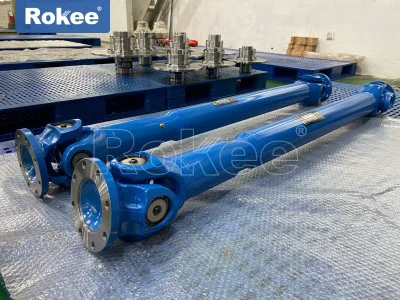
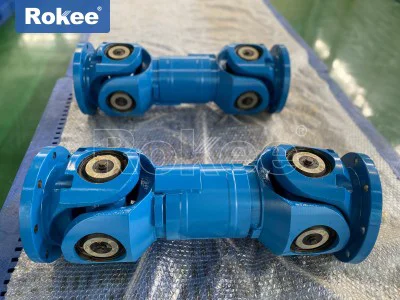
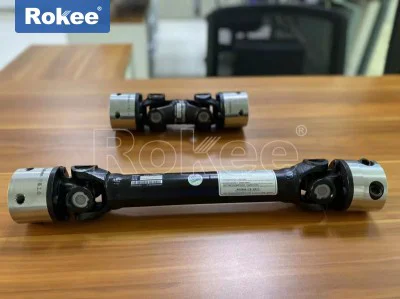
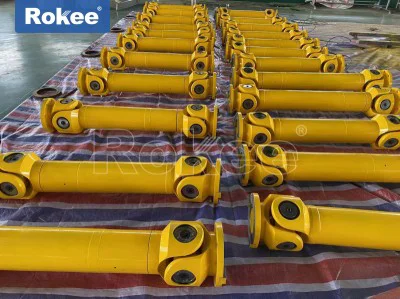
At its core, the cardan driveshaft is a hollow steel tube welded or splined at each end to a yoke that houses a universal joint. Each universal joint consists of two yokes, a cross-shaped trunnion with four bearing caps, and needle rollers pressed between the trunnion journals and the yoke bores. When two such joints are installed at the ends of a single shaft and phased correctly—meaning the internal yokes lie in the same plane—their inherent speed pulsations cancel: the acceleration induced at the first joint is mirrored and reversed at the second, yielding an output rotation that is nearly uniform even when both joints operate at modest angles. The intermediate bearing, positioned between a forward shaft segment and a rearward segment, effectively turns one long shaft into two shorter Cardan shafts in series. This configuration is mechanically equivalent to extending the drive train along a gently bent path while still permitting the suspension to compress and rebound, which changes the angle between the transmission output and the pinion gear with every bump and load change.
Designing a cardan shaft with an intermediate bearing requires careful attention to several interrelated geometric and dynamic parameters. Operating angles at each universal joint must be kept within recommended limits, typically modest single-digit degrees, because the magnitude of speed variation rises sharply with angle. When two universal joints are connected in series through the intermediate bearing, the designer must ensure that the angles at the front joint and the rear joint are as close to equal as possible, and that the yokes are phased to cancel velocity fluctuations. If angles are mismatched, the resulting second-order torsional vibration can excise resonance in the driveline, producing a noticeable shudder under acceleration or a high-speed whine that the rubber-mounted bearing can damp but not eliminate. The length of each segment is chosen to stay well below the first critical bending speed, because above that speed the shaft whirls like a skipping jump rope and can destroy bearings, seals, and the surrounding structure. Increasing wall thickness, using a larger diameter tube, and splitting the shaft at an intermediate bearing are the three principal levers engineers use to push critical speed upward while keeping rotating mass within budget.
The materials from which a cardan shaft and its intermediate bearing are fabricated reflect a balance among strength, fatigue endurance, cost, and corrosion resistance. The tubular section is commonly drawn or seamless steel tube in medium-carbon grades, induction-hardened at the weld ends, although high-performance vehicles increasingly use aluminum or even composite tubes to reduce unsprung and rotating mass. The yokes, flanges, and splined sleeves are forged from heat-treated alloy steels, then machined to close tolerances and often phosphated or powder-coated for corrosion protection. The trunnion bearings use needle rollers made from bearing-grade steel, precisely ground and assembled with radial clearance controlled to microns. The intermediate bearing housing is usually cast ductile iron for heavy vehicles or stamped steel for light cars, while the rubber isolator is formulated from natural or synthetic elastomer with carefully tuned durometer—soft enough to isolate vibration, firm enough to control lateral shaft position under cornering and braking loads. The whole assembly is dynamically balanced after manufacture, with small weld-on weights or drill-off material at predetermined planes, because even a few gram-centimeters of imbalance becomes a powerful vibration source at highway speeds.
Lubrication is the lifeblood of every universal joint and of the intermediate bearing itself. Needle-roller trunnions operate under extreme oscillating contact pressure, and without a continuous film of lithium or molybdenum-disulfide grease the needle ends rapidly brinell the cross journals, producing a sharp clicking or clunking noise on engagement. Modern universal joints are supplied with lifetime-sealed bearings, but in service vehicles—delivery vans, dump trucks, buses—technicians routinely pump fresh grease through zerk fittings until old, contaminated grease purges from the seals, flushing out water and abrasive dust that have migrated past the lip seals. The intermediate bearing is similarly sealed, but its grease can break down under sustained high operating temperatures, leading to dry-running noise and eventual bearing failure. A well-designed maintenance schedule includes inspecting the rubber boot for cracking, checking the splined slip joint for free axial movement, and listening for the characteristic low-frequency whine that signals a worn intermediate bearing. Properly lubricated and aligned, these shafts routinely cover hundreds of thousands of kilometers before service is required.
Failure modes on Cardan shafts with intermediate bearings are predictable and diagnosable with experience. The most common complaint is a resonant vibration that appears in a narrow speed band, often around cruising speed, and intensifies if the universal joints have loosened or the balance weights have fallen off. A clunk on throttle lift or application usually points to worn splines in the slip yoke or excessive radial play in one of the universal joint bearing caps. A rhythmic clicking that speeds up with road speed indicates a dry trunnion about to seize. The intermediate bearing itself announces trouble with a low-pitched, rough growl that is most noticeable when coasting in gear, because under power the load masks the defect; as it worsens, the noise becomes constant and the bearing can overheat, soften the rubber isolator, and eventually catastrophically seize. Diagnosticians use chassis-mounted stethoscopes, vibration frequency analysis, and simple hand-rotation checks with the vehicle raised to localize which joint or bearing is at fault. Replacing the whole shaft assembly is often more economical than chasing individual worn components once the tube itself shows fretting or corrosion at the welds.
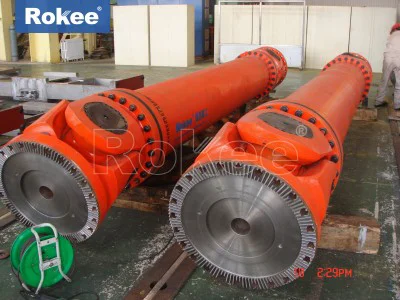
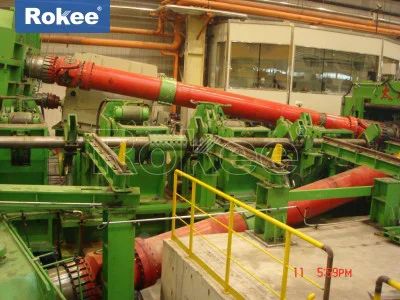
The applications of Cardan drive shafts with intermediate bearings span a remarkably broad engineering landscape. In passenger cars and crossover utility vehicles, the intermediate bearing appears on rear-drive platforms where the distance from transaxle to differential is too long for a single tube, and on all-wheel-drive vehicles where a power take-off at the transfer case feeds a rear prop shaft. In heavy commercial trucks, multiple intermediate bearings may support shafts that run several meters along the frame, transferring hundreds of kilonewton-metres of torque from the engine to driven axles. Buses and motor coaches use them to route power around engine-mounted cooling and exhaust hardware, while motorhomes apply them to overcome the large frame stretch between the transmission and a rear-located differential. Beyond on-road vehicles, agricultural tractors and combine harvesters rely on shielded Cardan shafts to drive implements from the power take-off, and construction equipment uses them on excavators, cranes, and concrete pump booms where articulation and misalignment are continuous. Even industrial installations—elevators, conveyor drives, marine auxiliary generators, and test rigs—borrow the same universal-joint principle when motors and driven equipment cannot be perfectly aligned.
Installation and service practices exert an outsized influence on how long a Cardan shaft survives. When fitting a replacement shaft, technicians must verify that the yokes are correctly phased so that the two universal joints cancel their speed fluctuations; an error of ninety degrees in phasing introduces a severe second-order torsional pulse that can shatter gearbox mounts and differential bearings within hours. The intermediate bearing bracket must be torqued to specification, because overtightening crushes the rubber isolator and destroys its damping, while undertightening allows the bracket to shift under load, reintroducing imbalance. Driveline angle measurement—using an inclinometer at the transmission output, the intermediate bearing center, and the pinion flange—confirms that operating angles are equal and within limits. Axial slip at the splined joint must move freely; corroded or dry splines bind and transmit suspension movements directly into the shaft, causing the tube to bow and whirl. Finally, the new assembly must be rebalanced if it was damaged during shipping, and the first few hundred kilometers of operation should include a check for loose fasteners and unusual heat at the bearing housing.
Looking ahead, Cardan drive shafts with intermediate bearings continue to evolve in response to shifting powertrain architecture. In electrified vehicles, where the motor sits closer to the driven axle, prop shafts are shorter and often abandoned altogether in favor of direct side shafts, but performance-oriented battery-electric trucks and sport utility vehicles still use Cardan shafts to connect a front motor to a rear drive unit, and the intermediate bearing is being repackaged into smaller, higher-speed assemblies designed for the elevated rotational speeds that electric motors allow. Material advances—carbon-fiber composite tubes, integrated torque sensors, and smart bearings with built-in temperature and vibration monitoring—are beginning to appear, promising predictive maintenance and reduced unsprung mass. Yet the fundamental geometry of paired universal joints, a supported intermediate bearing, and dynamically balanced tube sections remains unchanged: a proven, durable, and adaptable solution for the age-old problem of transmitting torque around corners, over bumps, and between machines that refuse to line up perfectly. As long as vehicles need to flex their suspensions and machines need to be mounted independently, the Cardan shaft with its intermediate bearing will remain an indispensable piece of mechanical engineering.