Low Backlash Cardan Coupling
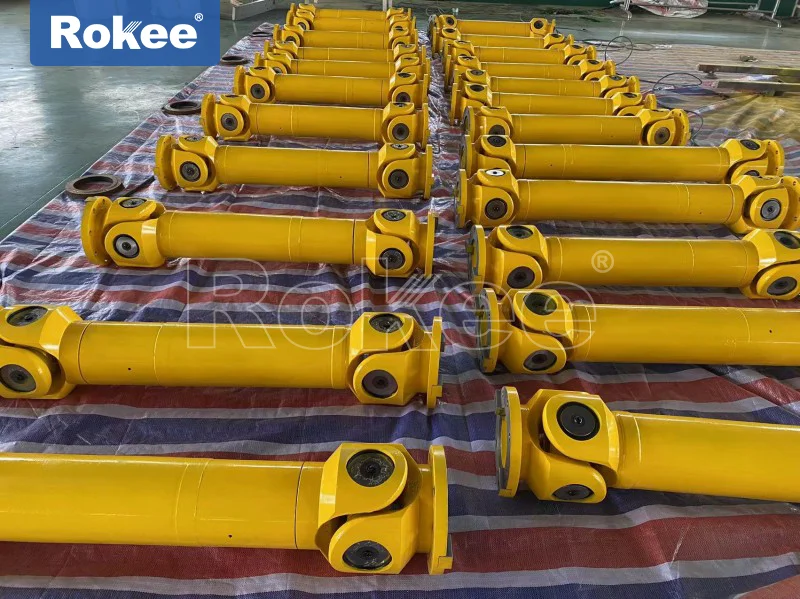
In the field of modern mechanical transmission systems, precise motion control and stable torque transmission have become core indicators that determine the overall performance of industrial equipment. As a key refined transmission component evolved from traditional universal joints, low backlash cardan couplings have gradually replaced ordinary cardan structures in high-precision industrial scenarios by virtue of their optimized structural design, minimized idle travel and excellent misalignment compensation capability. They play an irreplaceable role in connecting non-collinear driving and driven shafts, realizing continuous and accurate transmission of rotational motion and torque, and effectively solving the problems of motion deviation, torque loss and positioning inaccuracy caused by shaft displacement and mechanical clearance in traditional transmission structures. Different from conventional cardan couplings which focus only on basic power transmission, low backlash cardan couplings take clearance control as the core design goal, optimizing every matching link of the structure to suppress idle rotation gaps, thus adapting to high-precision, high-response and high-stability industrial transmission requirements.
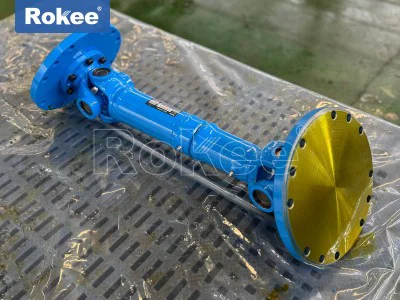
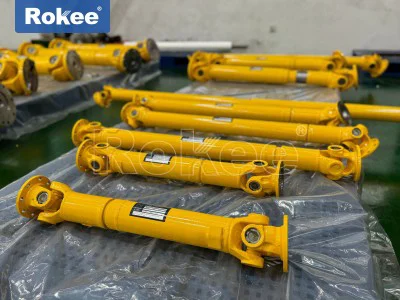
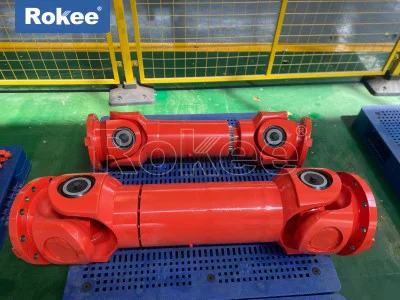
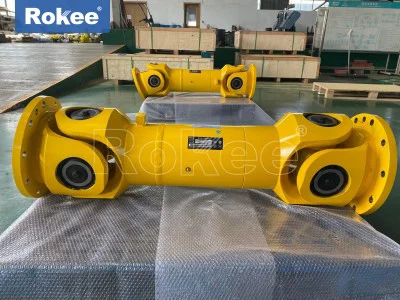
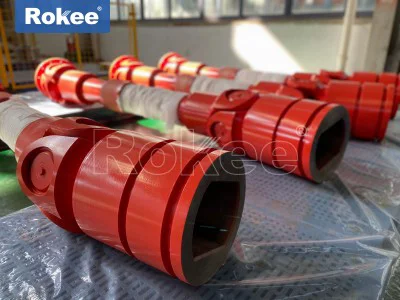
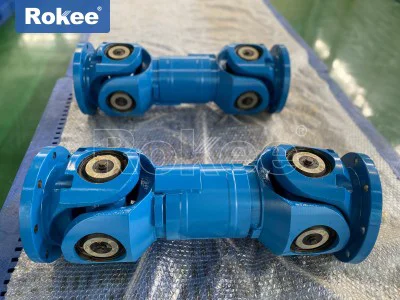
The basic mechanical structure of low backlash cardan couplings inherits the classic articulated design of universal joints, consisting of two fork-shaped yokes distributed on the driving and driven sides, a central cross-shaped spider and precision matching bearings. The two yokes are fixedly connected to the driving shaft and driven shaft respectively, and the four orthogonal arm ends of the cross spider are hinged with the bearing structures inside the yokes, forming a flexible kinematic pair that can rotate freely in multiple spatial directions. This basic structural form endows the coupling with inherent multi-dimensional misalignment compensation capability, which can adapt to angular deviation, axial displacement and radial offset between shafts caused by equipment installation errors, mechanical vibration and thermal deformation during operation. What distinguishes low backlash cardan couplings from ordinary products lies in the refined optimization of structural matching and manufacturing precision. Traditional cardan couplings usually reserve large assembly clearances between the cross spider, bearings and yoke holes to reduce assembly difficulty and avoid jamming in heavy-duty operation, which inevitably produces obvious transmission backlash. When the equipment starts, stops or reverses rotation, the clearance will form idle travel, leading to delayed motion response, reduced positioning accuracy and repeated positioning errors of the transmission system.
Low backlash cardan couplings eliminate excessive assembly gaps through precise machining and optimized structural matching. The matching surfaces between the cross shaft and bearing inner ring, between the bearing outer ring and yoke mounting hole, and between the yoke positioning surfaces all adopt high-precision finishing processes to ensure zero redundant clearance under normal working conditions. Meanwhile, the built-in precision roller bearings are optimized in structural design, with tighter dimensional tolerance control and better contact fit, which can effectively avoid microscopic sliding and idle rotation between parts during torque transmission. This series of optimizations fundamentally reduces the backlash of the coupling, enabling the transmission system to realize synchronous response of driving and driven shafts without obvious idle stroke when switching rotation directions, greatly improving the motion accuracy of the entire mechanical system. In practical operation, the low backlash characteristic ensures that the torque output is always synchronized with the power input, eliminating the torque hysteresis phenomenon common in ordinary couplings, and providing stable and accurate power support for precision mechanical movements.
In terms of working principle, the low backlash cardan coupling follows the kinematic law of universal joint transmission, realizing continuous torque and motion transmission between spatially staggered shafts. When the driving shaft rotates, the torque is transmitted to the cross spider through the driving-side yoke, and then the cross spider drives the driven-side yoke and the driven shaft to rotate synchronously. The orthogonal hinge structure of the cross spider allows the two yokes to deflect independently in different planes, so that the coupling can maintain stable power transmission when the two shafts form a certain operating angle. For ordinary cardan couplings, the structural clearance will cause the driving shaft to rotate a certain angle first to eliminate the gap before driving the driven shaft during reverse rotation, resulting in serious motion delay and transmission error. After precision optimization, the low backlash structure almost eliminates such idle travel. The close fit between internal parts enables the torque to be transmitted instantaneously without clearance loss during forward and reverse rotation, ensuring the consistency and continuity of motion transmission in the full rotation cycle.
The excellent comprehensive performance of low backlash cardan couplings makes them widely applicable in multiple high-precision and high-stability industrial fields. In precision automated processing equipment, such as semiconductor packaging equipment, precision testing instruments and automated processing production lines, the micro-scale positioning accuracy directly determines the product yield and processing quality. The low backlash characteristic of the coupling ensures that the rotating positioning of the equipment actuator is accurate and repeatable, avoiding processing defects and positioning deviations caused by transmission idle travel. In dynamic industrial transmission scenarios such as conveyor systems and material handling equipment, equipment will inevitably produce slight shaft displacement and vibration during long-term continuous operation. The multi-dimensional misalignment compensation capability of the coupling can absorb these dynamic deviations, while the low backlash structure ensures that the transmission efficiency remains stable without fluctuation, avoiding material conveying jitter and transmission failure caused by clearance impact.
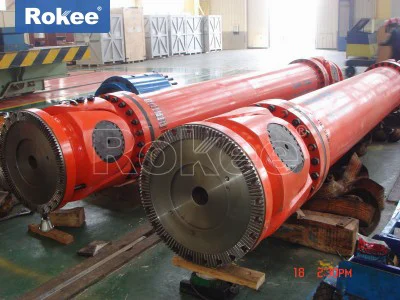
In addition, low backlash cardan couplings also show outstanding adaptability in heavy-duty precision transmission scenarios such as industrial gearbox matching, pump and compressor transmission systems. These equipment require both high torque transmission capacity and stable motion accuracy during operation. The optimized structural design not only retains the high load resistance and strong impact resistance of traditional cardan couplings, but also avoids the problem of increased transmission errors caused by structural gap enlargement under high load. Many traditional flexible couplings will produce obvious elastic deformation and clearance changes under high torque, which cannot meet the long-term precision operation requirements of equipment. In contrast, low backlash cardan couplings rely on rigid precision matching structure, with small deformation under load and stable clearance state, which can maintain consistent transmission accuracy and torque transmission efficiency for a long time.
In terms of structural design optimization, excellent low backlash cardan couplings usually adopt integrated precision forming technology for key components. The cross spider is integrally machined from high-strength alloy materials, with uniform structural stress and stable dimensional accuracy, avoiding deformation and clearance changes caused by local stress concentration during operation. The yoke structure adopts an integrated forging and finishing process, with smooth and flat matching surfaces and stable geometric tolerance, ensuring the coaxiality and verticality of the hinge structure. The internal bearings are designed with high-precision low-friction structures, which not only reduce assembly clearance, but also effectively reduce mechanical friction and wear during operation. The reduction of wear further maintains the long-term low backlash performance of the coupling, avoiding the gradual increase of idle travel caused by component wear after long-term operation, and greatly extending the service life of the transmission system.
Another core advantage of low backlash cardan couplings is their excellent dynamic response performance. In high-speed intermittent motion and frequent forward and reverse rotation working conditions, ordinary couplings with large backlash will produce obvious mechanical impact and vibration when switching motion directions. The instantaneous gap elimination process will form impact force inside the structure, leading to equipment vibration, noise and accelerated component fatigue damage. Low backlash cardan couplings basically eliminate the internal idle gap, so there is no gap impact during motion switching. The internal parts are always in a close fitting state during operation, realizing smooth switching of forward and reverse rotation, stable operation of the equipment, effectively reducing vibration and noise, and improving the overall operation stability of the mechanical system. This performance is particularly critical for high-frequency operation precision equipment, which can effectively reduce equipment failure rate and maintenance frequency.
In practical industrial application and system matching, the selection and use of low backlash cardan couplings need to comprehensively consider the operating angle, rotating speed, load type and working environment of the equipment. Although the coupling has excellent misalignment compensation capability, excessive operating angle will still affect transmission stability and service life. Good application practice usually controls the operating angle within a reasonable range, so as to give full play to its precision transmission advantages while avoiding excessive structural stress caused by large-angle deflection. For high-speed rotating equipment, the low backlash structure can effectively suppress the torque fluctuation and motion jitter caused by clearance, ensuring the dynamic balance of high-speed operation. For variable load working conditions with frequent load changes, the precise matching structure can resist micro-displacement of parts caused by load fluctuation, maintaining the continuity and accuracy of torque transmission.
Compared with other types of precision couplings, low backlash cardan couplings have unique comprehensive advantages. Diaphragm couplings and bellows couplings have good low backlash performance, but their misalignment compensation capability is limited, and they are only suitable for working conditions with small shaft deviation, with poor adaptability to large angular misalignment. Jaw couplings have simple structure and certain vibration damping performance, but their backlash control accuracy is limited, and they are easy to produce aging deformation and increased clearance after long-term use. Low backlash cardan couplings perfectly balance low backlash precision transmission and multi-dimensional large misalignment compensation capability, which can adapt to complex installation errors and dynamic shaft displacement working conditions while ensuring high-precision motion transmission, filling the performance gap of single-function precision couplings in complex industrial scenarios.
In terms of daily maintenance and long-term operation, low backlash cardan couplings have strong operational stability and low maintenance cost. The precision matching structure reduces the friction and impact wear between parts, and the high-strength alloy materials have good fatigue resistance and corrosion resistance, which can adapt to various complex working environments such as high temperature, dust and slight humidity. Regular lubrication maintenance can further reduce component friction, keep the internal matching state stable, and ensure that the backlash index does not change significantly during the whole service cycle. For long-term continuous operating industrial equipment, the stable low backlash performance avoids frequent transmission accuracy calibration work, effectively improves equipment operation efficiency, and reduces the hidden cost of precision loss caused by transmission system aging.
With the continuous upgrading of modern industrial manufacturing towards high precision, high efficiency and high intelligence, the requirements for transmission system accuracy and stability are constantly improving. Low backlash cardan couplings, as precision transmission components with both flexible compensation and high-precision transmission performance, will be more widely used in intelligent manufacturing equipment, precision industrial control systems, new energy equipment transmission and other emerging fields. Its unique structural advantages make it irreplaceable in complex transmission scenarios that require both misalignment adaptation and precise motion control. Through continuous structural optimization and process upgrading, the low backlash performance, load resistance and environmental adaptability of cardan couplings are constantly improved, providing more reliable basic component support for the high-quality operation of modern mechanical transmission systems.