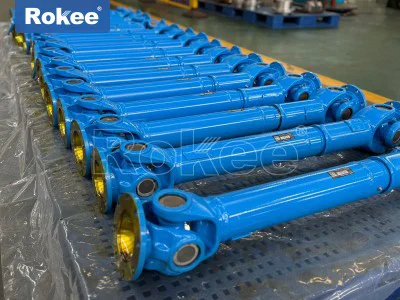
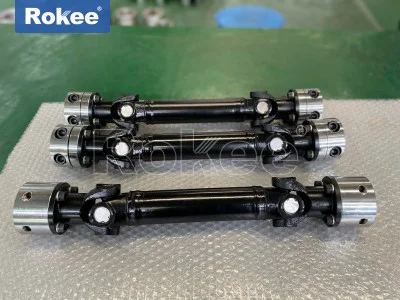
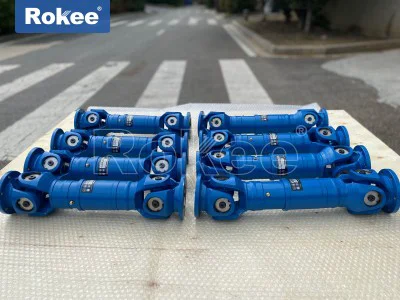
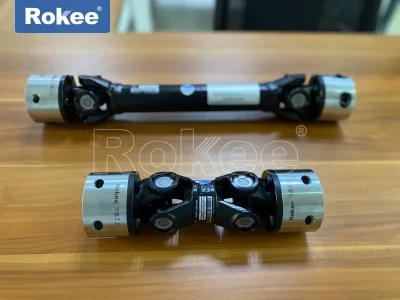
Small Size Universal Joint Coupling

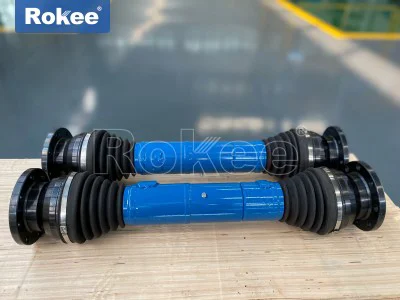
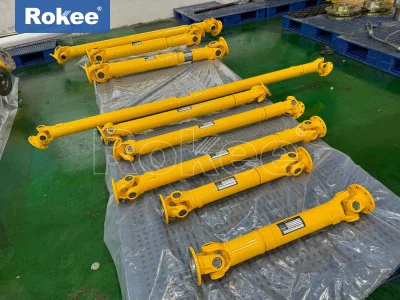
Small size universal joint coupling represents a refined category of flexible power transmission components built to operate within confined mechanical spaces, addressing a common challenge in compact machinery where two rotating shafts cannot remain perfectly collinear. Unlike rigid shaft couplings that demand precise shaft alignment and suffer rapid failure under even minor angular displacement, this compact variant retains the fundamental working principle of the classic universal joint while trimming overall dimensions to fit miniature assemblies. At its heart lies a cross-shaped spider, fitted between a pair of fork-style yokes mounted separately on the driving and driven shafts. This cross piece acts as a hinged pivot, permitting controlled angular deflection while transferring rotary torque continuously from one shaft to the other. Engineers often select this coupling when design constraints prevent motors, actuators, and output mechanisms from being aligned along a single straight axis. Many small-scale mechanical layouts simply lack room for bulky intermediate supports or complex alignment fixtures, making the compact universal joint a practical solution to bridge small angular offsets without sacrificing basic rotary connection. Even subtle misalignment arising from manufacturing tolerances, minor frame deformation under load, or slight thermal expansion can be absorbed by the hinge movement inside the joint, reducing stress transferred to bearings, motor housings and delicate transmission parts. Although it belongs to the broader family of universal couplings, the small size version is optimized for lighter torque ranges and tighter installation envelopes, making it distinct from heavy-duty cardan shafts used in large industrial equipment or automotive drivetrains.
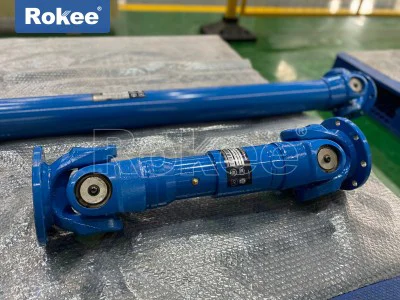
The physical structure of a small size universal joint coupling is deceptively simple, yet every component must be manufactured with careful precision to preserve smooth rotation and extended service life. Each assembly consists of two yokes, a central cross spider, and small bearing elements positioned at each arm of the cross where it interfaces with the yoke openings. The yokes feature machined bores on their outer ends, designed to slide onto mating shafts and secured by fastening hardware such as set screws or clamping collars. The cross spider’s four perpendicular arms insert into the bearing sleeves fitted within the yoke fork slots, creating four independent pivot points that allow angular movement in multiple planes. In many miniature designs, the bearings are compact needle or bushing inserts sealed to hold lubricant and block fine dust particles from entering the sliding contact surfaces. The overall geometry minimizes protruding features so the coupling can nest into narrow gaps between adjacent mechanical parts. Some configurations use a single universal joint to accommodate limited angular misalignment, while paired double-joint arrangements connect with an intermediate short shaft to reduce speed fluctuation inherent to single joint operation. This paired layout becomes critical in precision motion systems where uneven instantaneous rotational velocity from a single joint would degrade positioning accuracy. Every surface finish, bore tolerance and clearance gap is calibrated to balance low rotational resistance against structural rigidity, avoiding excessive play that would introduce backlash during start-stop cycles or bidirectional rotation.
Material selection for small size universal joint couplings balances mechanical strength, weight, wear resistance and environmental compatibility according to intended operating conditions. Alloy steel remains a prevalent choice for load-bearing components such as the cross spider and yokes, frequently treated through heat processing to harden contact surfaces while maintaining a tough core to resist shock and fatigue cracking under repeated cyclic rotation. For systems exposed to moisture, vapors or mild chemical splashes, stainless steel variants offer improved corrosion resistance, though they may come with slightly different friction characteristics and surface hardness. Lightweight aluminum alloy finds application in low-torque, high-speed assemblies where reducing rotating mass lowers inertia and lessens dynamic load on drive motors. Non-metallic bushings may replace rolling bearings in ultra-light duty or electrically isolated setups, cutting cost and eliminating metallic contact noise at the expense of maximum load capacity. Surface treatments such as electroplating or passivation are commonly applied to metal parts to prevent surface oxidation and improve sliding performance. Designers weigh these material tradeoffs carefully; harder materials resist abrasive wear better but can become brittle under sudden impact, while softer ductile materials tolerate shock loads yet wear faster during continuous rotation. Material choices directly affect maximum permissible operating speed, allowable angular deflection, service interval requirements and noise levels, making material specification one of the most important decisions when integrating the coupling into a machine design.
Understanding the operational mechanics and inherent motion characteristics helps users apply small size universal joint couplings appropriately and avoid unexpected performance issues. A single universal joint cannot deliver perfectly constant angular velocity between the input and output shafts when operated at an angle. As the input shaft rotates at a steady speed, the output shaft accelerates and decelerates twice per full revolution, creating periodic speed fluctuation that grows larger as the operating angle increases. This cyclic velocity variation generates torsional vibration and fluctuating torque loads transmitted through the driven system, which can harm precision positioning or create audible vibration in sensitive equipment. Installing two small universal joints connected by a short intermediate shaft cancels this fluctuation when arranged with proper orientation of the yokes. This double joint configuration ensures the speed variation introduced by the first joint is counteracted by the second joint, yielding nearly uniform rotational speed across the complete assembly. The maximum working angle is constrained by physical interference between yokes and cross spider; excessive angular deflection leads to binding, rapid bearing wear or mechanical lockup. Axial displacement can also be accommodated to a limited degree, though the small joint is not primarily engineered for large telescopic movement. Rotational speed limits exist as well, because centrifugal forces on the small moving components increase at higher revolutions, amplifying vibration and accelerating wear at bearing interfaces.
The practical advantages of small size universal joint couplings explain their widespread adoption across many types of compact mechanical motion systems. Foremost among these benefits is the ability to transmit rotary motion across angular misalignment, a capability that many other compact coupling styles cannot match. Flexible beam couplings, bellows couplings and jaw couplings tolerate only very small angular errors, while the hinged universal joint can handle substantially larger shaft angles within its rated working range. Its compact outer profile makes it easy to fit into densely packed equipment layouts where available space is extremely limited. The mechanical design delivers high torsional stiffness when compared with elastomer-based flexible couplings, maintaining precise rotational position transfer under torque loads with minimal torsional windup. Assembly and disassembly are relatively straightforward, as most models use simple clamping or set screw mounting onto standard round shafts. The design also supports custom bore sizes to match varied shaft diameters in prototype machinery or specialized automation devices. Compared with complex geared angle drives, the universal joint provides a much simpler means to redirect rotary motion without changing rotation direction or gear reduction ratio. These strengths make it attractive for designers seeking a straightforward mechanical solution rather than introducing complicated transmission subassemblies.
Despite its many merits, the small size universal joint coupling carries distinct limitations that must be acknowledged during system design to prevent premature failure. The fluctuating velocity of a single joint, as previously noted, introduces torsional vibration that may disturb fine positioning tasks, sensor readings or delicate workpieces. The internal bearings and sliding contact points are subject to wear over time, especially when operating continuously at large deflection angles or under cyclic load spikes. Wear gradually increases backlash, degrading motion precision and eventually leading to play that becomes audible as noise. Sealing is a persistent challenge in miniature designs; small gaps around bearing openings allow dust, fine debris or liquid contaminants to infiltrate the contact zones, accelerating abrasion. Load capacity drops significantly as the operating angle increases, so designers must derate torque ratings when using the joint at higher deflection angles. The coupling is not well suited to absorb large radial misalignment; excessive radial offset creates high side loads on bearings and cross components, leading to early fatigue. High cyclic reversing torque also stresses the cross spider and bearing interfaces, shortening operational lifespan. These constraints do not render the component unusable, but they require thoughtful engineering assessment to confirm the joint matches the load, angle, speed and environmental demands of the application.
Installation practices heavily influence the performance and service life of small size universal joint couplings, demanding careful attention to alignment, fastening and orientation. Before mounting, both mating shafts should be inspected for dimensional accuracy, surface roughness and any burrs that could interfere with seating inside the coupling bores. The shaft surfaces that contact the coupling bore must be clean and free of grease, metal shavings or debris to prevent slippage after clamping. When using a double universal joint setup, the relative angular orientation of the two yokes must be correctly aligned to counteract the inherent speed fluctuation. Incorrect phasing will amplify vibration instead of canceling it, producing worse dynamic behavior than a single joint. Fasteners such as set screws should be tightened to appropriate tension without over-tightening, which can deform the thin-walled yoke bores or create localized stress cracks. Clamping-style yokes distribute compression more evenly around the shaft and often offer superior grip in vibrating environments compared with simple set screw designs. After assembly, the full rotating system should be manually rotated to verify smooth movement and check for binding, catching or excessive play before power is applied. Initial low-speed test runs help identify misalignment or interference issues before the machine operates under full dynamic loads. Even minor installation oversights can compound stress on the small, delicate internal parts and drastically reduce the expected working lifespan of the coupling.
Routine maintenance for small size universal joint couplings focuses on preserving lubrication and monitoring wear at the internal hinge and bearing interfaces. Many compact joints come pre-lubricated from production, but this initial lubricant will degrade over extended operation, especially under elevated speed, temperature or heavy cyclic loads. Lubricant breakdown increases friction, creates heat and accelerates abrasive wear between the cross spider and bearing surfaces. Some sealed miniature designs restrict easy re-lubrication access, meaning once internal lubricant is depleted, component replacement becomes the practical option. Regular visual inspection can reveal warning signs including abnormal noise, vibration, backlash or visible corrosion on exposed metal surfaces. Any increase in rotational play during manual checking indicates bearing or cross spider wear that may progress rapidly under continuous operation. Operating in dusty or humid environments shortens maintenance intervals, as contaminants penetrate seals and scratch contact surfaces. Maintenance schedules should account for duty cycle; intermittent operation in clean conditions allows longer inspection gaps, while continuous high-speed rotation requires more frequent evaluation. When wear exceeds acceptable levels, replacement of the entire coupling assembly is typical because repairing the tiny internal components is often impractical. Proper maintenance prevents unexpected mid-operation failure that could damage surrounding motors, sensors and mechanical structures.
Small size universal joint couplings find application across a broad spectrum of compact machinery and precision motion systems, each use case leveraging its ability to transfer torque across angular shaft misalignment. Packaging machinery frequently integrates these couplings to drive small conveyors, folding mechanisms and rotary actuators, where frame geometry creates unavoidable angular offsets between drive motors and output shafts. Small automated equipment and desktop CNC devices rely on them to transmit rotary motion between stepper or servo motors and lead screws in tightly constrained machine frames. Robotics systems use miniature universal joints within joint assemblies and auxiliary drive linkages, allowing articulated movement while maintaining torque transmission. Laboratory instruments and test equipment employ these couplings to connect drive mechanisms to rotary sensors and sample positioning stages, where precise rotary transfer must occur despite minor assembly misalignment. Hobby-grade mechanical builds, model equipment and custom prototype machines also benefit from their compact footprint and simple shaft mounting. Even small material handling devices use them for auxiliary rotary drives. Across these diverse applications, the common requirement remains the same: transferring rotation between two shafts that cannot be perfectly aligned, within limited available space and under relatively light to moderate torque loads.
Looking forward, ongoing refinements to small size universal joint couplings continue to expand their usable range while preserving their core compact form factor. Manufacturing advancements allow tighter dimensional tolerances and smoother surface finishes on miniature cross spiders and bearing sleeves, reducing friction, backlash and noise. Improved sealing techniques and specialized lubricant formulations extend service life in dusty or humid environments, reducing the frequency of maintenance and replacement. New material combinations, including advanced alloy treatments and engineered polymer bearing inserts, offer alternative balances of weight, corrosion resistance and noise performance for specialized equipment. Designers also combine small universal joints with other flexible transmission components to create hybrid drive systems that handle multiple types of misalignment simultaneously. As automation and precision machinery trend toward smaller, denser assemblies, the demand for compact torque transmission solutions will continue to grow. Still, the fundamental mechanical tradeoffs of the universal joint design remain unchanged, requiring engineers to evaluate speed fluctuation, angle limits and wear characteristics for every unique system. When selected and installed with careful attention to these mechanical behaviors, the small size universal joint coupling remains a versatile, reliable and cost-effective solution for transferring rotary power between angularly offset shafts within the tight spatial limits of modern compact mechanical equipment.