Universal Shaft Coupling Assists PU Sandwich Panel Making Machine With Smooth Transmission
In the modern manufacturing sector focused on energy-saving building materials production, the stable and continuous operation of core processing machinery directly determines the overall production efficiency, product dimensional consistency, and surface quality of finished building panels. PU sandwich panel making machines stand as essential and widely applied production equipment for fabricating high-performance thermal insulation and composite building panels, undertaking the integrated processing procedures including raw material feeding, continuous foaming, composite pressing, fixed-length cutting, and finished product conveying in the entire panel production workflow. The whole production process of PU sandwich panels requires every functional unit of the making machine to maintain highly coordinated synchronous operation from power input to execution action output, and any slight fluctuation, transmission lag, or rotational speed deviation in the power transmission link will be directly transmitted to the panel forming process, resulting in uneven foaming density of PU materials, inconsistent bonding strength between panel surface layers and core materials, irregular panel edge cutting, and a series of product quality defects that cannot be repaired. Among all the mechanical components that support the normal operation of the PU sandwich panel making machine’s power transmission system, the universal shaft coupling plays an irreplaceable core role, acting as a key connecting and transmission medium between the driving power component and the driven working component, effectively solving various misalignment problems inevitably generated during the long-term operation of the equipment, ensuring continuous, stable and low-vibration torque and rotational power transmission, and laying a solid mechanical foundation for the smooth and efficient production of high-quality PU sandwich panels.
The production operation scenario of PU sandwich panel making machines has distinct industrial characteristics that differ from ordinary light-duty processing equipment, putting forward higher and more stringent requirements for the performance, structural stability and environmental adaptability of supporting power transmission components. This type of production machine usually operates in a continuous cyclic working mode for a long time, with most production lines maintaining non-stop running status for dozens of hours continuously to meet the large-scale market demand for PU sandwich panels used in factory buildings, cold storage buildings, and prefabricated construction projects. During the long-term continuous operation, the internal mechanical structure of the equipment will be affected by multiple external and internal factors, leading to non-negligible relative position deviation between the driving shaft and the driven shaft of each transmission node. On the one hand, in the initial equipment installation and commissioning stage, affected by manufacturing tolerances of mechanical components, on-site installation foundation leveling errors, and assembly gaps between different functional modules, it is difficult to achieve absolute perfect coaxial alignment between the power output shaft of the motor and reducer and the power input shaft of the pressing roller, conveying roller and cutting execution mechanism, and tiny angular deviation and radial offset will inevitably be formed between the connected shafts. On the other hand, during the formal production and operation process, the equipment will generate continuous mechanical vibration under the action of cyclic load impact from raw material pressing and foaming composite processing; at the same time, the heat released by PU material chemical foaming reaction and the temperature change of the production workshop environment will cause thermal expansion and slight structural deformation of the metal components of the equipment frame and transmission shafts, further expanding the misalignment degree between the driving and driven shafts. In addition, the long-term cyclic operation of the equipment will lead to minor wear and aging of the base fixing parts and connecting fasteners, resulting in slow axial displacement and angular deflection of the transmission shaft position over time. If rigid transmission connecting parts are used in this working environment, the unresolvable shaft misalignment will cause huge additional mechanical stress and friction loss in the transmission process, not only leading to severe vibration and abnormal noise during equipment operation, accelerating the wear and damage of transmission bearings, gears and other vulnerable parts, increasing the frequency of equipment failure and shutdown maintenance, but also causing unstable transmission torque and fluctuating rotational speed, directly affecting the pressing uniformity and conveying stability of PU sandwich panels in the forming process.
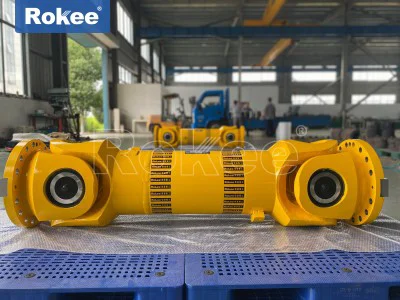
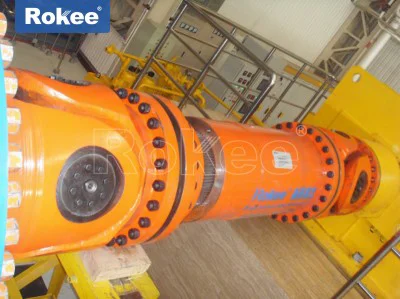
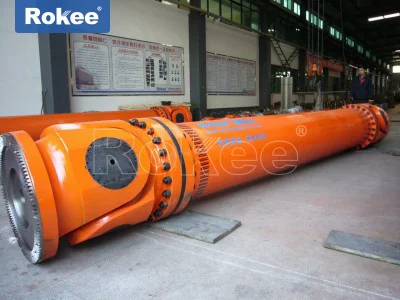
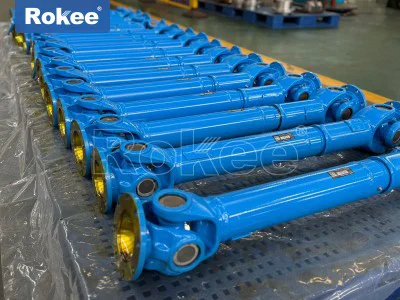
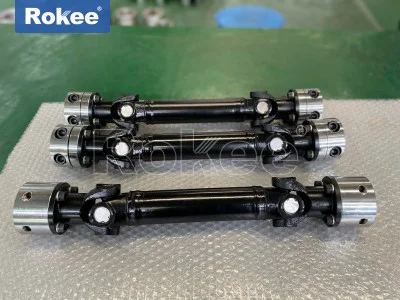
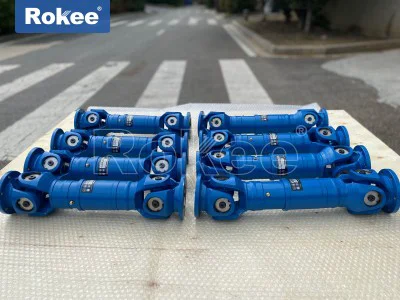
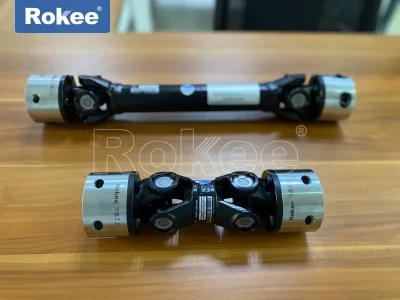
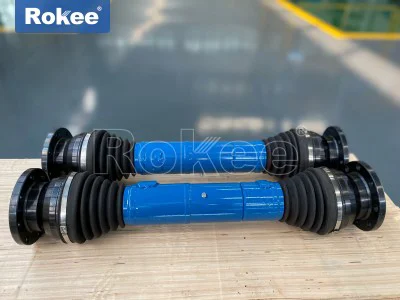
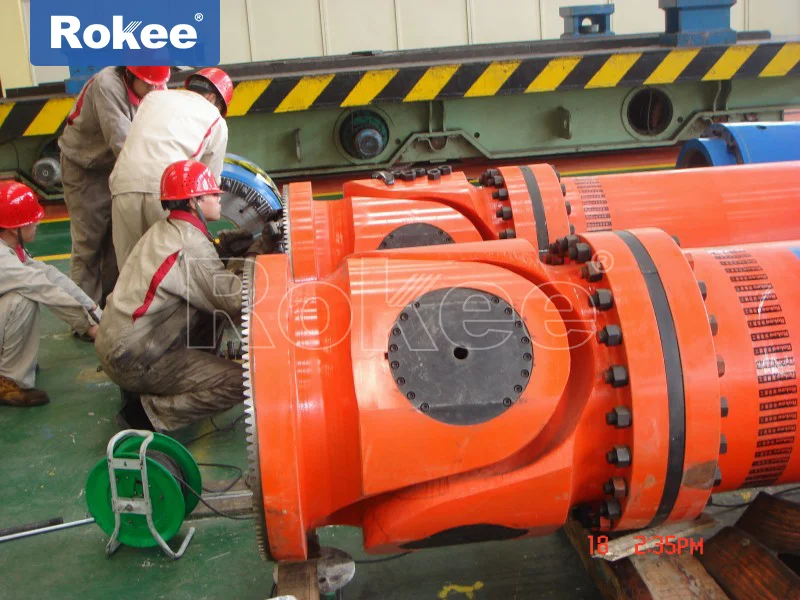
The fundamental structural design and working principle of universal shaft coupling perfectly fit the special transmission needs of PU sandwich panel making machines under complex working conditions, making it the optimal matching component for the core transmission link of such building material production equipment. The mainstream universal shaft coupling applied in industrial production adopts a classic cross-axis hinge structure, which is mainly composed of two fork-shaped yoke heads, a central cross shaft connecting assembly and supporting rotating bearing components. The cross shaft is arranged between the two opposite yoke heads, and each end of the cross shaft is connected with the inner part of the yoke head through a high-precision bearing structure, forming a flexible hinged connection mode that can rotate freely in multiple directions. Unlike rigid couplings that rely on fixed rigid connection to transmit power and cannot adapt to any shaft misalignment, the universal shaft coupling realizes the flexible transmission of rotational motion and torque through the spatial linkage mechanism formed by the cross shaft and yoke heads. When the driving shaft rotates and outputs power, it drives the connected active yoke head to rotate synchronously, and the cross shaft pivots and rotates under the drive of the active yoke head, and then transmits the rotational power and torque to the driven yoke head connected to the driven shaft, finally realizing the synchronous rotation and power transmission between the two misaligned shafts. The core advantage of this structural design is that it can effectively compensate for angular misalignment, axial displacement and tiny radial offset between the driving shaft and driven shaft generated by installation errors, thermal deformation, mechanical vibration and component wear during equipment operation. For the continuous production scenario of PU sandwich panel making machines, double-section universal shaft couplings are mostly adopted in key transmission positions. By reasonably arranging two groups of universal joint structures at equal angles, the input angular velocity and output angular velocity can be kept consistent in the transmission process, avoiding the periodic angular velocity fluctuation of single-section universal joints during operation, ensuring that the rotational speed and torque transmitted to each working execution component of the panel making machine remain stable and uniform without obvious periodic changes.
The smooth transmission effect brought by the universal shaft coupling to the PU sandwich panel making machine is directly reflected in every key production link of panel processing and forming, effectively optimizing the production stability and finished product quality of the entire production line. In the raw material feeding and preliminary composite laminating stage of PU sandwich panel production, the surface base materials including color steel plates and other metal sheets need to be continuously and evenly conveyed at a constant stable speed to ensure the accurate matching and alignment of upper and lower surface materials and the quantitative injection of PU foaming raw materials in the middle layer. The conveying rollers responsible for base material transportation are driven by an independent power transmission system, and the universal shaft coupling connects the power output end of the power device and the rotating shaft of the conveying rollers. It absorbs the vibration and shaft misalignment generated during the high-frequency rotation of the conveying rollers, avoids the jitter and speed fluctuation of the conveying rollers caused by rigid transmission stress, ensures that the base materials are fed forward at a constant linear speed, prevents the deviation and wrinkling of the surface base materials in the conveying process, and lays a good foundation for the subsequent uniform composite foaming of PU materials. In the core foaming and pressing forming stage of PU sandwich panels, the upper and lower pressing rollers of the making machine need to maintain stable pressing pressure and synchronous rotating speed, so that the PU foaming materials between the upper and lower base materials can be fully and evenly foamed, and the bonding between the core material and the surface materials is firm and uniform without local hollowing or uneven thickness. The transmission system of the pressing roller group bears large cyclic mechanical load for a long time, and the shaft misalignment caused by load impact and thermal deformation is more obvious. The universal shaft coupling can flexibly adapt to the real-time position change of the pressing roller rotating shaft in the working process, maintain stable torque transmission under variable load conditions, ensure the synchronous and consistent rotation speed of the upper and lower pressing rollers, avoid the deviation of pressing gap caused by transmission jitter, and ensure that the overall thickness of the formed PU sandwich panels is uniform and the internal foaming structure is dense and consistent.
In the fixed-length cutting and finished product output stage of PU sandwich panel production, the stability of power transmission also directly affects the dimensional accuracy and edge flatness of finished panels. The cutting execution mechanism and finished product output conveying mechanism of the panel making machine need to complete accurate positioning and fixed-speed conveying actions according to the set production parameters. Any transmission delay or speed mutation will lead to inaccurate cutting length of panels and rough and irregular cutting edges, increasing the subsequent trimming processing workload and reducing the yield of qualified products. The universal shaft coupling ensures that the power can be transmitted to the cutting mechanism and output conveying mechanism in real time and smoothly, eliminates the transmission resistance and mechanical impact caused by shaft misalignment, makes the cutting action precise and in place, keeps the finished panels conveyed stably after cutting, effectively guarantees the dimensional standard and appearance quality of each finished PU sandwich panel, and reduces the rate of defective products in the production process. In addition, the stable transmission performance brought by the universal shaft coupling also avoids the frequent vibration and impact of the equipment during operation, reduces the vibration interference between different functional modules of the panel making machine, makes the whole production line run more smoothly and orderly, and creates a good mechanical operating environment for long-term continuous production.
In addition to optimizing the production processing effect and finished product quality of PU sandwich panel making machines, the application of universal shaft coupling also brings significant advantages in reducing equipment operating costs, extending mechanical service life and simplifying daily maintenance work, creating greater long-term production value for building material manufacturing enterprises. In the traditional transmission mode using rigid connecting parts, the additional mechanical stress and friction generated by shaft misalignment will cause serious wear to bearings, gears, transmission shafts and other core vulnerable parts of the equipment. These parts are prone to frequent failure and damage under long-term high-load operation, requiring enterprises to spend a lot of time and manpower on frequent shutdown maintenance and parts replacement, which not only interrupts the continuous production rhythm and reduces the actual production output of PU sandwich panels, but also increases the daily operation and maintenance cost of the equipment. After adopting the universal shaft coupling with flexible compensation performance, most of the additional mechanical stress and vibration impact generated by shaft misalignment can be buffered and released through the flexible hinge structure of the coupling itself, avoiding the long-term action of abnormal stress on other precision transmission components of the equipment, effectively reducing the wear degree of bearings, gears and other key parts, greatly extending the overall service life of the equipment transmission system and core components. The structural design of the universal shaft coupling is simple and compact, with few internal wearing parts and stable overall performance. It does not need complex and frequent daily maintenance work during long-term operation. Only regular simple lubrication inspection and fastening check of connecting parts are required to maintain good working condition, reducing the daily maintenance workload and maintenance labor cost of enterprise equipment management personnel.
Moreover, the excellent environmental adaptability of universal shaft coupling also enables it to maintain stable and reliable working performance in the complex production environment of PU sandwich panel manufacturing workshops. The production workshop of PU sandwich panels inevitably has a certain amount of dust generated by material cutting and processing, and a small amount of chemical volatile gas generated by PU material foaming reaction. The universal shaft coupling is made of high-strength alloy materials through forging, heat treatment and precision machining processes, with high overall structural strength, good wear resistance and corrosion resistance, and will not be easily affected by workshop dust and trace chemical volatile media during long-term operation. It can maintain stable structural coordination and flexible rotation performance, and will not have structural clamping, transmission stuck or performance attenuation due to the influence of external environmental factors. At the same time, the universal shaft coupling can still maintain efficient and stable power transmission performance under the working conditions of long-term continuous operation and variable cyclic load, without performance degradation or transmission failure due to long-time high-intensity work, ensuring that the PU sandwich panel making machine can maintain consistent production efficiency and product quality standard in long-term batch production tasks.
With the continuous upgrading of the prefabricated construction industry and the increasing market demand for high-quality energy-saving thermal insulation building materials, PU sandwich panel making machines are developing in the direction of larger-scale production, higher processing precision and longer continuous operation cycle, which also puts forward higher requirements for the stability, efficiency and durability of the equipment power transmission system. As an indispensable basic transmission component, the universal shaft coupling will continue to play a key supporting role in the operation of PU sandwich panel making machines. By virtue of its unique flexible misalignment compensation capability, stable torque transmission performance and excellent long-term operation reliability, it continuously eliminates various adverse factors affecting the smooth operation of the transmission system in the production process, ensures that every production link of PU sandwich panel forming, pressing, conveying and cutting is carried out in an orderly and stable manner, helps building material production enterprises realize high-efficiency and low-failure continuous production, and steadily produces high-quality PU sandwich panels that meet the needs of modern building construction. In the field of industrial mechanical power transmission, every seemingly ordinary basic component bears the important responsibility of supporting the stable operation of large production equipment, and the universal shaft coupling has become an indispensable reliable guarantee for the efficient and smooth operation of PU sandwich panel making machines with its solid mechanical performance and practical application value.