Cardan Coupling Axial Misalignment
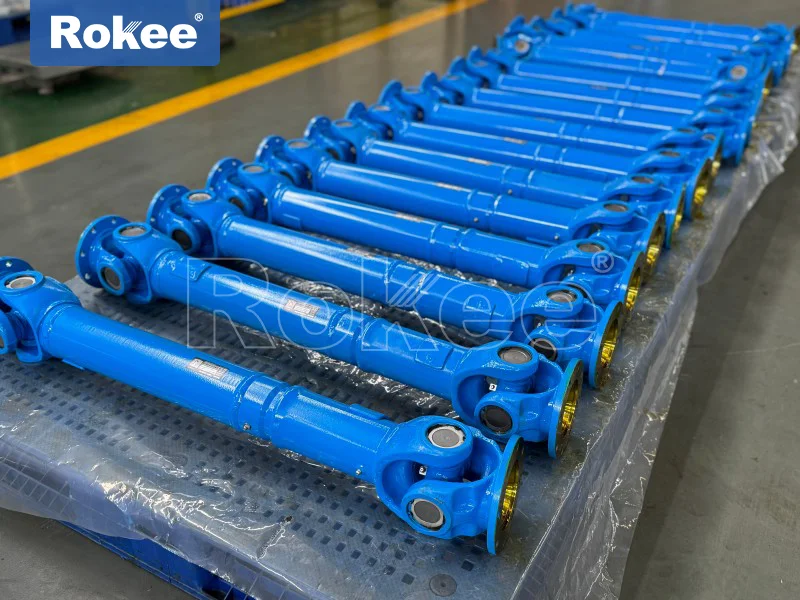
As a core component widely adopted in mechanical transmission systems, cardan couplings undertake the critical task of transmitting torque and rotational motion between disjointed driving and driven shafts. Unlike rigid coupling structures that require precise coaxial alignment of connected shafts, cardan couplings are inherently designed to tolerate and compensate for various shaft misalignments generated during equipment installation and operation. Among all types of shaft misalignment, including angular deviation and radial offset, axial misalignment stands out as the most pervasive and easily overlooked abnormal operating state, which refers to the linear displacement along the central axis of the paired shafts beyond the reasonable design range. This form of misalignment does not produce obvious operational abnormalities in the initial stage of equipment operation, so it is often ignored in routine equipment debugging and daily maintenance, yet it continuously erodes the transmission performance, structural stability and service life of the entire mechanical system in long-term continuous operation. In practical industrial operation, axial misalignment of cardan couplings mainly stems from multiple comprehensive factors, covering installation process deviations, structural changes during equipment operation, and environmental-induced component deformation, all of which will break the ideal matching state of the coupling’s internal kinematic pairs and trigger a series of cascading mechanical problems.
The fundamental causes of axial misalignment in cardan couplings can be categorized into installation-induced errors and operation-induced displacements, each with distinct generation mechanisms and evolutionary characteristics. In the equipment installation stage, the assembly spacing between the driving shaft and driven shaft fails to meet the design matching requirements, resulting in excessive axial clearance or excessive compression of the coupling’s telescopic structure. Most cardan couplings are equipped with spline telescopic pairs, a key structural design to adapt to axial position changes of shafts, but this telescopic structure has a fixed effective stroke range. Improper installation positioning often leads to the spline pair being in a limit compression or limit extension state from the start of operation, completely losing the reserved axial adjustment margin. This rigid assembly state directly transforms minor installation deviations into fixed axial misalignment faults, which will continue to exist throughout the equipment operation cycle unless manually corrected. In addition to installation errors, operational dynamic changes are more likely to induce gradual axial misalignment, which is the main cause of late-stage coupling failure in long-running equipment. Mechanical components will produce slight thermal expansion and contraction under the continuous action of operating temperature changes; long-term alternating load operation will cause micro-deformation of the equipment frame and fixed support structure; mechanical vibration generated during high-speed rotation will also induce slow axial displacement of shaft components. These subtle and cumulative changes will continuously push the connected shafts to produce axial relative displacement, gradually exceeding the adaptive range of the coupling’s telescopic structure and forming stable axial misalignment.
Axial misalignment fundamentally disrupts the original kinematic and dynamic balance state of cardan coupling transmission, triggering a chain of adverse effects on component performance and system operation. Under ideal coaxial operating conditions, the internal cross shaft and bearing components of the cardan coupling bear uniform and stable load, and the spline telescopic pair only performs small-range free telescopic adjustment following the natural displacement of the shaft system, with smooth torque transmission and low mechanical loss. Once axial misalignment occurs, the stress distribution of the coupling’s internal transmission components becomes extremely uneven. When the axial displacement is excessive, the spline pair is constrained and cannot flexibly telescope, resulting in sustained extrusion and friction between spline teeth. Long-term constrained friction will cause uniform wear on the spline tooth surface, reduce the matching precision of the telescopic structure, and further expand the degree of axial misalignment, forming a vicious cycle of misalignment aggravation and component wear. Meanwhile, the axial tension or compression force generated by misalignment will be transmitted to the cross shaft and bearing assembly, making the bearing bear additional axial load beyond the design scope. Different from conventional radial load during normal operation, this abnormal axial load will cause asymmetric wear of bearing rollers and raceways, increase the operating friction resistance of the coupling, and lead to a significant decline in torque transmission efficiency.
In high-speed operating scenarios, the adverse effects of axial misalignment are further amplified, accompanied by obvious vibration and noise problems that threaten the stability of the entire transmission system. The constrained telescopic structure and uneven internal load distribution will cause periodic unbalanced force during the rotation of the cardan coupling. This periodic force cannot be offset by the coupling’s own structural compensation capability, resulting in regular mechanical vibration of the coupling and the connected shaft system. The vibration frequency is synchronized with the equipment rotation speed, and the vibration amplitude will gradually increase with the extension of operating time and the deterioration of misalignment degree. Sustained high-frequency vibration will not only accelerate the fatigue wear of the coupling’s own components, but also be transmitted to the entire mechanical equipment, causing loose connection of peripheral fastening parts, abnormal vibration of supporting components, and even resonance of local structures in severe cases. In addition, the continuous friction and impact between internal components caused by axial misalignment will produce persistent mechanical noise. The noise intensity is positively correlated with the misalignment degree and operating speed, which not only reduces the operating comfort of the equipment, but also serves as an intuitive early warning signal of potential coupling failure. More importantly, long-term vibrating operation will change the lubrication state inside the coupling: the unstable fitting gap of kinematic pairs makes it difficult to form a continuous and effective lubricating oil film, and the vibration effect will also cause lubricant leakage and deterioration, further worsening the friction and wear environment of components.
Long-term uncorrected axial misalignment will significantly shorten the service life of cardan couplings and induce various typical mechanical faults, which are important hidden dangers leading to equipment shutdown and maintenance. The most common failure mode is premature fatigue damage of spline pairs. Under the repeated action of axial alternating stress and friction, micro-cracks are easily generated on the surface and root of spline teeth, and the cracks will gradually expand with the accumulation of operating cycles, eventually leading to tooth surface peeling, tooth root fracture and other failures. For bearing components, abnormal axial load will cause local overheating during operation, accelerating the aging and failure of bearing lubricants, and dry friction will lead to serious wear and ablation of bearing components, resulting in reduced rotation flexibility or even jamming of the coupling. In severe cases, excessive axial misalignment will cause insufficient engagement length of the spline pair, reduce the structural connection stiffness and torque bearing capacity of the coupling, and even cause instantaneous disengagement of transmission components under sudden load impact, leading to sudden interruption of power transmission. In addition, axial misalignment will change the stress state of the coupling’s flange connection part, causing uneven stress on fastening bolts, inducing bolt fatigue loosening and fracture, and further triggering safety accidents such as coupling separation during operation.
It is worth noting that the structural characteristics of different types of cardan couplings lead to differences in their tolerance to axial misalignment. The double-joint cardan coupling composed of two universal joints and an intermediate shaft has a relatively stronger axial displacement compensation capability due to the matching use of two sets of telescopic structures. Its intermediate shaft can cooperate with the double universal joint structure to adapt to a certain range of axial displacement while ensuring constant-speed torque transmission. In contrast, the single-joint cardan coupling has a simpler structure and no auxiliary telescopic adjustment space, so it is more sensitive to axial misalignment, and slight excessive axial displacement will cause obvious operational abnormalities and component wear. In practical application scenarios, the operating load and speed of equipment also affect the hazard degree of axial misalignment. Low-speed and light-load equipment can tolerate a small range of axial misalignment for a long time without obvious faults, while high-speed and heavy-load transmission equipment has extremely strict requirements for axial alignment state, and even tiny axial displacement deviation will be rapidly amplified into severe mechanical failures due to the superposition of high-speed centrifugal force and heavy load stress.
Effective detection and accurate diagnosis of axial misalignment are the prerequisites for eliminating faults and optimizing the operating state of cardan couplings. Different from angular misalignment which can be judged by obvious rotation angle deviation, axial misalignment is hidden in the linear displacement of the shaft system, and most of its early abnormal states cannot be identified by naked-eye observation. In daily equipment maintenance, axial misalignment can be detected by measuring the axial spacing change of the coupling and the telescopic state of the spline pair. By detecting the axial gap of the coupling at multiple rotation angles, the fixed displacement deviation of the shaft system can be accurately judged; by checking the engagement stroke of the spline telescopic structure, it can be determined whether the coupling is in a limit compression or extension misalignment state. With the development of mechanical fault diagnosis technology, vibration monitoring has become an efficient means of dynamic diagnosis for axial misalignment faults. The axial misalignment fault has typical vibration signal characteristics, mainly manifested as stable fundamental frequency vibration consistent with the rotation speed, and the vibration amplitude will increase synchronously with the aggravation of misalignment. Through real-time monitoring and spectral analysis of equipment vibration signals, early axial misalignment faults that cannot be found by conventional detection methods can be accurately identified, realizing predictive maintenance of couplings.
Scientific adjustment and standardized maintenance are key measures to eliminate axial misalignment and prevent fault recurrence. For axial misalignment caused by installation deviations, the fundamental solution is to re-calibrate the axial position of the driving and driven shafts, adjust the assembly spacing of the coupling to the optimal design range, ensure that the spline telescopic pair has sufficient free adjustment stroke, and avoid limit assembly states. In the calibration process, it is necessary to comprehensively consider the thermal expansion margin of high-temperature operation and the structural settlement margin of long-term load operation, so as to reserve a reasonable axial compensation space for the coupling. For axial misalignment generated during equipment operation, regular dynamic detection and fine adjustment are required in daily maintenance. Timely correct the axial displacement of the shaft system caused by structural deformation and vibration displacement, regularly check the wear state of the spline pair and bearing components, and replace severely worn parts in time to avoid increased misalignment deviation caused by component failure. At the same time, standardized lubrication maintenance should be implemented: select matching lubricants according to operating conditions, regularly supplement and replace lubricants, ensure the formation of stable lubricating oil film inside the coupling, reduce the friction and wear of kinematic pairs under misalignment state, and delay the deterioration of faults.
In the long-term operation of mechanical transmission systems, axial misalignment of cardan couplings is an inevitable adaptive problem between mechanical structural characteristics and complex operating conditions. No equipment can maintain absolutely ideal coaxial alignment of shafts for a long time, and minor axial displacement is within the allowable adaptive range of coupling design. The core of coupling operation maintenance is to control the axial misalignment degree within a reasonable tolerance range, avoid excessive misalignment that breaks the balance of kinematic and dynamic performance, and eliminate various potential faults induced by misalignment. With the continuous improvement of mechanical transmission precision and equipment operation reliability requirements, the control of axial misalignment of cardan couplings has become an important part of equipment precision maintenance. In addition to conventional detection and adjustment means, optimizing the structural design of couplings, improving the flexibility and compensation range of telescopic structures, and improving the structural stability of equipment shaft systems can fundamentally reduce the occurrence probability of axial misalignment. Meanwhile, establishing a perfect regular detection and maintenance mechanism can realize early warning and rapid processing of misalignment faults, ensure that cardan couplings always maintain efficient, stable and safe operating state in the full life cycle of equipment operation, and provide reliable guarantee for the stable operation of the entire mechanical transmission system.