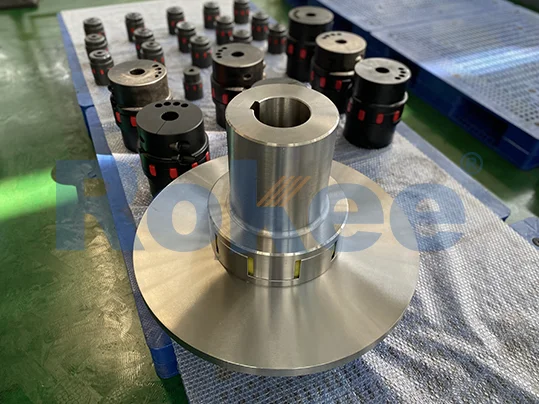
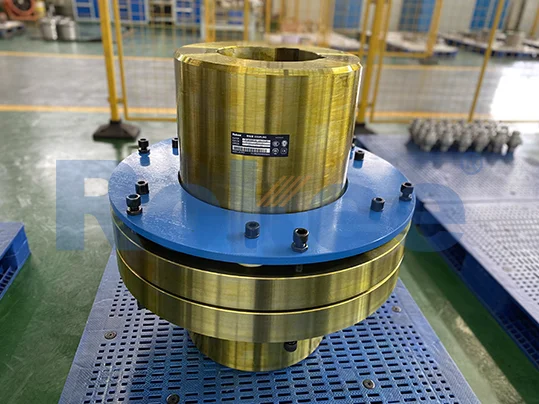
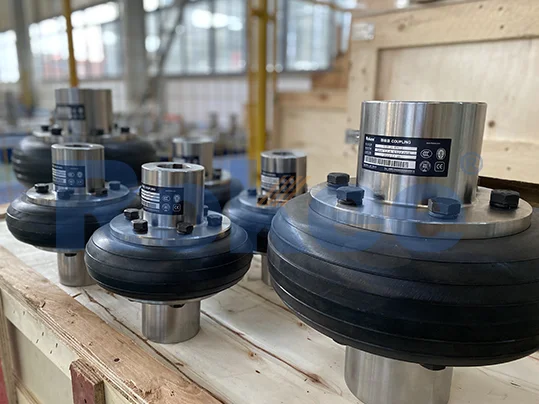
Elastic Coupling is a device used for the longitudinal joining of two rotating parts of a machine, designed to compensate for the relative displacement of the parts’ axes and to absorb the shocks caused by joining the parts. Flexible Coupling is one of the major types of couplings. They find use to connect two shafts, end-to-end in the same line to transmit power that is torque from one shaft to another, thereby causing both to rotate in unison, at the same rpm. The other purpose is to compensate for small amounts of misalignment and random movement between the two shafts.
Flexible coupling is an important mechanical transmission device, mainly used to connect two shafts and allow a certain angle and axial displacement while transmitting torque.
Elastic Coupling is a mechanical device designed with a special structure to compensate for the relative displacement between two shafts. Flexible couplings can be divided into two categories based on whether they contain elastic elements: non elastic element flexible couplings and elastic element flexible couplings.
function and characteristic
Displacement compensation capability: Flexible couplings can compensate for the angle, parallel, and axial displacement between two shafts, which is their most significant feature. Through the deformation of the internal mechanical structure or elastic components of the coupling, various offsets between the two shafts can be effectively adjusted to ensure the stable operation of the transmission system.
Vibration control: For flexible couplings with elastic components, they can not only compensate for displacement, but also reduce the vibration amplitude of the transmission system, especially suitable for working conditions with slight impact.
Efficient torque transmission: Flexible couplings can efficiently transmit power while compensating for displacement, ensuring the normal operation of mechanical systems.
Common types and structures
Cross slider coupling: composed of a cross slider and two connecting plates, with a simple structure and strong compensation ability, suitable for low-speed and heavy-duty applications.
Gear coupling: compensates for complex offsets using gear mesh clearance, suitable for situations requiring high-precision transmission.
Serpentine spring coupling: composed of a serpentine spring and two connecting plates, it has high strength, high precision, and is suitable for high torque transmission.
Elastic sleeve pin coupling: absorbs impact energy and compensates for the offset between the two shafts through elastic elements (such as rubber sleeves).
Elastic column pin coupling: using elastic column pins as transmission components, providing radial compensation.
Metal elastic coupling: The structure is relatively complex, but it can provide good connection and torque transmission effects at high speeds and large torques.
Elastic belt coupling: mainly suitable for transmission of various mechanical equipment, with high torque transmission capacity, compact structure, and good vibration absorption.
Elastic Couplings are widely used in various transmission systems with axial, radial, or angular offsets, especially in working conditions with stable loads and minimal impact. Its advantage lies in the ability to compensate for the relative displacement between the two axes, reduce the vibration and noise of the transmission system, and improve the stability and reliability of the mechanical system.
When designing flexible couplings, it is necessary to choose suitable materials according to the working environment to ensure the durability of the coupling. At the same time, it is necessary to accurately calculate the size of the coupling to ensure its load-bearing capacity and compensation capability. In terms of installation and maintenance, it is necessary to strictly follow the specifications to extend the service life of the coupling.
Elastic Coupling as an important mechanical transmission device, play an irreplaceable role in mechanical systems. By selecting appropriate types and structures, as well as proper installation and maintenance, the stable operation and efficient transmission of mechanical systems can be ensured.